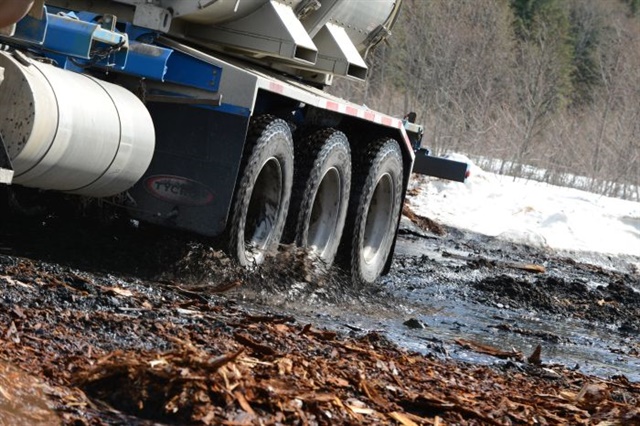
Steel wheels shed weight

Who knows what you'll find when the pavement comes to an end. At that point it's too late to realize that you spec'd the wrong tires.
">Who knows what you'll find when the pavement comes to an end. At that point it's too late to realize that you spec'd the wrong tires.
">It doesn't make sense to ask a plow horse to run the Kentucky Derby, or to a hitch a thoroughbred to a tiller. Yet that's the sort of choice faced by fleets that operate in mixed on- and off-road service. There's no straight answer, just a bunch of compromises.
Trucks used in construction, mining, logging and other severe-service, off-road applications often travel across challenging surfaces strewn with rocks, nails and other debris that can cause tire damage. Off-road tires are designed for toughness; resistance to cuts, chips and tears; on- and off-road traction; and long miles to removal. Tires intended for on-highway use are designed a long, fuel-efficient life that is only occasionally threatened by anything worse than a pothole.
So how does a fleet manage the spec'ing decision? It helps to assign priorities to the problem, such as how much time will the truck spend off road, how severe is the terrain it will operate in, and how important fuel economy is compared to the risk of a terrain-induced tire failure or a mission-limiting traction event.
Let's use as an example a fleet that hauls aggregate, logs, cement or some such commodity from a mill or plant to a customer about 100 miles away. The truck may spend 5% of its time in the plant on rough ground, so the tires will need some traction and cut resistance. But the majority of the time would be spent on highway at highway speed where fuel economy matters.
“If the fleet operates more on-highway than off-road, then they may prioritize fuel economy,” says Matt Schnedler, product manager at Bridgestone. Such a fleet might opt for a lug-type drive tire ...Read the rest of this story

Continental, an automotive supplier, tire manufacturer and industrial partner, has introduced the Extreme Duty Poly-V belt for the North American heavy-duty aftermarket.
The Extreme Duty Poly-V straight-ribbed belt is designed to perform better under higher underhood temperatures that Continental says results in lower emission standards. The belt comes with a 100,000-mile guarantee.
The belt has four times the flex life of previous belts and was tested in a heat environment that was 20% higher than mandated by SAE standards. The test was conducted to simulate an engine with a number of accessories and low circulation.
It is offered in 90 parts numbers designed for Class 6-8 vehicles and is currently available in 8-, 10- and 12-ribbed profiles, packaged in new sleeve design.
Follow @HDTrucking on Twitter
...Read the rest of this story