Driver iQ Parent Firm Restructures and Rebrands under Cisive Name

Driver iQ Parent Firm Restructures and Rebrands under Cisive Name

Driver iQ, a provider of comprehensive background screening and driver monitoring services, has announced that its parent company, Carco Group, is changing its name to Cisive.

The name change to Cisive is intended to better communicate the company's focus on clear and accurate insights for HR solutions, security and insurance fraud prevention clients.

“Providing the trucking industry's most accurate solution for driver employment history and background screening needs will be even easier as part of the new Cisive family of brands,” said Lana Batts, co-president of Driver iQ. “The drive and innovative approach at Cisive will further strengthen the already formidable screening and investigation capabilities in place at Driver iQ.”

Cisive will house the Carco and Driver IQ brands and continue its mission to help clients identify fraud and reduce risk through innovative technology. The company said it is rebranding to keep pace with its growth and drive innovation across the human resource capital management market.

Driver iQ screens trucking industry employees and maintains a driver employment database with information on driving records, employment verification, criminal records and ongoing driver minoring. The Carco brand will focus exclusively on pre-insurance vehicle inspections and fraud prevention.

“Cisive stands for clear and accurate insights that give our clients confidence in their most critical decisions while protecting their brand and reputation,” said Jim Owens, CEO and president of Cisive. “It has become harder and more complex to separate fact from fiction in a world where instant information rules. Today's businesses demand an experience and perspective best delivered by technology integrated with human insight.”

Related: TCA Launches Accreditation Program to Foster Professional Development

Follow @HDTrucking on Twitter

...Read the rest of this story
Five Years To Autonomous?

<img width="150" src="http://www.automotive-fleet.com/fc_images/blogs/m-freightliner-07-15c466-030-1.jpg" border="0" alt="

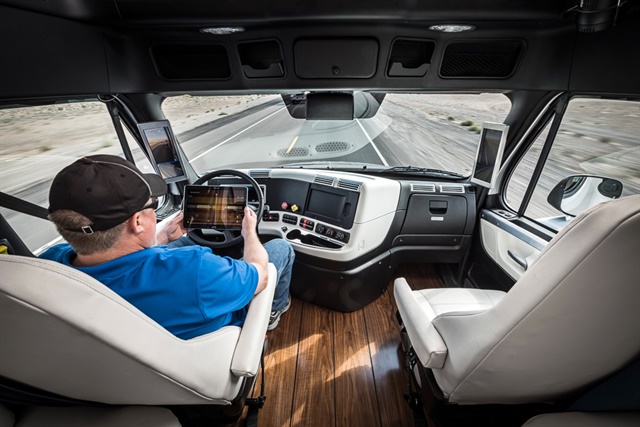
Autonmous vehicles will help move freignt more efficiently. But how engaged will drives have to be?

">

Autonmous vehicles will help move freignt more efficiently. But how engaged will drives have to be?

">

Earlier this week, the Governors' Highway Safety Association (GHSA) presented a webinar on emerging autonomous vehicle technology. The purpose of the event was two-fold: To raise awareness of the fast pace with which autonomous vehicle technology is moving and highlight the need, on the state level, to prepare for the eventual deployment of autonomous vehicles in terms of policy, legislation, and law enforcement.

Dr. James Hedlund is the primary consultant working with the GHSA on autonomous vehicles and I followed up with him after the webinar to expand on some of the themes that were discussed. Hedlund knows his stuff: He is principal, Highway Safety North, Ithaca, N.Y. He spent 22 years at the National Highway Traffic Safety Administration in various research and management positions, most recently as associate administrator for Traffic Safety Programs. From 2011 to 2015 he served as a consultant on management and data analysis for the SHRP 2 naturalistic driving study of the National Academy of Sciences. He has published over 60 research studies, conference summaries, research syntheses, and guides on a variety of behavioral traffic safety subjects.

Our discussion touched on several relevant points, including Hedlund's feeling that commercial vehicles will be the driving force in autonomous vehicle adoption nationwide and the fact that this “disruptive technology,” as he called it, has the potential to transform our society in ways we understand very little at the moment.

Jack Roberts: Give me some background on GHSA; its mission and goals.

Jim Hedlund: GHSA is the national organization representing the highway safety offices present in each state. These offices receive federal money from the United States Department of Transportation to use on traffic safety activities. The organization seeks to help members coordinate those efforts on a ...Read the rest of this story

Roadnet Anywhere Update Improves on Route Optimization

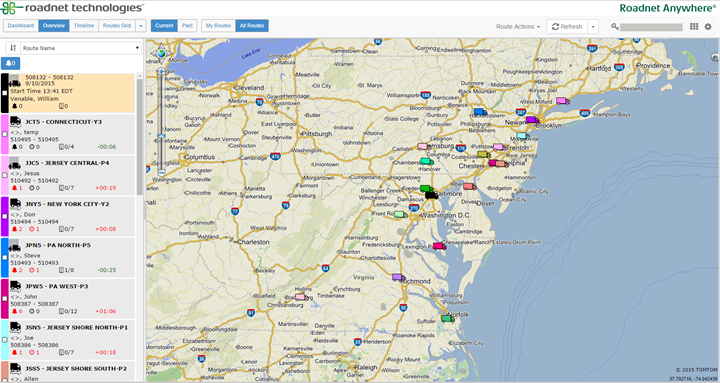
Omnitracs has released Roadnet Anywhere version 4.4, incorporating tools to quantify savings and analyze the effectiveness of route optimization practices.

Through a new Optimal Routes Feature, users can measure the effectiveness and impact of routing decisions on cost, time, and distance. Users can generate theoretical route-level scenarios to compare against actual routes.

The Business Optimal feature represents the ideal route, taking into consideration customer delivery windows, order of deliveries, and other service-related constraints. True Optimal represents the theoretical best sequence with no constraints. Comparing actual routes to the Optimal Route scenarios can provide insight into the decisions made by routers, as well as highlight instances in which an over-emphasis on customer service has led to overall inefficiency.

“Route optimization is an area where small changes can make a big impact on the bottom line, but even if executives know that intuitively, instinct needs to be backed by data,” said Kevin Haugh, chief strategy and product officer at Omnitracs. “With Roadnet Anywhere v4.4, executives can see the current and potential ROI of their route optimization practices, thereby being given the ability to better hold the organization accountable for the performance improvements desired.”

Roadnet Anywhere version 4.4 also introduces the MyStats page within the Roadnet Mobile app for iOS and Android. MyStats gives drivers a real-time view into their performance, without having to interrupt their routes. Drivers who are ahead or behind schedule can adjust their performance without having to be notified by a manager. Managers are able to control which stats the drivers have access to, including adherence to schedule, how long they have been on the route, or remaining deliveries.

“A key ingredient to achieving operational improvement is providing drivers with timely input and coaching in how they are performing,” said Haugh. “This capability further enhances the ability of our customers to provide such feedback ...Read the rest of this story