HDT Top 20 Products of 2017

HDT Top 20 Products of 2017

Each year, HDT's editors spend a lot of time going to press conferences and combing through news releases on the latest new products for trucking. At the end of the year, they embark on a process to identify the very best of the past year's introductions to come up with our Top 20 Products.

Editors sifted through all of the new product announcements that appeared in the magazine or on HDT's Truckinginfo.com website over the course of last year to winnow down the list. Products were chosen based on their level of innovation, ability to address significant industry issues, and potential benefit to a truck fleet's bottom line. Then we asked a number of our fleet readers to weigh in on the selections to help us arrive at the final 20.

Please note that our criteria does not include consideration of entire vehicles, and products considered must be commercially available or scheduled to become commercially available within the year. On the following pages you'll find the 2017 Top 20 Products, presented in alphabetical order by company.

EverSteel Wheel from Accuride

1. EverSteel wheel technology is designed to prevent corrosion in steel wheels. EverSteel is applied with a four-phase coating process designed to improve wheel durability and service life. In independent tests, EverSteel demonstrated double the operational life of Accuride's own Steel Armor steel wheels and as much as six times longer than its competitors, according to Accuride. Wheels with EverSteel are suited for trailer applications and fleets operating in ice and snow because of its resistance to corrosion.

Bendix ADB22X-LT air disc brake for trailers

2. The ADB22X-LT is the first Bendix air disc brake engineered specifically for trailers and is for axles rated at 23,000 pounds. It's also the lightest air disc brake in Bendix's lineup, 40 pounds per tandem lighter than its companion ADB22X. ...Read the rest of this story
Diesel Prices Continue to Increase

<img width="150" src="http://www.automotive-fleet.com/fc_images/news/m-on-highway-diesel-fuel-prices-11-1-2.jpg" border="0" alt="

Source: EIA

" >

Source: EIA

" width="250" height="341">

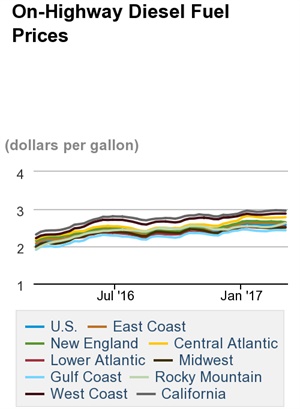
Diesel prices in the U.S. have continued to move upward with a minor increase last week, according to the latest numbers from the Energy Department.

The average price of on-highway diesel fuel in the U.S. rose by a barely noticeable 0.2 cents last week thanks to offsetting price decreases in many major regions last week. The average price currently stands at $2.579 per gallon which is nearly 56 cents more expensive than it was in the same week of 2016.

Prices varied up and down when broken down by region with the largest increase hitting the Rocky Mountain area at 4.3 cents per gallon. The region with the largest drop in prices was New England where diesel was 1.2 cents cheaper for the week.

The average price of regular gasoline was up by 2.7 cents during the same period, jumping to $2.341 per gallon at the pump. The price is 50 cents more expensive than it was in the same period a year ago.

Prices varied up and down depending on the region with the largest increase coming to the Midwest at 5.7 cents per gallon. The largest decrease in prices occurred in New England where gas prices dropped 1.4 cents on average.

Crude oil prices were negatively affected by a subdued economic forecast coming out of China that lowered growth expectations for the country, according to a MarketWatch report. Weak global demand, mostly as a result of Chinese economic troubles, played a major role in large oil price drops last year and with the latest economic forecast adding to it, oil prices fell on March 6.

Other factors that may have affected prices include increased oil production domestically and the looming increase in interest rates.

Related: Rising Factory Orders Latest Indicator of Interest Rate Hike

Follow @HDTrucking ...Read the rest of this story

No clear ‘net benefit’ to overnight restart, FMCSA concedes

Inspector General signs off on review of hours of service changes The Congressionally mandated review of 2013 changes to truck driver hours of service requirements has turned up no evidence that the restart provisions are, overall, beneficial. The tip comes from none other than the Department of Transportation's Office of the Inspector General (OIG).

read more

...Read the rest of this story

No ‘Net Benefit’ Found in Controversial 34-Hour Restart Provisions

<img width="150" src="http://www.automotive-fleet.com/fc_images/news/m-trucksparkedatnight-cr-jp-1-2.jpg" border="0" alt="

Photo: Jim Park

">

Photo: Jim Park

">

A DOT study apparently has failed to “explicitly identify a net benefit” from two suspended provisions of the hours of service rules regarding the 34-hour restart.

The Federal Motor Carrier Safety Administration issued hours-of-service regulations in 2013 that featured two controversial restart provisions. They required that the 34-hour restart include two 1 a.m. to 5 a.m. periods, even if the 34 hours had already been reached. It also limited use of the restart provision to once every 168 hours. The trucking industry raised concerns about the rule's unintended consequences, such as increased congestion during the daytime traffic hours.

In late 2014, as part of the Consolidated and Further Continuing Appropriations Act of 2015, Congress suspended those two provisions and directed FMCSA to conduct a study of the operational, safety, health, and fatigue impacts of these rules.

Although the data collection for that study was completed in 2015, the study has not get been made public. However, the law also mandated that the DOT Office of Inspector General review the study.

Last week, in a letter to Congress, the OIG wrote that it “found that DOT's study met the act's requirements. We also concur with the Department's conclusion that the study did not explicitly identify a net benefit from the use of the two suspended provisions on driver operations, safety, fatigue, and health.”

Drivers from a variety of fleet sizes and operations provided a substantial amount of data during the study period, according to the FMCSA. More than 220 drivers contributed data as they drove their normal routes. The data included over 3,000 driver duty cycles captured by electronic logging devices, over 75,000 driver alertness tests and more than 22,000 days of driver sleep data.

Related - Regulatory Outlook: Sunny if Foggy for 2017

Follow

Morgan Launches NexGen Line of Truck Bodies

<img width="150" src="http://www.automotive-fleet.com/fc_images/news/m-morgan-nexgen-1.jpg" border="0" alt="

Photo: Morgan Corporation

">

Photo: Morgan Corporation

">

Truck and van body maker Morgan Corporation has launched its NexGen line of truck bodies for dry freight and refrigerated applications.

NexGen bodies make use of more advanced designs and materials, resulting in truck bodies that are lighter than similar units but are capable of carrying more payload, according to Morgan. The design of NexGen bodies also results in increased fuel economy and better resistance to the elements.

The lightweight body is built of non-corrosive materials to inhibit rust, improving durability and slowing aging. NexGen bodies feature stain-resistant phenolic flooring in the dry freight body and an aluminum silent floor in the reefer.

Sealed joints prevent leaks to keep product, cargo, or tools dry, using elastomeric gaskets in the connection profiles to provide protection from water intrusion. The bodies also use hard-mount installation brackets in place of U-bolts to improve overall durability.

For more information, click here.

Related: Truck Body Aimed at Landscaping Fleets

Follow @HDTrucking on Twitter

...Read the rest of this story

Economic Watch: Rising Factory Orders Latest Indicator of Interest Rate Hike

An increase in new factory orders is one of the latest economic signs that the Federal Reserve is moving close to another jump in interest rates, some analysts believe.

New orders for manufactured goods in January increased 1.2% from the month before, according to a full Commerce Department report released Monday, slightly better than a Wall Street consensus estimate. It was boosted by sizable jumps in the notoriously volatile aircraft components for both defense and nondefense.

This followed an unrevised 1.3% improvement in December while new orders are up 5.5% from January 2016.

Orders for manufactured durable goods increased 2% in January following two straight months of declines, better than the first estimated 1.8% gain.

Total shipments of factory goods increased 0.2% in January following a 2.5% surge in December, marking 11 consecutive monthly improvements.

Shipments of so-called “core-capital goods,” which are an indication of business investment and are used in calculating the nation's gross domestic product, fell 0.4% in January, better than the first reported 0.6% drop.

“On balance, the hard data in the manufacturing sector continue to show improvement, although the pace has been slower than sentiment indicators alone would indicate,” said Tim Quinlan, senior economist at Wells Fargo Securities.

He noted that core capital goods orders are up 8.7% on a three-month average annualized basis. That's the fastest pace since 2014 and it corroborates some of the rising sentiment seen in other indicators.

This and other recent indications, such an strong employment, rising prices and anecdotal evidence of a firming gross domestic product, have led some analysts to say they believe the Federal Reserve will increase interest rates when it meets later this month.

Among them is CNBC's Jim Cramer, who said last week that "The rest of the economy is strong enough to take it” and there is no excuse for the central bank ...Read the rest of this story