Isuzu Sets Production, Ordering for Class 6 Cabover

Isuzu Sets Production, Ordering for Class 6 Cabover

<img width="150" src="http://www.automotive-fleet.com/fc_images/news/m-isuzu-ftr-family-dock-lr-1.jpg" border="0" alt="

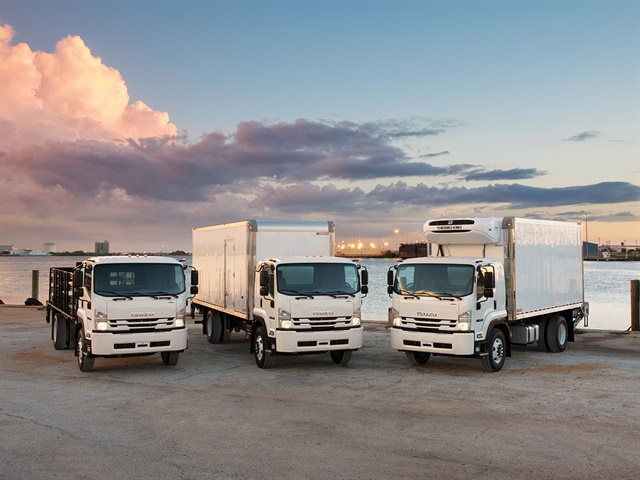
Photo of FTR cabovers courtesy of ICTA.

">

Photo of FTR cabovers courtesy of ICTA.

">

Isuzu Commercial Truck of America (ICTA) will begin production of its 2018 FTR Class 6 cabover in May and start taking orders for the medium-duty truck in April, the company announced at the Work Truck Show in Indianapolis.

Spartan Motors is assembling the 2018 FTR at its Charlotte, Mich., assembly plant that spans 85,000 square feet. The vehicle will retail for $82,180, the manufacturer announced.

"This truck's combination of low-cab-forward design and Class 6 GVWR gives it fantastic maneuverability and visibility along with the ability to carry more cargo than a conventional Class 6 truck," said Shaun Skinner, president of ICTA. "Its four-cylinder diesel engine is environmentally friendly and gives the truck outstanding fuel efficiency. Its class-leading warranty gives its owners peace of mind."

The FTR is powered by Isuzu's 4HK1-TC 5.2L turbocharged four-cylinder diesel engine that now carries a B-10 durability rating of 375,000 miles, meaning that 90% of engines should reach that odometer reading before needing an overhaul. When fitted in the FTR, the engine makes 215 hp and 520 lb.-ft. of torque at peak operation.

Isuzu pairs the engine with an Allison 2550 RDS 6-speed automatic transmission with power take-off (PTO) capability.

The front axle can take 12,000 pounds of capacity, while the rear axle is rated at 19,000 pounds. The GVWR is 25,950 pounds. The 11R22.5 tires are fitted to 22.5-inch steel wheels.

Users can add an available 50- or 100-gallon fuel tank depending on which wheelbase they choose. The truck is available in eight wheelbase lenghts from 152 to 248 inches. It can accommodate bodies from 14 to 30 feet.

Related: Isuzu Debuts 2018 Class 6 FTR Truck

Follow @HDTrucking on Twitter

...Read the rest of this story
Infrastructure Reform Group Finds Twin 33s Boost Safety and Efficiency

<img width="150" src="http://www.automotive-fleet.com/fc_images/news/m-twin-33-1.jpg" border="0" alt="

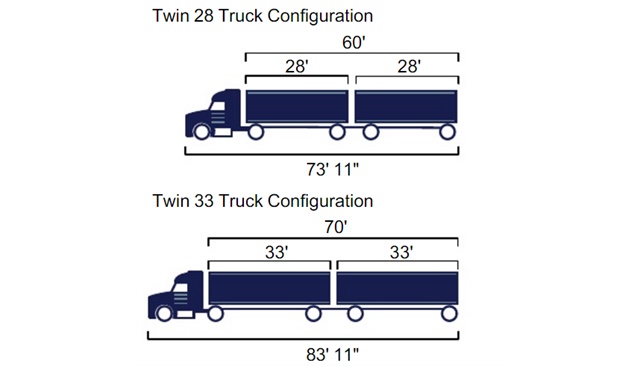
Image via report: Twin 33 Foot Truck Trailers: Making U.S. Freight Transport Safer and More Efficient

">

Image via report: Twin 33 Foot Truck Trailers: Making U.S. Freight Transport Safer and More Efficient

">

The Americans for Modern Transportation coalition released a new study finding that twin 33-foot trailers would boost safety and efficiency with widespread adoption.

The study, entitled Twin 33 Foot Truck Trailers: Making U.S. Freight Transport Safer and More Efficient, was conducted by Ronald Knipling, a 35-year traffic safety researcher. In it, Knipling found that twin 33s improved safety primarily through road stability and cutting down on the number of trucks on the road.

Because trailers often fill up before hitting the 80,000-pound limit, according to the study, by switching from twin 28-foot trailers to twin 33s, cargo volume could increase by 18.6% while still not needing to increase the maximum weight limit. This means that using twin 33s would require 15.7% fewer trucks and trailers to carry the same amount of cargo.

“Allowing widespread use of Twin 33 trailers is common sense policy. Not only are they more stable at highway speeds, the efficiency gains mean we have fewer trucks on the road,” said Knipling. “Fewer trucks means fewer accidents, less wear and tear on our roads, and more focused enforcement by weigh stations for all types of trucks. It's a win-win for drivers, consumers, businesses, and the economy.”

The study found that through a widespread adoption of Twin 33s, truck miles driven could have by reduced by as much as 3.1 billion miles and reduced the number of truck-involved accidents by 4,500 annually.

Fewer trucks on the road would also reduce fuel use, saving 255.2 million gallons of fuel and reducing carbon emissions by nearly 3 million tons. The effect of this reduction would be similar to taking 551,000 cars off of the road, according to the study.

Another positive change by switching to twin 33s was reduced ...Read the rest of this story

Trucking Company Faces EEOC Lawsuit Over Veteran’s Service Dog

The Equal Employment Opportunity Commission has filed a lawsuit against CRST Expedited for allegedly failing to accommodate a veteran with a service dog and then retaliating against the man.

According to the EEOC lawsuit, Leon Laferriere applied to be a truck driver with CRST in Fort Meyers, Florida, and signed up for the driver's certification course with CRST's partner training company. After being accepted in the program but before leaving for it, Laferriere disclosed his disabilities and use of a trained service dog to help him control anxiety and symptoms of post-traumatic stress disorder.

After completing the training program, Laferriere was told he could not advance on to the on-the-road program, which requires overnights away from home, allegedly due to CRST's no-pet policy. As a result, he was not hired by the company.

Shortly after Laferriere's disqualification from hire, the EEOC alleges that CRST developed a new Service Dog Process to address accommodation requests for the use of a service dog. Despite this, the lawsuit claims that Laferriere was denied the opportunity to qualify for hire under the new policy.

"Laferriere did the right thing by disclosing that he used a service dog due to disabilities to the CRST recruiter before leaving for the driver's certification course," said Julianne Bowman, district director for the EEOC's Chicago district office, which investigated the charge of discrimination.

The EEOC says that this incident violates the Americans with Disabilities Act for failing to provide a reasonable accommodation for disability, failing to hire an applicant due to a disability, and retaliating against an applicant for seeking a reasonable accommodation, as well as interfering with an applicant's rights under the act.

"CRST's refusal to accommo­date Mr. Laferriere is an example of the hardships that returning veterans with disabilities can face as they seek to reintegrate into civilian life,” said Jean Kamp, associate ...Read the rest of this story

Ford F-650/F-750 Again Named Medium-Duty Truck of the Year

Ford's F-650 and F-750 vocational trucks have been named the 2017 Medium-Duty Truck of the Year award for the second consecutive year, Work Truck magazine announced at the Work Truck Show in Indianapolis.

The trucks were chosen from a field of 12 trucks.

"Our customers demand the most capable, dependable vehicles to get the job done and we strive to meet and exceed those expectations," said John Ruppert, Ford general manager, commercial vehicle sales and marketing. "Winning the prestigious Work Truck magazine Medium-Duty Truck of the Year award for the second straight year is confirmation that we are doing our job to give customers what they need. Customers have embraced Ford medium-duty trucks as is evident by 2016 sales of F-650 and F-750 being at their highest level since 1997."

Ruppert accepted the award from Mike Antich, Work Truck's editor and publisher, during a March 14 ceremony.

Related: Ford F-650/F-750 Named Medium-Duty Truck of the Year

Follow @HDTrucking on Twitter

...Read the rest of this story

Ford Updates Transit Van for 2018

<img width="150" src="http://www.automotive-fleet.com/fc_images/news/m-ford-transit-2017-1-1.jpg" border="0" alt="

Photo of 2017 Transit courtesy of Ford.

">

Photo of 2017 Transit courtesy of Ford.

">

Ford added several new features and new optional equipment to its Transit full-size van for the 2018 model year, the company announced at the Work Truck Show in Indianapolis.

Ford's 2018 Transit will move the rear-view camera above the rear doors on medium- and high-roof models. It will also get a locking glove box, new rear door exit handle, and rear LED cargo lamp switch.

New optional equipment includes heavy-duty cargo area flooring, heavy-duty rear scuff plate kit, extended-length running boards, a push-down manual parking brake, alloy dual rear wheel package, and charcoal leather-triummed heated seat package.

Other new options include power-folding short-arm heated mirrors and turn signals; AM/FM stereo with audio output jack, microphone, and Bluetooth interface; and D-pillar assist handles for medium- and high-roof models.

Related: Ford Adds Electrification to Vehicle Modifier Program

Follow @HDTrucking on Twitter

...Read the rest of this story

Ford Adds Electrification to Vehicle Modifier Program

<img width="150" src="http://www.automotive-fleet.com/fc_images/news/m-xl-hybrid-cutaway-e350-2.jpg" border="0" alt="

Photo of XL Hybrids E-350 cutaway courtesy of Ford.

">

Photo of XL Hybrids E-350 cutaway courtesy of Ford.

">

Ford has expanded its Qualified Vehicle Modifier (QVM) program to include companies who install electrified and hydraulic hybrid systems so those vehicles will retain the factory powertrain warranty.

The newly christened eQVM program, announced at the Work Truck Show in Indianapolis, is launching with XL Hybrids, Lightning Hybrids, and Motiv Power Systems. These three companies produce hybrid versions of Ford trucks and vans.

"Ford supports electrification for a variety of vehicle types," said Richard Cupka Jr., Ford's sustainability and QVM program manager. "The eQVM program extends that support to the vocational truck industry, where customers need relatively small numbers of specialized vehicles. There is no one-size-fits-all work truck."

XL Hybrids offers a gasoline-electric hybrid drive system for the Transit, E-350 and E-450 chassis vans; F-250 to F-550 Super Duty trucks; F-650 and F-750 medium-duty trucks; F-53 or F-59 stripped chassis; and a plug-in hybrid upfit for the F-150.

Lightning Hybrids offers a hydraulic hybrid energy recovery system for the Ford E-350 and E-450 chassis; F-350 to F-550 Super Duty trucks; F-650 and F-750 medium-duty trucks; and F-59 chassis.

Motiv Power Systems offers an all-electric powertrain for the Ford E-450 and F-59 chassis.

The Ford QVM program includes more than 200 companies. To be included in the program, companies must complete on-site assessments at each location to verify that the operation meets manufacturing, assembly, workmanship, customer service and quality requirements. The company must also show it uses processes to produce vehicles that meet federal regulations.

The eQVM program builds on the Advanced Fuel QVM program Ford launched in 2010. Through that program, customers can obtain Ford Transit Connect, Transit or E-450 vans and chassis, F-Series trucks and F-53/F-59 stripped chassis that run on compressed natural gas or propane autogas.

Related: Ford Updates Transit Van for 2018

Follow @HDTrucking ...Read the rest of this story

Cummins Highlights Improvements in 2017 MidRange Engine Lineup

<img width="150" src="http://www.automotive-fleet.com/fc_images/news/m-cummins-2017-b6-7-1.jpg" border="0" alt="

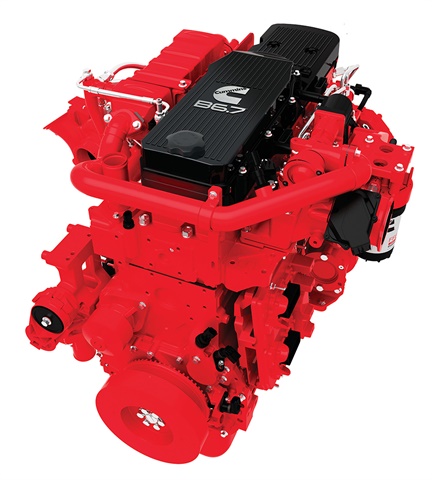
Cummins 2017 B6.7 engine has improved fuel economy.

" >

Cummins 2017 B6.7 engine has improved fuel economy.

" width="300">

Cummins announced improvements to its MidRange engine lineup for 2017 at the Work Truck Show in Indianapolis.

The MidRange lineup features engines ranging from the diesel V5.0, B6.7 and L9 to the Cummins Westport natural gas ISB6.7 G and ISL G Near Zero engines.

"Cummins announced our new MidRange engine platforms last year, but we haven't been resting on our laurels,” said Jeff Caldwell, executive director of North American Truck OEMs for Cummins.

B6.7

Fuel economy improvements mean the B6.7 engine is seeing an average improvement of 8.5% on efficiency ratings and 5% on performance ratings over Cummins' EPA-2013 ISB6.7, says Cummins.

For some applications and duty cycles, specifically pickup and delivery, the efficiency ratings have demonstrated up to a 13% fuel economy improvement.

"The program started with a goal of delivering 7% better fuel economy on the efficiency ratings and 1% better fuel economy on the performance ratings over the 2013 product,” Caldwell said. “As the program progressed, we found opportunities to tune and optimize the engine, delivering further efficiency, and allowing us to surpass initial expectations."

Apart from base engine fuel economy enhancements, Cummins also has Stop-Start capability with the B6.7, which will provide additional fuel economy improvement from 3% to 15%. Stop-Start technology allows the engine to operate only when necessary, by shutting off the engine during idle.

The 2017 B6.7 also includes a longer warranty, a complete 3-year/unlimited-mile warranty in truck applications.

Cummins Westport Natural Gas Engines

Now in full production for bus, medium-duty truck and vocational applications are the ISB6.7 G and the ISL G Near Zero.

Based on the B Series diesel engine platform, the ISB6.7 G is Cummins Westport's most compact natural gas offering, according to Rob Neitzke, president of Cummins Westport.

Also available is the ISL G Near Zero, which has emissions certification from ...Read the rest of this story