Isuzu Begins Production of Class 6 FTR

Isuzu Begins Production of Class 6 FTR

<img width="150" src="http://www.automotive-fleet.com/fc_images/news/m-ftr-plant-12-100dpi-1.jpg" border="0" alt="

Eight wheelbase lengths, ranging from 152 to 248 inches, accommodate bodies from 14 feet to 30 feet, allowing for a wide variety of body applications. (Photo courtesy of ICTA)

">

Eight wheelbase lengths, ranging from 152 to 248 inches, accommodate bodies from 14 feet to 30 feet, allowing for a wide variety of body applications. (Photo courtesy of ICTA)

">

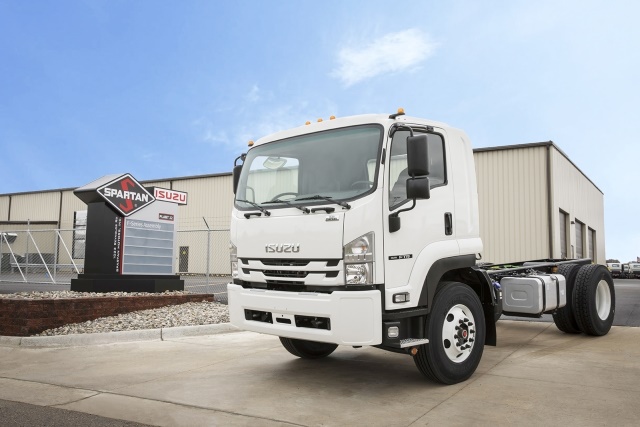
Isuzu Commercial Truck of America, Inc., distributor of low cab forward trucks, has announced that production of its all-new entry in the Class 6 medium-duty truck segment — the 2018 Isuzu FTR — began May 8, 2017.

The truck is being produced at a new 80,000-square-foot Spartan Motors facility in Charlotte, Mich.

“We believe that the all-new FTR is the truck of the future,” said Shaun Skinner, president of Isuzu Commercial Truck of America. “This truck's combination of low-cab-forward design, Class 6 GVWR, and four-cylinder diesel engine gives it fantastic maneuverability, the ability to carry more cargo than a conventional Class 6 truck, and outstanding fuel efficiency."

The FTR is powered by Isuzu's 4HK1-TC 5.2L turbocharged four-cylinder diesel engine — a first in the segment, according to the truckmaker. It generates 520 lb.-ft. of torque and 215 hp and carries a B10 durability rating of 375,000 miles — meaning that 90% of engines should reach that mileage before requiring an overhaul. The truck has a gross vehicle weight rating of 26,950 pounds.

"We're also thrilled to be working with Spartan Motors in Michigan,” Skinner added. “Much of the engineering for this truck was done at the Isuzu Technical Center of America in Plymouth, Michigan, and many of the parts for it are U.S.-sourced. This is a true medium-duty Class 6 truck designed and built for this market, in this market.”

Eight wheelbase lengths, ranging from 152 to 248 inches, accommodate bodies from 14 feet to 30 feet, allowing for a wide variety of body applications.

The new truck assembly plant where the FTR is being produced represents a $6.5 million investment and has already brought new jobs to ...Read the rest of this story

Navistar’s Sass Surveys the Road Ahead for HDTX Attendees

<img width="150" src="http://www.automotive-fleet.com/fc_images/news/m-hdtxjeffsass2017-1.jpg" border="0" alt="

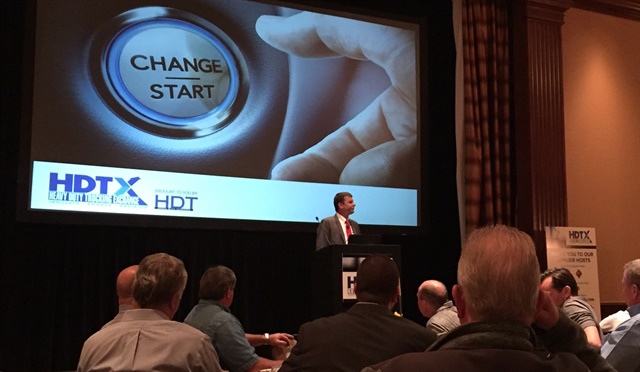
Jeff Sass addressing attendees of first HDTX fleet networking conference.

">

Jeff Sass addressing attendees of first HDTX fleet networking conference.

">

As Navistar works to move past the mistakes of the past and looks ahead to the future, International Trucks' Jeff Sass opened HDT's inaugural Heavy Duty Trucking eXchange fleet networking conference in Phoenix this week with a peek at the future, from electric trucks to autonomous vehicles. HDTX is a new invitation-only event for select truck fleet executives co-hosted by an array of suppliers.

Sass, senior vice president, North America Truck Sales and Marketing, was up front about how the company's failed emissions compliance strategy is still affecting customers plagued with reliability issues, but forthrightly dealt with customer questions and complaints. And he pointed out that Navistar has an all-new engine, the A26, introduced at the American Trucking Associations' Technology & Maintenance Council meeting earlier this year.

“All the people involved in the MaxxForce program are gone,” he said. The 12.4-liter A26 is the first product of Navistar's Project Alpha and was designed with drivers and uptime in mind, he said.

“But connected trucks is really where the industry is headed,” Sass said. Trucks will talk to each other, to the infrastructure around them, and to their owners. Reprogramming trucks remotely and being able to do advanced prognosis on trucks, he said, are “another aspect of making it easier to drive the trucks. Because we have a significant driver shortage.

“We as an industry have adopted advances in automated connected vehicle technology,” he continued, noting that advanced driver assistance systems, such as lane departure warning, collision mitigation and cameras, are making truck driving easier and safer — and, he said, “will lead at some point to autonomous, driverless trucks.

“Now, do I believe that on I-10 out here at 3 o'clock in the afternoon as my wife is driving ...Read the rest of this story