<img width="150" src="http://www.automotive-fleet.com/fc_images/articles/m-tire-pressure-maintenance-1-2.jpg" border="0" alt="
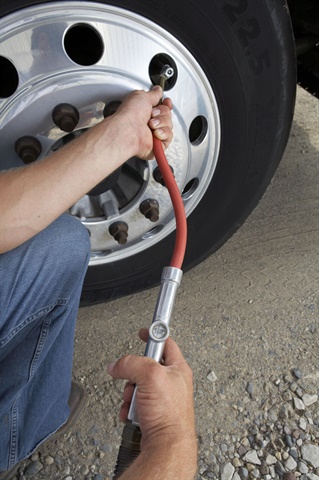
Inflation pressure should be checked with a reliable gauge at least weekly, and every time a trailer comes out of a drop yard. Photo from Michelin.
" >
Inflation pressure should be checked with a reliable gauge at least weekly, and every time a trailer comes out of a drop yard. Photo from Michelin.
" width="300">Almost everyone is familiar with the adage 10% under-inflation can cause a 1% degradation in fuel economy due to the increased rolling resistance of softer tires. So, are we talking about 1 tire out of 18, just the tires on the truck, just the tires on the trailer or would all the tires have to 10% under inflated to account for the 1% reduction in fuel economy?
We asked several tire makers that question and the answer was universal: all the tires need to be 10% underinflated before the truck sees a 1%-drop in fuel economy.
Here's how Terry Smouter describes it. He's the business development manager for Continental Commercial Vehicle Tires.
"The overall fuel economy of the vehicle is dependent on the axle position of the under-inflated tire," he says. "The drive and trailer axles contribute more to the overall fuel economy of a truck than the steer position."
There have been multiple studies conducted in Europe and here at home that show in general that tire pressure maintenance isn't something all fleets are good at.
So, what exactly is recommended pressure? There is only one official reference to tire pressure anywhere; the tire makers' Load & Inflation tables (also available through the Tire Industry Association). The L&IT speak only to the minimum pressure required to support a given load, which isn't much to go on.
"The load and inflation tables are standards that are consistently maintained by all tire manufacturers and provide the guidelines to which tires can safely carry a given load," notes Prosser Carnegie, product development manager for Continental Truck Tires, NAFTA. "The key concern as a tire manufacturer is when a tire is being run