Radiant Logistics appoints new VP of international services
Radiant Logistics announced it has appointed Randy Briggs as vice president of international services of its freight forwarding operations.
read more
...Read the rest of this storyRadiant Logistics announced it has appointed Randy Briggs as vice president of international services of its freight forwarding operations.
read more
...Read the rest of this storyChief announced its Heavy-Duty Rivet Gun puts out 10 metric tons of compression force to install new rivets or press out existing rivets in the thick steel and aluminum used to build heavy-duty truck cabs. It also uses 8 metric tons of tension force to hydraulically retract the punching tool from metal sheets.
read more
...Read the rest of this storyPresident Trump is trying to revive the coal industry and extend the lifespan of the oil business. But renewables like solar and wind power are still likely to thrive.
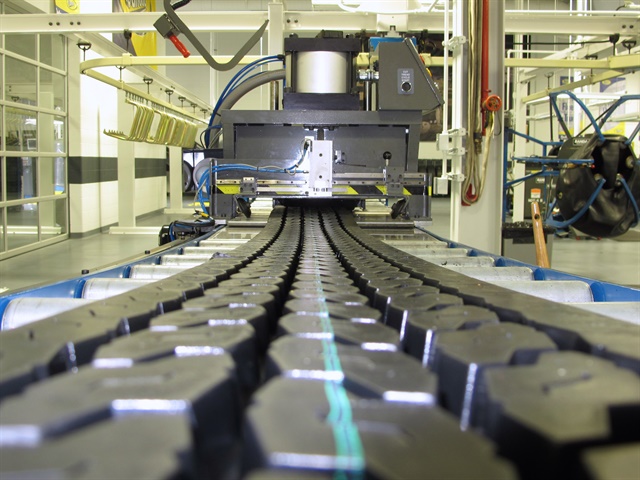
Tread patterns are available for any type of operation from low rolling resistance drive tires to vocational tires. Photo by Jim Park
">Tread patterns are available for any type of operation from low rolling resistance drive tires to vocational tires. Photo by Jim Park
">Retreading can extend casing life two, three or even four times, thus significantly lowering the lifecycle cost of the tire. While retread costs vary with the type of tread, the quality of the casing and the contract arrangement you have with the retreader, prices are roughly 1/3 to 1/2 that of a new tire.
If you keep an eye on casing value, you'll know that casings sold seem to fetch a fraction of what they are truly worth. You might get $90 to $125 for a good casing in a tight market, but retreading the casing gives you a virtually new tire with a couple of hundred thousand miles of life left in it -- and you can often retread several times. Where does the real value lay?
"A casing is a terrible thing to waste since at least 75% of the cost of a tire is in the casing, notes Ron Elliott, marketing and communications manager, Marangoni Tread North America.
Elliot says the key to a successful retreading program is to start with a quality casing, and then work to protect your casing investment with good maintenance, particularly pressure management.
"Most casings are designed and manufactured to be highly repairable and retreadable to last more than one life," Elliott says. "A proper tire management program will help ensure the very lowest total running cost."
If retreads get a bum rap, it's probably because the tire has been neglected.
It hardly needs to be said, but proper inflation and regular inflation checks will keep all tires in service longer. And of course retreads suffer from the stigma of being assumed to explode more often than new tires. Several tire debris studies have all but disproven ...Read the rest of this story

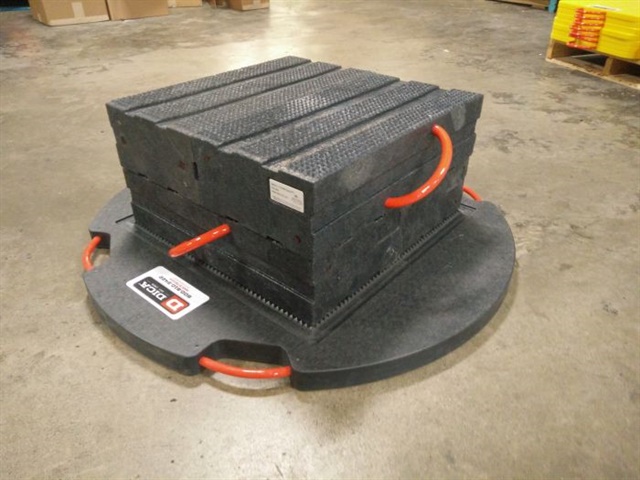
Dica ProStack Cribbing provides utility crews and municipal fleet operators with a solution for operating in uneven ground conditions.
Working along sloped roadsides or against curbs, utility crews can be faced with setting outrigger-enabled equipment on sloped or uneven ground. ProStack Cribbing has been developed with an interlocking design that provides additional height under outrigger floats when setting up in uneven ground conditions.
ProStack Cribbing has three basic parts: a basic outrigger pad, interlocking cribbing blocks and a high-friction top grip pad. The base ProStack Outrigger Pad is manufactured with a pyramid-shaped surface that interlocks with the cribbing blocks. On top of the base pad, operators stack layers of two 6-by-12-by-24-inch cribbing blocks with the pyramid-shape surface, that lock into the base pad. Lastly, a ProStack Grip Pad is placed on top of the stack to protect the pyramid surface on the cribbing blocks and provide a high friction surface for the outrigger foot.
ProStack is available in three Cribbing Kit options that include either a DR36-2, DR42-2, and DR48-2 base outrigger pad, along with four cribbing blocks and one grip pad. ProStack individual parts are also available for purchase, including Cribbing Wedges, which can be used on sloped surfaces to establish a level foundation under the ProStack Outrigger Pad.
Follow @HDTrucking on Twitter
...Read the rest of this storyFiat Chrysler's (NYSE: FCAU) troubled Fiat division had another disastrous sales month. The company sold 2,670 cars in May, down 16% from the year earlier. Sales for the first five months of the year were ...
The Latest on an attack at a casino and hotel complex in the Philippines (all times local): 12:30 p.m. The Metropolitan Manila police chief says thick smoke trapped people in the gambling area where a ...