Film Promotes Pennsylvania RR’s TrucTrain Service in the 1950s

Film Promotes Pennsylvania RR’s TrucTrain Service in the 1950s

<img width="150" src="http://www.automotive-fleet.com/fc_images/blogs/m-pennsy-piggyback-1.jpg" border="0" alt="

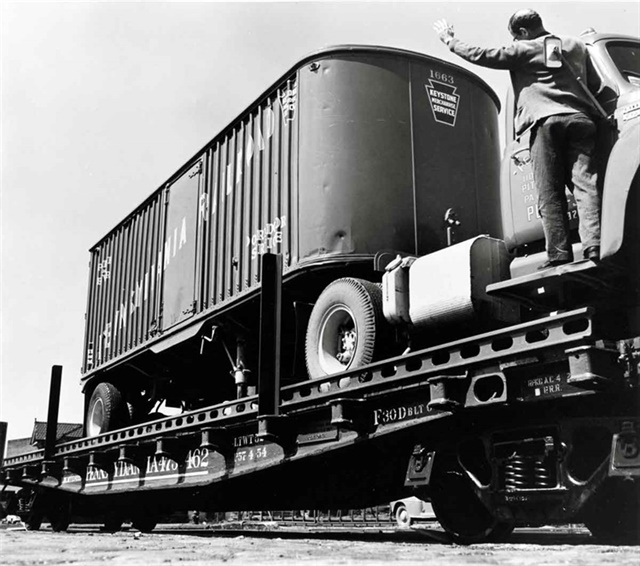
The guy on the running board is there strictly for the camera, because drivers in piggyback terminals were very good at backing trailers onto flatcars. Photo: Pennsylvania Railroad/Classic Trains

">

The guy on the running board is there strictly for the camera, because drivers in piggyback terminals were very good at backing trailers onto flatcars. Photo: Pennsylvania Railroad/Classic Trains

">

Before I was a truck buff, I was a train fan. So, when I got into the truck-writing business, first in 1973 and then for good in '78, it pained me to hear drivers and executives talk about railroads as “the enemy.” Sometimes they gloated over how they were taking business from the rails, and they could do it because they offered better service.

Meanwhile, railroad people had also come to view the trucking industry as a great threat and an unfair competitor, because taxes were used to build highways while the railroads built and maintained their own tracks and rights-of-way, and paid taxes on all of it. They didn't acknowledge that truck operators paid plenty of extra taxes to use the highways, and continue to. Books have been written on that subject, so I shan't go further with it here.

But there was an area where railroads and trucking companies cooperated in the 1950s. That was trailer-on-flatcar (TOFC) service, also known as “piggyback.” I just came across the above photo, shot about 1950, of a short trailer being backed onto a piggyback flatcar in Chicago. That got me searching for more “pig” pictures, and I immediately found a short promotional film produced for the long-defunct but once powerful Pennsylvania Railroad.

The 1955 film is almost pro-trucking, with the narrator calling it “a great industry.” It talks about crowded highways populated by cars and an increasing number of large trucks, and includes one scene of “blocked” traffic (today, we call that gridlock). But, the narrator proclaims, the solution lies with America's railroads and their “excess capacity” – caused by truckers stealing their freight, ...Read the rest of this story

Economic Watch: Manufacturing Hits Nine-Month Low, Home Sales Rebound

A first look at the nation's manufacturing sector this month shows conditions have hit a nine-month low, while home sales have roared back amid near-term expectations the overall economy will continue with a moderate expansion.

The seasonally adjusted Flash U.S. Manufacturing Purchasing Mangers' Index (PMI) from financial information services provider IHS Markit fell from a final May level of 52.7 to a preliminary reading of 52.1 in June.

While a level above 50 indicates manufacturing activity is expanding, this is the slowest pace since last September.

The weaker PMI reading largely reflected softer rates of output and new business growth in June, which more than offset stronger contributions from job creation and inventory building, according to the report.

According to Chris Williamson, chief business economist at IHS Markit, the U.S. economy is ending the second quarter on a softer note.

“The average expansion seen in the second quarter is down on that seen in the first three months of the year, indicating a slowing in the underlying pace of economic growth,” he said. “While official GDP [gross domestic product] data are expected to turn higher in the second quarter after an especially weak start to the year, the relatively subdued PMI readings suggest there are some downside risks to the extent to which GDP will rebound.”

A final reading on June will be out in early July, along with the more closely watched monthly survey of purchasing managers from the Institute for Supply Management.

New, Existing Home Sales Come Back to Life

This report came as separate ones showed the market for both new and existing homes has turned around.

New home sales in May increased 2.9% from the month before to a seasonally adjusted annual rate of 610,000 while the April level was revised upward, according to the Commerce Department.

When May is compared to the same time a ...Read the rest of this story

XPO Logistics LTL drivers surpass one billion accident-free miles

XPO Logistics announced its less-than-truckload (LTL) professional drivers have surpassed one billion miles with no preventable accidents.

XPO has approximately 12,575 professional drivers in its LTL transportation network, and began tracking consecutive accident-free miles by driver in April 2012. XPO noted that by May 2017, 890 XPO drivers had achieved one million, two million or three million accident-free miles, and the total for all these drivers had exceeded one billion miles.

read more

...Read the rest of this story

Trucking’s Share of Cross-Border Freight Falls

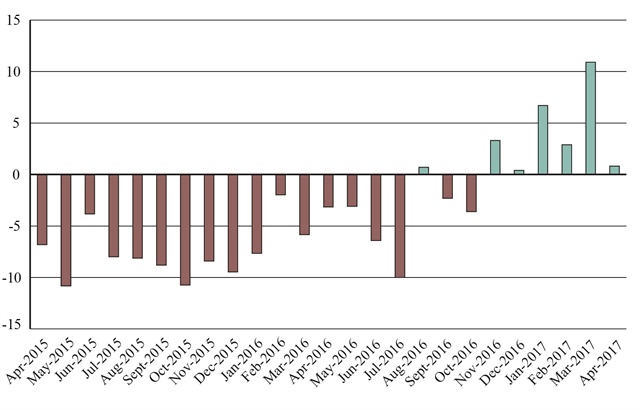
The value of freight moved between the U.S and its North American Free Trade Agreement partners Canada and Mexico moved higher in April for the sixth straight month, but trucking's share fell, according to new U.S. Transportation Department figures.

U.S.-NAFTA freight totaled $91.1 billion in current dollars in April, 0.8% higher than compared to the same time in 2016.

Despite the overall gain the value of freight moved by truck fell 5.5% while air freight fell 2.1%. The value of commodities moving by pipeline increased 63.5%, vessel by 27.8%, and rail by 5.8%.

The large percentage increase in the value of goods moving by pipeline and vessel was due in part to a 25% increase in the year-over-year price of crude oil between April 2016 and April 2017, according to the report.

The top commodity category transported between the U.S. and Canada during April was vehicles and parts, of which $4.8 billion, or 53.7%, moved by truck and $3.9 billion, or 43.8%, moved by rail.

Trucks carried 62.6% of U.S.-NAFTA freight and continued to be the most heavily utilized mode for moving goods to and from both U.S.-NAFTA partners. Trucks accounted for $29.4 billion of the $49.5 billion of imports or 59.5%, and $27.6 billion of the $41.6 billion of exports, or 66.3%.

Rail remained the second largest mode by value, moving 16.4% of all U.S.-NAFTA freight.

U.S.-Canada Truck Freight Falls 2.8 Percent

The value of U.S.-Canada freight flows increased by 2.5% in April from a year earlier to $47 billion as the value of freight on three major modes increased from a year earlier.

The value of freight carried on pipeline increased by 67.1%, vessel by 13.8%, and rail by 6.4%. Truck decreased by 2.8%, and air decreased by 7.2%.

Trucks carried 57.6% of the value of the freight to and from Canada while rail carried 17.7% followed by ...Read the rest of this story