ELD Mandate Tops ATRI’s Top Trucking Issues List

ELD Mandate Tops ATRI’s Top Trucking Issues List

<img width="150" src="http://www.automotive-fleet.com/fc_images/news/m-brewster-3-1.jpg" border="0" alt="

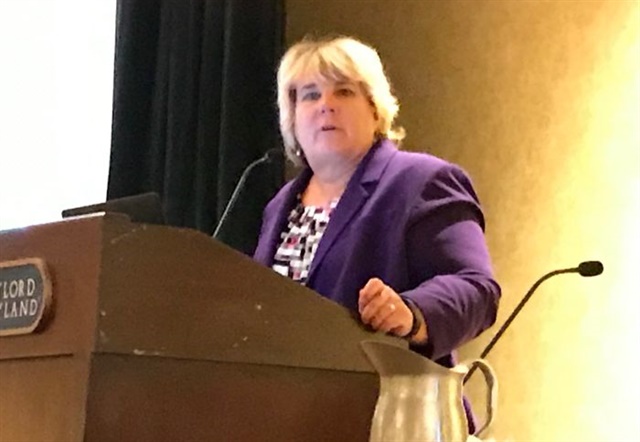
Rebecca Brewster, president of ATRI, discusses recent research results at the in.sight user conference. Photo: Jim Beach

" >

Rebecca Brewster, president of ATRI, discusses recent research results at the in.sight user conference. Photo: Jim Beach

" width="350" height="242">

CSA, driver retention and the driver shortage fell out of the top 5 of the industry's Top 10 issues in 2016, with the ELD mandate moving up from 6 to 1, according to research by the American Trucking Research Institute's Rebecca Brewster. Speaking at the Trimble in.site user conference in Nashville Aug. 14, Brewster said it's the first time CSA has been ranked outside of the top 5 issues.

As reported by surveys of trucking companies and drivers, the top 10 issues were the ELD mandate, hours-of-service, the cumulative economic impact of trucking regulations, truck parking, the economy, CSA, driver shortage, driver retention, transportation infrastructure/congestion/funding and driver distraction.

The top issues differed for drivers vs. carries, however with drivers listing the ELD mandate as the number one issue while carriers listed the driver shortage as the key concern.

For commercial drivers, the top issues are: ELD mandate, hours-of-service, truck parking, cumulative impact of truck regulations, economy, CSA, driver retention, sleep apnea rulemaking, FMCSA mission and driver health/wellness.

For carriers, the list includes driver shortage, ELD mandate, cumulative impact of trucking regulations, economy, hours-of-service, driver retention, CSA, transportation infrastructure/congestion/funding, federal preemption of state regulation of commerce (F4A) and driver distraction.

Brewster said ATRI is exploring a young driver assessment tool to find a way to identify those young drivers who may have the behavioral characteristics and maturity to drive large trucks.

A recently completed survey of drivers regarding parking found that 36% reported parking in an unauthorized spot at least 3-4 times week. The average remaining hours of driving time a driver has before looking for a parking spot was about an hour, according to the survey, which comes out to an economic cost of about $4,600 per year ...Read the rest of this story
ATA: Message to California, Don’t Mess With Trucking

<img width="150" src="http://www.automotive-fleet.com/fc_images/news/m-chris-spear-1-1.jpg" border="0" alt="

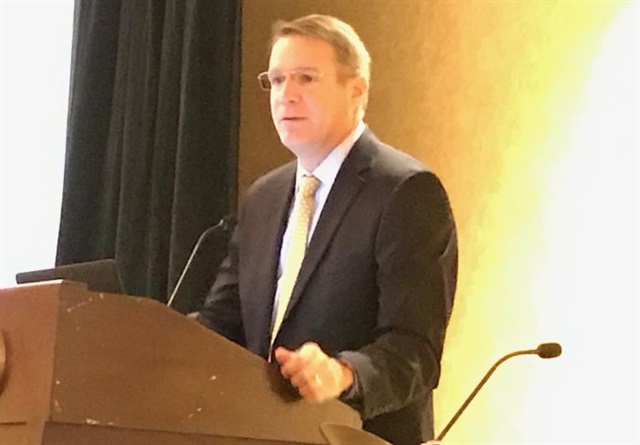
ATA president and CEO Chris Spear. Photo: Jim Beach

">

ATA president and CEO Chris Spear. Photo: Jim Beach

">

State governments, especially California, need to understand they can't “mess with trucking,” said Chris Spear, president and CEO of the American Trucking Associations.

Singling out California's meal and rest break rules that are causing problems for truckers in California, Spear said that ATA would be “stepping out of our comfort zone” to help its state trucking association partners fight these kinds of rules that hurt trucking. Noting that trucking is interstate commerce, Spear said ATA would sue California over the issue which he argued compromised safety and only benefited “trial attorneys.” He also pointed out proposals in New Hampshire to charge tolls on bridges in the state only to trucks.

As for the federal governments, Spear said that ATA needed “under stand them. We have to work with them.” The roads and bridges we all drive on are “not political.”

The truck industry is too big and too important not to engage, Spear said, noting that trucks move 70% of domestic freight and over 70% of NAFTA freight. As for changes to the NAFTA or other trade agreements, he said, “if you tweak it and do it wrong, we'll be the first people to feel it.”

On autonomous vehicles, Spear said that while the technologies were promising, the media hype indicating driverless trucks are in the near future are “bunk.”

“We are not talking about driverless, it's not going to happen anytime soon.” After all he noted, jetliners are capable of taking off, flying and landing without anyone in the cockpit, “but we don't do it.”

With driverless trucks way off in the future, the industry still needs to find more drivers. Spear said the industry needs a way to get to 18-21 year-olds – not to let them drive, but to get them in the ...Read the rest of this story

User Conference Highlights the Fast Pace of Change

<img width="150" src="http://www.automotive-fleet.com/fc_images/articles/m-peoplenet-panel-1.jpg" border="0" alt="

Panel at PeopleNet presentation during the in.sight User Conference + Expo. Photo: Trimble

">

Panel at PeopleNet presentation during the in.sight User Conference + Expo. Photo: Trimble

">

Change and its quickening pace was an over-riding theme at Trimble's in.sight user conference for TMW Systems and PeopleNet customers that kicked off Aug. 14 in Nashville.

Connected trucks, e-commerce, autonomous vehicles and ELDs were singled out as potential change agents pushing the trucking industry's future. David Wangler, president of TMW Systems, noted pace of change over just the last few decades saying, “the pace of change is accelerating” and that businesses could no longer think “on a linear basis. We need to think exponentially.”

Brian McLaughlin, president of PeopleNet noted that the two companies, along with other Trimble business units in the transportation sector were there to help customers “solve the problems of an ever-changing supply chain.”

The good news, Wangler said, was that the transportation industry thrives on challenge. One of which is to acknowledge that in the industry, “what was fixed, is becoming more dynamic” as customer expectations continue to rise and shippers and transportation face greater pressure to meet these expectations.

That is why both companies say a focus on the “final mile” of a shipment has become more important. “Increasingly, carriers are developing local delivery units,” Wangler said. Carriers are also under increased pressure to provide real-time visibility of loads all along the supply chain. And, they must have a way to squeeze more costs out of the last mile since it accounts for about 50% of the total transportation costs. Carriers will be under pressure from shippers to help them reduce these costs.

Another positive of the changing nature of trucking is that “transportation is an amazing space for innovation,” McLaughlin said. The vision was for a connected supply chain including connected trucks, drivers, freight and business intelligence. It's moved from “vision to reality in record time.”

The ...Read the rest of this story

SPECIAL REPORT: The early days of mandatory training

TORONTO, ON -- Darryl Robitaille belongs to a rare graduating class, one of the first future truck drivers to study under Ontario's new Mandatory Entry-Level Training (MELT) regime. That means he had to complete at least 103.5 hours of approved training before the Ontario Ministry of Transportation would allow him to take the road test for an AZ licence to drive tractor-trailers. And he failed on the first attempt. “The road test I did fine on,” says the resident of Caledonia, Ontario, referring to actions like steering and backing. His challenge was with new questions linked to pre-trip inspections. “I was extremely nervous,” Robitaille adds. This despite the fact that he personally completed a 200-hour training program, well above the mandated minimum introduced on July 1. But with a little extra studying he passed the test on his second attempt. Now he is looking to secure his first job behind the wheel. Robitaille can take comfort in knowing he wasn't alone. ...Read the rest of this story