Big Lots tops Street 2Q forecasts
The Columbus, Ohio-based company said it had net income of 67 cents per share. The results topped Wall Street expectations. The average estimate of nine analysts surveyed by Zacks Investment Research was ...
The Columbus, Ohio-based company said it had net income of 67 cents per share. The results topped Wall Street expectations. The average estimate of nine analysts surveyed by Zacks Investment Research was ...

A top economic adviser to President Donald Trump said he's come under "enormous pressure" both to quit and to remain at the White House following the administration's widely criticized response ...
New orders for key U.S.-made capital goods rose slightly more than expected in July and shipments surged, pointing to an acceleration in business spending early in the third quarter. Strength in business investment bolsters the case for the Federal Reserve announce next month a plan to start unwinding its massive bond portfolio. Non-defense capital goods orders excluding aircraft, a closely watched proxy for business spending plans, increased 0.4 percent last month after being unchanged in June.
Portugal's benchmark bond yield hit its highest level in almost a month on Friday to cap one its biggest weekly jumps of the year, as renewed focus on the ECB policy outlook weakened sentiment towards lower-rated euro zone debt. A sell-off in southern European bonds that began with Italy earlier this week spread to Portugal and Spain on Friday. The premium investors demand to hold 10-year Portuguese bonds over German peers rose to its highest level in five weeks, while Spanish bond yields hit their highest since late July.

Federal Reserve Chair Janet Yellen on Friday defended the web of regulations the Fed helped enact after the 2008 financial crisis, saying it helped restore the banking system's health and disputing criticism ...

New orders for big-ticket durable goods fell in July by the most in nearly three years, as orders and shipments for core-capital goods surged, according to a new report, while a separate one showed the market for existing home sales declined following a drop in new home sales.
The 6.8% drop in orders for new durable goods was largely due to drop in the volatile aircraft sector and follows a revised 6.4% improvement in June, according to the Commerce Department. Many analysts were anticipating a slightly larger decline.
Excluding transportation orders, new orders for durable goods increased 0.5% in July, marking three consecutive monthly improvements.
Shipments of durable goods increased 0.4% in July from the month before, the third straight monthly gain.
The closely watched orders for nondefense capital goods minus aircraft, an indicator of business investment, increased 0.4% in July, slightly better than Wall Street expectations, and is up from being nearly unchanged in June. Compared to July 2016, orders for these goods are up 3.3%.
Shipments of core capital goods jumped 1% in July following an upwardly revised to a 0.6% increase in June following an originally reported 0.1% gain. Core capital goods shipments are used to calculate equipment spending in the government's gross domestic product measurement.
The gain in durable goods shipments translates into a “special plus and one that will lift gross domestic product,” once the third quarter is over and numbers are released, according to analysts at Econoday.
“Positives are definitely the theme of today's report, one that helps offset last week's unexpected decline in manufacturing production and supports the enormous strength being signaled by advance regional reports,” they said. “The economy may very well get a solid second-half boost from what has been an improving factory sector.”
Existing Home Sales Drop Following New Home DeclineOn the other hand, sales of existing ...Read the rest of this story
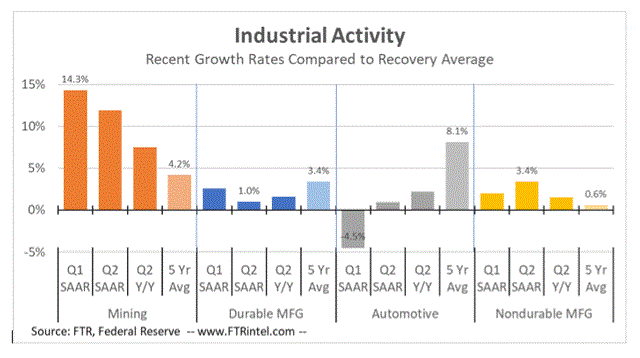
Industrial activity has picked up its pace during 2017 after a stretch of weakness that lasted from mid-2015 until late 2016. Recent reports have done little to change our underlying assumptions of the U.S. economy or freight demand.
Let's key in on a couple of important segments to trucking and see what sort of movement has occurred during the first half of 2017.
MiningIt is easy to see from the chart above that mining activity was very, very strong early in 2017. This sector includes four important segments: stone/earth, metal, coal, and oil/gas. Not surprisingly, the impetus for growth has come from the oil and gas shale fields. Construction (and especially housing) have been lackluster, metal demand has rebounded some but remains weak, and coal demand turned back up in late 2016 but hasn't moved much since then.
Durable ManufacturingDurables are the biggest component of manufacturing and tend to be more cyclical than non-durables (we may not buy a new car during a recession, but we still eat and drive). This segment slowed noticeably during the second quarter – and it remains well below the average growth for this recovery.
AutomotiveAutomotive (this includes both vehicles and parts) is a big component of durable manufacturing. While we did eke out a gain in the second quarter, you can easily see that we are running well below the recovery average and we had a very negative quarter in Q1. Automotive demand looks to have topped out, and growth in industrial activity or freight demand is not likely to come from this segment.
Non-Durable ManufacturingNon-durables did see a notable uptick in the second quarter. Surprisingly, this sector has been quite weak during much of this recovery. The three main segments are: food, fuel, and chemicals. Chemicals growth has been weaker than anticipated during this recovery as it ...Read the rest of this story