Covenant Transportation Group Announces Third Quarter Financial and Operating Results


Navistar has launched the Core Advantage Program, which is designed to help fleet owners reduce costs by helping them manage their core and remanufacturing activity.
Through new tools like the Navistar Core Management System software, fleets can streamline the process of tracking the turning in of used cores, such as engine blocks.
“Core [return] is a key part of the business and the Core Advantage Program demonstrates our commitment to provide the best tools in the industry for our fleet customers and help them reduce their operating costs,” said Joel Larsen, vice president, parts product management, Navistar. “The program will increase our product and service offerings, including Navistar's private label brand Fleetrite parts and our OnCommand suite of value-added services. A good ‘core return' program is key to a successful ‘reman' program.”
Cores are employed to remanufacture a returned part and restore it to a “like new” condition. Remanufactured parts have the features and functionality of a new part and come with a warranty.
Navistar said that with its Core Advantage Program, fleets can have an account number and location codes within CMS, allowing it to see and run reports on purchases, return history, core eligibility, and core fallout rates across multiple locations.
Fleet owners can use the system to answer questions that include: Which locations have the most fallout? Are we buying the correct part? Which core eligibility will expire soon?
“The Core Advantage Program was built and designed by Eddie Wessler and his team, who run Navistar's core operations and have over 100 years of combined experience in remanufacturing and core,” said Chintan Sopariwala, general manager of core and remanufacturing operations, Navistar. “The whole idea is to reduce the burden of managing cores for our customers."
To learn more about this program, fleets can contact Navistar Core Operations at 1-800-758-3771 or email [email protected].
Related: ...Read the rest of this story

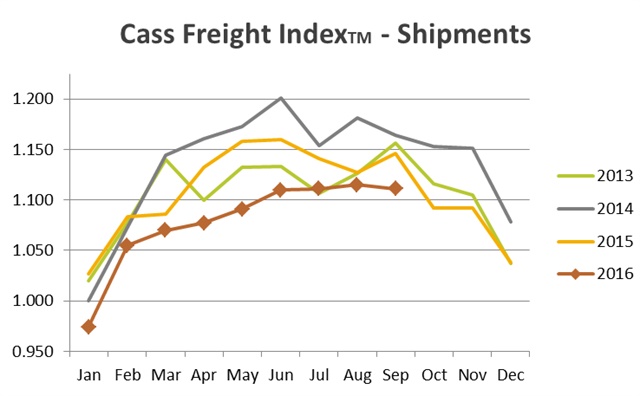
After offering a glimmer of “less bad” hope in August, one measure of freight shipments data in September disappointed -- although there are a few areas of growth.
Turns out that September report was "false hope," says the author of the monthly Cass Freight Index Report, Donald Broughton, who's managing director, chief market strategist and senior transportation analyst at the investment firm Avondale Partners.
“September data is once again signaling that overall shipment volumes and pricing continued to be weak in most modes, with increased levels of volatility as all levels of the supply chain – manufacturing, wholesale and retail – continue to try and work down inventory levels," said Broughton.
“That said, there have been a few areas of growth, mostly related to e-commerce, with lower levels of expansion being experienced in transit modes serving the auto and housing/construction industries."
In the Cass Freight Expenditures Index, expenditures (the total amount spent on freight) were up month-over-month in August, and the year-over-year rate of contraction appeared to be ‘less bad' than the rates in May, June, July, and August.
In September, however, index measurements for freight shipments and expenditures fell 3.1% and 3.8%, respectively, compared to a year ago. It was the 19th straight month of shipment declines. Shipments dropped 0.4% last month from August. Expenditures rose 5.2% month over month, but Broughton said this was the result of the steady increase in the price of fuel over the last six months and not an increase in pricing power.
Broughton said continued weakness in freight movements is being driven by the excess of capacity in most modes, whether you're talking about trucking, rail, air freight, barge, ocean container or bulk.
“Although at first blush it appears that in most modes the gap between spot pricing and contract pricing appears to be closing slightly, this is more a ...Read the rest of this story

While the strength of nation's homebuilding market has eased just a bit, it remains robust. Meanwhile, a measure of consumer prices show it's approaching a level the Federal Reserve has said it needs to hit in order to raise interest rates.
The Commerce Department reported on Wednesday total housing starts in the U.S. fell 9% in September from the month before, the second straight monthly drop and short of many analysts' expectations. However, new construction of single family homes, the biggest share of the market, increased 8.1% to its highest level since February. In contrast, new construction on multifamily units dropped a sharp 38%, the largest decline since 2009.
An indicator of future building activity, the number of new home building permits issued, rose 6.3% in September from August, hitting a year-to-date high level. It also improved 8.5% above the level from September 2015, indicating the underlying strength of the new home market.
“The overall unexpected decline leaves housing starts down an annualized 7% in third quarter, although the gross domestic product (GDP) implications are not as negative as the headline suggests, with the decline concentrated in multi-unit starts, while single unit starts, which have a greater impact on GDP growth, posted a modest increase,” said Josh Nye, economist at Royal Bank of Canada Economic Research.
His group is expecting a a slightly greater moderation in homebuilding activity in the current quarter on top of recent weakness in existing home sales, down an annualized 9% in July and August relative to the second quarter.
“Overall, we forecast a 0.3 of a percentage point drag on GDP growth from the residential sector, although strength in consumer spending and improving business and inventory investment are expected to provide more than enough offset,” Nye said. “We are now monitoring GDP growth to pick up to 2.6% in the ...Read the rest of this story