Swift Transportation (SWFT) Stock Higher on Q3 Earnings Beat, UBS Upgrades


The Environmental Protection Agency and the National Highway Traffic Safety Administration have officially published the Phase 2 greenhouse gas/ fuel efficiency rule for commercial vehicles in the Federal Register.
The rule was finalized in August and now that it has been published it in the Federal Register, it has an effective date of December 27, 2016.
In more than 2,000 pages, the GHG Phase 2 rule sets new standards for commercial vehicle and trailer manufacturers to further reduce greenhouse gas emissions and increase fuel economy goals. It expands on the GHG Phase 1 goals and is aimed at creating a cleaner and more efficient generation of commercial vehicles through existing technologies and new innovations.
The rule sets CO2 limits for Model Year 2021 to 2027 trucks and tractors and Model Year 2018 to 2027 trailers as entire vehicles. The rule also sets separate engine fuel-efficiency standards for each category of commercial vehicle, including light-, medium- and heavy-duty vehicles. Also, for the first time, the GHG Phase 2 rule will regulate trailers.
Taken as a whole, the rule requires engine manufacturers to reduce CO2 emissions by 4%-5% from 2017 through 2027 and to attain fuel efficiency improvements of 16% or better for vocational and heavy-duty vehicles.
GHG Phase 2 also includes rules for natural gas vehicles and engines to reduce methane emissions and regulates glider kits, requiring engines to meet the same standards as new vehicles.
Related: GHG Phase 2: Weighing the Devil in the Details
Follow @HDTrucking on Twitter
...Read the rest of this storyread more
...Read the rest of this storyOptronics International has released its new Opti-Brite LED Headlamps, featuring retroflective LED technology designed to emit a wider, brighter beam for increased visibility and safety.
The Opti-Brite LED Headlamps were designed with a distinct look and feel to set them apart from other LED headlamps. The Headlamps feature unique centralized lens elements that house LED conspicuity arrays and rear-facing LEDs.
The rear-oriented LEDs interact with metallic parabolic reflectors to create a beam patter designed to be bright, with broad, smooth, photometric characteristics that approximate the color temperature of natural sunlight, improving visibility and reducing eye fatigue.
Optronics' new LED headlamps come in three formats that cover a wide range of vehicle makes and models. The HLL93HLB series fits a seven-inch round format and has both high and low beam functions built in. The HLL79HB high-beam lamps and HLL78LB low-beam lamps fit four- by six-inch rectangular formats and are compatible with four-lamp systems with separate, dedicated high-beam and low-beam lamps.
The lamps use standard H4 three-blade connectors for converting any vehicle with compatible headlamps to the new LED technology. All lamps are engineered to accommodate both 12- and 24-volt electrical systems. The new lamps have an expected service life of 30,000 hours.
Follow @HDTrucking on Twitter
...Read the rest of this story
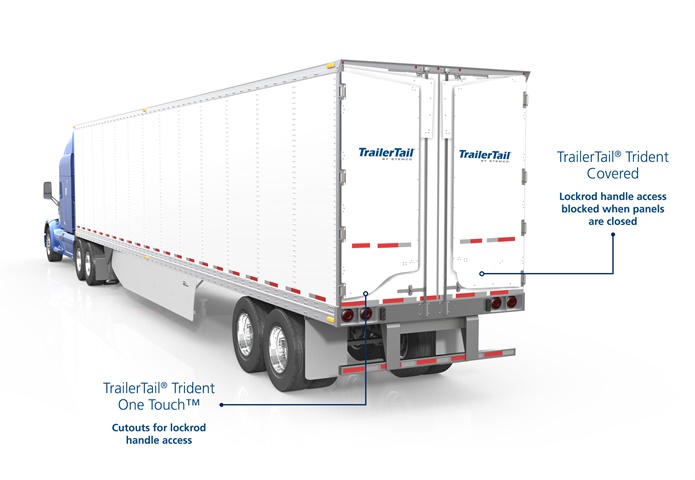
Stemco says its new TrailerTail Covered rear trailer fairing will be deployed more than current designs simply because drivers must open the panels to get at doors' locking handles to close trailer doors. When used more often, the device will increase fuel efficiency and return on investment for fleets.
TrailerTail Covered's side panels are slightly wider so they obstruct access to handles and locking rods, the company explained. With current designs, drivers can forget to deploy TrailerTail panels, but now they can't.
“We've seen tremendous improvements over the past two years in the number of TrailerTail fairings open while on the road, saving fleets an additional 5% percent or more on their fuel bill, but we continue to develop solutions to increase the odds drivers will open their TrailerTail before driving,” said Bob Montgomery, vice president of Stemco Innovative Tire and Mileage Solutions.
“TrailerTail Covered makes opening and closing the TrailerTail an integral part of a driver's process by linking it to operating the trailer doors.”
Panels must be away from the doors to access handles for both opening and closing. So panels are deployed as a driver departs from a pickup or delivery. Drivers would have to intentionally push the panels back against the doors for them to be undeployed.
By streamlining airflow at the back of the trailer, TrailerTail fairings not only reduce fuel consumption but also improve safety, reduce driver fatigue and lessen equipment wear and tear by increasing vehicle stability, Montgomery said. To date, over 50,000 TrailerTail units have been sold in North America, saving companies over $150 million and reducing their carbon footprint.
The Covered option is available for no additional charge for Trident and 4x4 manual deployment systems. Customers may also choose AutoDeploy, which features a built-in speed sensor that automatically unfolds TrailerTail panels when the vehicle reaches ...Read the rest of this story