Top 5 tech award finalists announced
As we rush headlong into the newfangled “digital world” of e-commerce, the Internet of Things (IoT), and connected trucks, an interesting concern is being raised among consumers that motor carriers may want to pay attention to: device interoperability.
read more
...Read the rest of this story
XPO Logistics Inc. on Tuesday announced financial results for the fourth quarter and full year 2016 with both revealing it moved well into the black.
For the fourth quarter of 2016, revenue increased 10% from the same time in 2015 to $3.68 billion. Net income was $29.8 million, or 22 cents per share, compared with a net loss $63.1 million, or a loss of 58 cents per share, for the same period in 2015.
"I'm pleased that we delivered record fourth quarter results for net income, cash flow from operations, adjusted EBITDA and free cash flow,” said Bradley Jacobs, chairman and CEO. “We generated the strongest growth in last mile and contract logistics, driven primarily by e-commerce, more than offsetting a weak intermodal environment. Our less-than-truckload operations in North America capped an outstanding year with a 40% increase in fourth quarter adjusted operating income.”
XPO's transportation segment generated total revenue of $2.33 billion for the quarter, compared with $2.1 billion for the same period in 2015.
The year-over-year increase in revenue was primarily attributed to the acquisition of Con-way Inc. in October 2015 and to organic growth in both North America and Europe, partially offset by the divestiture of the former Con-way Truckload in October 2016.
“Organic revenue growth for the segment was led by the last-mile unit, primarily driven by an increase in e-commerce business. Revenue growth was partially offset by softness in North American intermodal volumes,” XPO said in a statement.
Operating income for the transportation segment increased to $84 million, compared with an operating loss of $6.1 million a year ago.
The company's logistics segment generated total revenue of $1.38 billion for the quarter, compared with $1.27 billion for the same period in 2015.
In Europe, organic growth from new contracts with e-commerce and cold-chain customers was negated by the adverse impact of ...Read the rest of this story
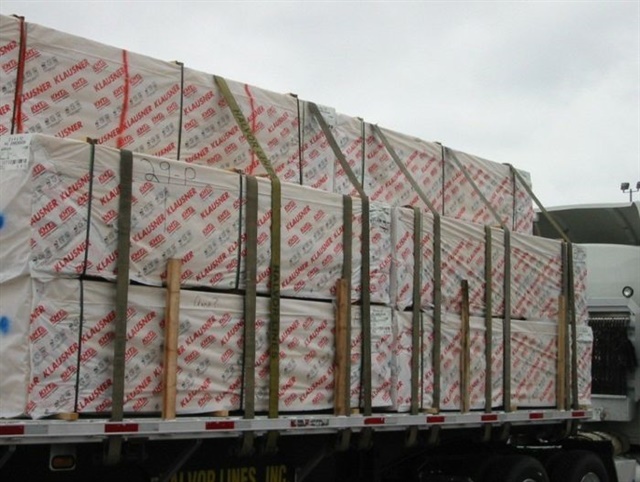
Belly strapping: The lower stack of this load was secured before the top stack was placed aboard and tied down. There are more than enough straps to satisfy safety and regulatory demands. Photos: Commercial Vehicle Safety Alliance
">Belly strapping: The lower stack of this load was secured before the top stack was placed aboard and tied down. There are more than enough straps to satisfy safety and regulatory demands. Photos: Commercial Vehicle Safety Alliance
">Securing loads is a matter of safety and good business. If a piece of cargo is damaged because it shifts or falls off a trailer, the carrier and driver won't be paid because the load didn't get delivered, and someone could get hurt or killed.
Keeping loads in place during transit is the aim of federal Part 393 regulations governing how items are to be blocked, braced or tied down on flatbeds and inside vans and refrigerated trailers – and on the tractor, for that matter. On a truck that's moving, will the load stay put during turns and sudden stops?
What do inspectors look for in safety violations? “Make sure you have enough (securement) straps for the weight of the load,” says Kevin Tomlinson, director of maintenance at South Shore Transportation, a flatbed carrier based in Sandusky, Ohio. “We do a lot of belly strapping [on the first tier of the load] and then more on top. They check loads for having enough straps, and that they're not frayed. The enforcement officers look for that kind of thing.”
Tie-down ratingsThe combined ratings of all the straps or chains must equal at least one-half the load's total weight, says Kerri Wirachowsky, newly appointed director of roadside inspection programs for the Commercial Vehicle Safety Alliance, and a 26-year veteran of enforcement work with the province of Ontario's Ministry of Transportation. If the load is 40,000 pounds, all the tie-downs together must equal at least 20,000. There are further rules for blocking dense cargo.
“In Canada, the working load limit (WLL) must be visible and readable, printed, stamped or embossed ...Read the rest of this story
Image: FMCSA
">Image: FMCSA
">A large coalition of groups representing property and passenger carriers is requesting that Secretary of Transportation Elaine Chao rescind the Carrier Safety Fitness Determination notice of proposed rulemaking issued over a year ago by the Federal Motor Carrier Safety Administration.
The NPRM, which came out on Jan 21, 2016, seeks to establish a new motor carrier safety-rating system based on scores generated by FMCSA's Compliance, Safety, Accountability program.
Making their case in a Feb 15. letter to Chao, the industry groups contend that the safety-fitness determination proposal should take a back seat to FMCSA fixing its CSA system, citing the flaws of the data that drives the current Safety Measurement System (SMS) within CSA.
Back in December 2015, FMCSA said it was proposing to adopt “revised methodologies” for determining when a motor carrier is not fit to operate based on: (1) the carrier's on-road safety performance in relation to five of the seven Behavioral Analysis and Safety Improvement Categories (BASICs) tracked by the agency's CSA program; (2) an investigation; or (3) a combination of on-road safety data and investigation information.
“The intended effect of this action is to more effectively use FMCSA data and resources to identify unfit motor carriers and to remove them from the nation's roadways,” the agency stated at the time.
The signatories to the stakeholder letter state that their major concern with the SFD proposal is that it would use a methodology built on “flawed Compliance, Safety and Accountability (CSA) program/Safety Measurement System (SMS) data and scores, which Congress directed the agency to review and reform just months earlier in the Fixing America's Surface Transportation Systems Act (FAST Act) enacted in December of 2015.”
The letter points out that those CSA reforms are “in process” via a study by the National Academy of Sciences, the final report from which ...Read the rest of this story

These five truck dealers were nominated for the annual Truck Dealer of the Year Award presented by American Truck Dealers, Heavy Duty Trucking, and Procede Software.
The award honors excellence in business practices, industry leadership, and community service. Faculty members from Indiana University's Kelley School of Business chose the winner and finalist.
Following what many dealers describe as the best year ever for truck sales, “business has definitely softened,” says Robert Nuss, president, Nuss Truck Group, Rochester, Minnesota and ATD/HDT Truck Dealer of the Year. “I have 40 plus years experience, but the reality is I have 40 one-year experiences,” he says, commenting on the fact that each year brings its own set of challenges to truck dealers as they try to meet changing customer needs.
In response to the slowdown in business, Kathryn “Katie” Hopkins, executive vice president and dealer principal, Truck Centers Inc., Troy, Illinois, and Truck Dealer of the Year finalist, says she is eliminating stock trucks at her dealerships and is focusing more on having demo trucks available for potential customers. “We have multiple demos so we can allow our customers to try a certain product, but we don't have a huge number of stock trucks on the lot anymore.”
Nominee James Carello, president and dealer principal, Regional International Corp., Henrietta, New York, describes business as OK. “While it is not devastating, there is no robustness to it. We are just plodding along. [Fleets] just aren't buying now, whether it is over utilization of equipment or the fact they can't find drivers.”
Gary Nicholas, president and CEO, Nicholas-Wyoming Valley Truck Sales Inc., Luzerne, Pennsylvania, believes the recent presidential election made buyers nervous, “but now that it is over with, we can move forward.”
While there have been challenges for Gateway Truck & Refrigeration, headquartered in Collinsville, Illinois, Zach Wagner, chief operating officer, ...Read the rest of this story