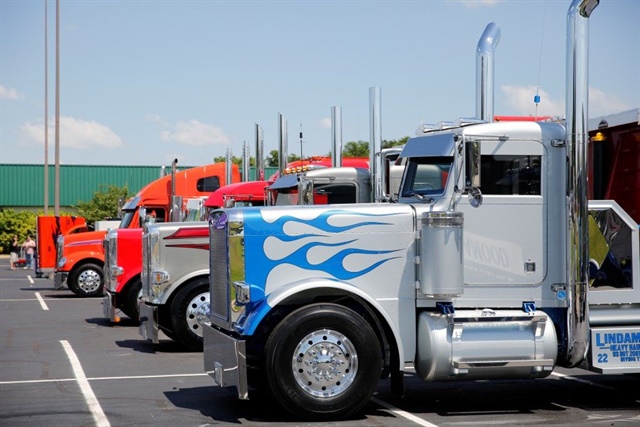
OTA to host Indo-Canada businesses at town hall


According to WardsAuto data, U.S. big-truck sales totaled 25,726 units in January, 17.9% below like-2016's 31,351. Medium- and heavy-duty truck sales in Canada also fell last month – down 3.6% compared to the previous year.
read more
...Read the rest of this storyImage: WhiteHouse.gov
">Image: WhiteHouse.gov
">A lawsuit brought by two high-profile public advocacy groups and a prominent labor seeks to block the executive order signed by President Trump on Jan. 30 that directs federal agencies to repeal two federal regulations for every new rule they issue.
The plaintiffs, Public Citizen, the Natural Resources Defense Council and the Communications Workers of America, filed their complaint with the U.S. District Court for the District of Columbia on Feb. 8 to secure a ruling that would declare the executive order cannot be lawfully implemented and bar the agencies from implementing the order.
Trump's order calls for new federal regulations to have a net cost of $0 this fiscal year, but without taking into account the value of the benefits of public protections, contend the plaintiffs.
The order on “Reducing Regulation and Controlling Regulatory Costs” was issued by Trump on January 30 and Interim Guidance on complying with it was issued by the White House's Office of Management and Budget on Feb. 2.
Named as defendants in the suit are the president, the acting director of the Office of Management and Budget and the current or acting secretaries and directors of more than a dozen executive departments and agencies, including newly confirmed Secretary of Transportation Elaine Chao.
The complaint holds that the agencies cannot lawfully comply with the president's order because doing so would violate the very statutes under which the agencies operate as well as the federal Administrative Procedure Act.
“The Executive Order exceeds President Trump's constitutional authority, violates his duty under the Take Care Clause of the Constitution, and directs federal agencies to engage in unlawful actions that will harm countless Americans, including plaintiffs' members,” states the 49-page complaint.
The plaintiffs also argue these specific points in the complaint:
“The agencies' governing statutes do not authorize agencies to repeal an existing regulation, weaken ...Read the rest of this story
Orange EV's T-Series terminal tractor looks and works just like a diesel, but its fully electric drive system produces no emissions and can save up to 90% over existing fuel and maintenance costs. Photos: Jim Park
">Orange EV's T-Series terminal tractor looks and works just like a diesel, but its fully electric drive system produces no emissions and can save up to 90% over existing fuel and maintenance costs. Photos: Jim Park
">There's no arguing with the utility of an electric terminal tractor. Gone are all the usual concerns about EV range. These trucks are almost exactly the same truck you are currently using except for the powertrain, so there's little transition anxiety. They are as capable as any diesel-powered hostler, and for the environmentally conscious, they produce zero on-site emissions.
Last summer, during Bobit Business Media's Fleet Technology Expo, we had a chance to try one of Orange EV's all-electric T-Series on-road terminal tractors. I don't have a ton of experience driving these trucks, so I wasn't able to make a direct comparison to the diesel versions, but it was pretty cool.
As it was explained to me, the basic operating controls for the hydraulic lift are the same as a diesel, as is the forward and reverse selector – at least from the operator's perspective.
An electric motor drives the hydraulic pump for the lifter and there's even a boost option to speed up the lift (formerly accomplished by revving the engine), which draws some hydraulic flow from the power steering. But since you're usually stopped when lifting, you're not giving up anything.
The air compressor for the brake system is electrically driven, and all the usual vehicle systems, such as lighting, wipers, defrosters, mirror controls, and in-cab displays monitors, radios, etc., use a step-down transformer to get the 12 volts they need.
The forward and reverse selector looks the same as the diesel version, but with the T-Series, the controller simply switches the flow of current through the motors so they turn forward or backward. There's no transmission to deal ...Read the rest of this story
Photo: Daimler Trucks North America
">Photo: Daimler Trucks North America
">Daimler Trucks North America announced that its new corporate headquarters building in Portland, Ore., has been awarded the Platinum Leadership in Energy and Environmental Design certification.
The LEED Platinum certification is the highest rating that a building can receive from the U.S. Green Building Council, a nonprofit that promotes sustainable building design, construction, and operation.
“Achieving LEED certification is more than implementing sustainable practices. It represents a commitment to making the world a better place and influencing others to do better,” said Mahesh Ramanujam, president and CEO, USGBC. "Given the extraordinary importance of climate protection and the central role of the building industry in that effort, Daimler Trucks North America demonstrates their leadership through their LEED Platinum certification of their Portland headquarters.”
To achieve a Platinum certification, DTNA focused on making certain aspects of the design and construction of the building as green as possible. The company said that during the building's construction, 95% of the demolition and construction waste was recycled from the project site.
Steps were also taken to reduce the headquarters' energy consumption through features such as LED lighting, an intelligently controlled radiant HVAC system, and onsite renewable energy.
The building also features a living green wall that was installed in the lobby to bring in the natural air cleaning benefits of vegetation absorbing CO2 and a green roof for storm water management.
“As a leader in the industry with a reputation for high standards in engineering and sustainable practices, we felt it was important to have our headquarters campus reflect those values,” said Martin Daum, president and CEO of Daimler Trucks North America. “As one of Portland's largest employers, we will now have a state-of-the-art work environment to inspire the great talent in our organization and to continue contributing to long-term prosperity in Portland.”
Related: Daimler Trucks ...Read the rest of this story
Photo: Workhorse
">Photo: Workhorse
">Workhorse Group has announced that its medium-duty electric trucks are up to six times more efficient than comparable gas- or diesel-powered models.
Using metrics from the companies Metron telematics system to track the first 250,000 miles driven by the vehicles, Workhorse calculated that its electric delivery truck models are achieving over 30 miles per gallon equivalent during normal use.
Mile-per-gallon equivalent is a measure of energy consumption and not fuel costs. It is calculated using the equivalent energy in a gallon of gasoline or diesel fuel converted into kilowatt-hours and comparing that to an electric motor producing the same amount of energy.
The U.S. Environmental Protection agency has established the standards for "MPGe" y pegging the energy content of a gallon of gasoline at around 34 kilowatt-hours. For diesel fuel, the energy content of a gallon is closer to 38 kilowatt-hours.
For Workhorse's comparison, the company said that a comparable delivery truck typically achieves 5-8 miles per gallon, or 5-8 miles per 34 kilowatt-hours of energy while its electric delivery vehicles can travel more than 30 miles on that same amount of energy.
"By achieving 30 MPGe with over 125 medium-duty trucks on the road, Workhorse is setting a new standard with our electric delivery vehicles," said Steve Burns, Workhorse CEO. "Medium-duty local delivery trucks are the backbone of the last-mile delivery system and a sixfold fuel economy increase as well as reduced maintenance and zero or near zero emissions are a major change to the conventional delivery system."
It is important to note that while MPGe is a good metric for determining vehicle efficiency, it does not translate directly to vehicle costs because a gallon of gasoline does not necessarily cost the same as 34 kilowatt-hours of electrical charge.
Workhorse's Metron telematics system allows fleet managers to monitor and manage the performance of fleet vehicles ...Read the rest of this story