Daimler HQ recognized for green design


he ELD Mandate affecting millions of commercial drivers will be enforced beginning this December, 2017. If you are currently required to complete a Record of Duty Status (ROD), either occasionally or daily, then it's likely the ELD Mandate will affect you. So, what should you do? This whitepaper from Telogis will help you to navigate this ELD mandate in an effective way.
read more
...Read the rest of this storyDeborah Lockridge
" >Deborah Lockridge
" width="185" height="244">You can't maintain and repair your trucks without tools. But the tools available to you today go far beyond wrenches and multimeters, even beyond portable diagnostics tools or computer tablets.
The most powerful tools you may not be fully taking advantage of in the shop involve information.
Of course, you're holding one basic information tool in your hands. HDT has been bringing you the latest maintenance trends and practices, and basic how-to refreshers, for more than 90 years.
Last year, one of the things we told you about was using Lean and other waste-reduction systems in the shop. You don't even have to officially use Lean tools, but the ability to analyze your shop processes and make it easier and faster for your techs to do their jobs is a powerful tool.
That's just one way to use information as a tool. More data is available to the trucking industry today than ever before in its history. An amazing amount of information flows from the truck itself, much of it available at your fingertips via telematics even though the truck may be hundreds of miles away, from engine fault codes to the pressure in the tires.
In this issue's story on uptime, Randy McGregor tells about how he looked for patterns in the data to determine patterns in emissions system failures, allowing him to get ahead of potential problems before they resulted in downtime.
But it's easy to feel like you're over your head in a sea of data. One tool that can help is standardized Vehicle Maintenance Reporting Standards (VMRS) — a system that uses numbers to describe parts and maintenance activities. This series of codes is used to describe virtually every facet of the maintenance operation, from parts to manufacturers to technician work to vehicle location. Although it was unveiled in ...Read the rest of this story

In 1995, Jeff Bezos launched a website to sell books. He billed it as “Earth's biggest bookstore,” and went through ideas for names including “Cadabra” and “Relentless.” Eventually, he named it after the largest river in the world.
It turned out to be an apt name. Amazon unleashed an ever-growing, inexorable river of e-commerce. The impact of that flow on transportation and logistics goes far beyond Amazon, and far beyond the delivery drivers who were pounding up your home's front stairs at 11 p.m. the week before Christmas.
The U.S. Commerce Department didn't have holiday sales figures at press time, but it reports that for the third quarter of last year, U.S. retail e-commerce sales were $101.3 billion, up 15.7% from the third quarter of 2015. (That's adjusted for seasonal variation, but not for price changes.)
In contrast, total retail sales for the third quarter were up only 2.2% year over year.
And it's not just consumer goods like clothing and electronics. For instance, Darryl Barber, automotive segment marketing manager for UPS, says e-commerce is changing the way auto parts distributors do business.
“Consumers who are buying a part are as likely to go online and order it as drive to a local store,” he says. “The aftermarket manufacturers we deal with [report] aftermarket business is up 3.5 to 4% year over year, but it's up 16 to 20% for the e-commerce channel.”
For UPS, that means parts previously moving in palletized shipments to a warehouse or distribution center are now going out in more frequent, smaller shipments, Barber says. “A lot of times they end up in the package cars on the street — the same guys that deliver your Christmas presents.”
Much of the most direct impact of e-commerce is on package carriers such as UPS and FedEx. UPS, for instance, projects that business-to-consumer parcels ...Read the rest of this story
Source: EIA
" >Source: EIA
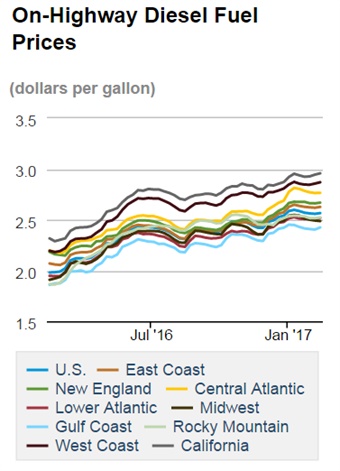
" width="250" height="346">Diesel prices increased for the first time in nearly a month but have overall remained nearly flat during the same period of time, according to the latest numbers from the Energy Department.
The average price of on-highway diesel fuel fell by 0.7 cents last week, settling at $2.565 per gallon at the pump. After peaking at nearly $2.59 per gallon in early January, the price has hovered around $2.56 per gallon for the past month. Compared to the same week in 2016, the price of diesel fuel is now 58.5 cents more expensive per gallon.
The largest increase in prices hit the Gulf Coast region, where prices jumped by 2.1 cents last week. While most regions saw price increases, diesel prices fell in the Midwest by 0.5 cents.
The average price of regular gasoline was also up last week, increasing 1.4 cents per gallon at the pump. The price is now 58.3 cents more expensive per gallon than it was in the same week a year ago.
Price changes varied by region with the largest increase in prices hitting the West Coast at 3.2 cents per gallon. The largest price decrease occurred in the Lower Atlantic region with a 1.1-cent drop for the week.
Crude oil prices were down again on Feb. 13 over the prospect of increased U.S. oil production, according to a MarketWatch Report.
The major OPEC global oil producers have so far complied with an agreement to freeze and reduce oil production to stabilize the market. However, increased oil production in the U.S. has offset the expected price increases.
Related: Diesel Prices Fall, But Just Barely
Follow @HDTrucking on Twitter
...Read the rest of this story