Category: Trucking News

Peterbilt 520, 320 eligible for hybrid, zero-emission voucher

The Peterbilt Models 520 and 320 equipped with the Cummins ISL-G Near Zero engine have been granted eligibility for the California Air Resources Board (CARB) Hybrid and Zero-Emission Truck and Bus Voucher Incentive Project (HVIP). HVIP encourages the commercialization of low-emitting hybrid and zero-emissions trucks by assisting fleets with purchase of these advanced technology vehicles.

read more

...Read the rest of this story

Ford Offers CK-4 Alternative Oil for Super Duty Diesels

<img width="150" src="http://www.automotive-fleet.com/fc_images/news/m-ford-sd-motorcraft-oil-1.jpg" border="0" alt="

Screenshot via Ford.

">

Screenshot via Ford.

">

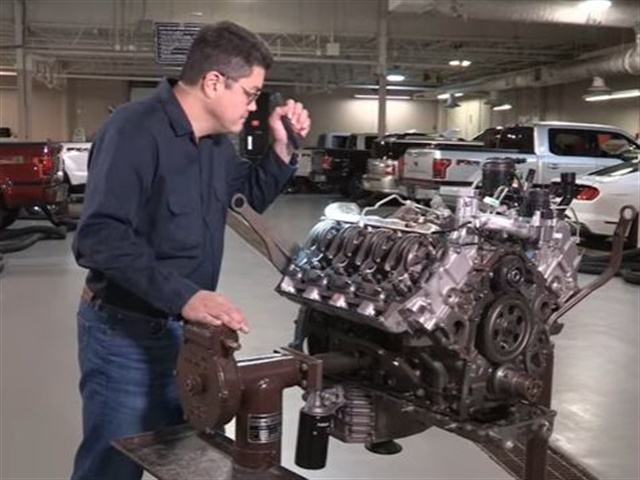
Ford is recommending the use of Motorcraft-branded diesel engine oil for its Super Duty trucks and warning fleet and commercial customers to avoid using new CK-4 or FA-4 oils because they may cause damage to the engine, the company told AutomotiveFleet.com.

Motocraft's WSS-M2C171-F1 formulation should be used in all Power Stroke diesels, especially the 6.7L that powers the F-250, F-350, and F-450, because it better protects the engine against high-mileage wear, according to the company. Ford had previously recommended CJ-4 formulations for its Super Duty trucks. On Dec. 1, the American Petroleum Institute began licensing the new CK-4 and FA-4 oils. CJ-4 oils will eventually be phased out.

Commercial users should avoid the FA-4 formulation due to its low viscosity. CK-4 motor oils should be avoided because they provide "inadequate wear protection," according to a statement.

The oil certification information is located on the back of an oil pouch in a circle known as the API donut.

Customers shouldn't use oils labeled CK-4/SN unless they have been approved by Ford to meet WSS-M2C171-F1. This is possible with SAE 10W-40, 15W-40, 5W-40 and 0W-40 oils. SAE 10W-30 oils showing CK-4/SN cannot meet WSS-M2C171-F1.

Motorcraft Super Duty diesel motor oil is formulated with premium hydroprocessed base oils and additive technology necessary to meet WSS-M2C171-F1. This new oil also meets the requirements of Cummins CES20086, Detroit Diesel 93K222, Volvo VDS-4.5 and Mack EOS-4.5, according to Ford.

View a video from Ford here:

Related Photos: Ford's 2017 F-250

Follow @HDTrucking on Twitter

...Read the rest of this story

Commentary: See the Light…and Everything Else

<img width="150" src="http://www.automotive-fleet.com/fc_images/articles/m-rolf-lockwood-16-1.jpg" border="0" alt="

Rolf Lockwood

" >

Rolf Lockwood

" width="185" height="244">

I've long held that North American headlight standards are inherently dangerous because they don't allow brightness levels to match the speeds we travel. It's just too easy to “over-drive” your lights, meaning you can't see as far ahead as it will take you to stop. You just don't see obstructions until it's too late.

Until a decade or two ago, my own first step upon getting a new car was to make lighting upgrades, but modern cars – and most trucks – make that very difficult and/or expensive. There's nowhere to find a solid mount for driving lamps when “bumpers” are plastic, for example, but long-range driving lamps are essential for me. Nowadays I'm outta luck.

Headlamp bulb changes are easier, and I usually go the H4 halogen route. I have yet to try the LED option, but I recently asked for comment on it and several folks chimed in.

“Poor headlights have been a sore point for me for all of the 37 years I have been in this industry as a fleet manager,” one fellow told me. “Unbelievable how you buy new trucks and the headlights do not give adequate lighting.

“About 15 years ago I discovered all the common lights in semis can be upgraded from the standard halogen to ‘high-output' halogen for about $5 per light. They made a huge difference.

“In the last two years I've purchased 15 Navistar trucks with LED headlights. Wow! Every driver had positive comments. Less fatigue and less eye strain. The lights are brighter and there's much more side visibility. I'm also testing LED replacement lights on my older units.

“The bad news is it now costs about $500-600 a truck for the sealed beams. I think this cost will go down as demand increases. The only negative on LED lights is that ...Read the rest of this story

Diesel Prices Fall; U.S. Crude Production Slipped in 2016

<img width="150" src="http://www.automotive-fleet.com/fc_images/news/m-diesel-prices-m20-1.jpg" border="0" alt="

Source: EIA

" >

Source: EIA

" width="250" height="343">

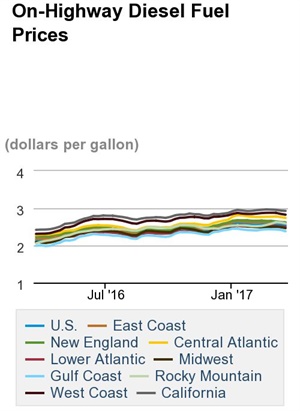
The price of diesel fuel continued to slide last week, as the latest numbers from the Energy Department show a two-week trend of falling fuel prices.

The average price of on-highway diesel fuel fell by 2.5 cents last week, falling to $2.539 per gallon at the pump. The price is now 42 cents more expensive on average than it was in same week of 2016.

Prices were down in all regions of the country with the largest decrease coming to the Gulf Coast, dropping 3.9 cents. The smallest decline was found in New England where prices were down only 0.6 cents for the week.

The average price of regular gasoline was also down last week, though only by 0.2 cents per gallon with the price hovering around $2.32. The price is now 31.4 cents higher than it was in the same week a year ago.

Prices varied up and down by region, with the largest drop occurring in the Lower Atlantic at 0.8 cents per gallon. The largest increase in prices was a similarly small 0.4 cents per gallon in the Midwest.

Meanwhile, the Energy Department released its analysis of U.S. crude oil production in 2016, which showed that it decreased for the year overall. Despite the decline, U.S. crude production began to rise in the last few months of 2016 and total production for the year was still above the five-year average.

Crude prices increased from a low of around $31 per barrel to $52 per barrel, which was the largest annual increase in prices since 2009. An agreement by OPEC countries to cut production and increase prices had the intended effect on the crude oil market at the end of the year, but it has since remained flat in 2017, largely thansk to increased U.S. oil production.

Related: Trucking Engineers ...Read the rest of this story

Spec’ing for Resale

Used truck prices are down. Way down. According to J.D. Power and Associates, last year the retail value of used trucks was 13% lower than in 2015. Trucks sold at auction fared even worse. Predictions are for the supply of used trucks to stay high, which translates into lower prices for this year as well.

While there is not much you can do about the supply of used trucks, the way you spec your vehicles on the front end can have an impact on their value — either positive or negative — at resale time.

Dale Tower, vice president of remarketing for AmeriQuest Used Truck Services, says the market and equipment have become more specialized in recent years. “Fleets are buying for their specific needs and the value that provides on the front side. The assumption is they will still be able to get out of the trucks when they have served their useful life.”

He adds, “Some fleets are being surprised quite a bit as the used truck market has done a 180 in the past one to two years, and is now a solid buyers' market.”

We talked to industry experts to get their input on the role certain specs play in the resale value of a truck.

Downsized engines

While some fleets have been spec'ing smaller engines on new trucks to save weight and cost, Chris Visser, senior analyst and product manager, commercial vehicles, NADA Used Truck Guide, a division of J.D. Power, says there is still a preference for big-bore engines in the highway segment.

Claude Ricciardi, director of purchasing at New York-based Transervice Logistics, agrees that smaller engines, those 13L and under, “have a definite negative effect on resale.” Visser explains that “for those OEMs with 15L and 13L engines, we see a roughly $3,000 deduction for the smaller engine in a ...Read the rest of this story