Author: Vitaliy Dadalyan

Verizon-Fleetmatics Deal Makes Telematics Giant

<img width="150" src="http://www.automotive-fleet.com/fc_images/news/m-fleetmatics-verizon-logos-1.jpg" border="0" alt="

Logos via Verizon and Fleetmatics.

">

Logos via Verizon and Fleetmatics.

">

Verizon will control about 25% of the telematics market following its planned acquisitions of Fleetmatics and Telogis in moves that indicate steady growth ahead for fleet telematics use, experts told AutomotiveFleet.com.

The deals will bring about 1.4 million units in service under Verizon's telematics unit and create a telematics provider with the potential to dominate the market, said Clem Driscoll, who produces an annual market study. The units would be shifted to operate on Verizon's cellular network.

"Fleetmatics is the largest fleet tracking company in the world, and this is the largest acquisition in the history of this industry," said Driscoll, who's been watching the industry for two decades. "It's the largest in terms of money and subscribers."

Verizon should be able to complete its acquisitions, even in a challenging regulatory environment. Anti-trust concerns should be allayed because there are still several hundred telematics vendors in the U.S., Driscoll said.

After the dust settles, Geotab and GPS Insight would be Verizon's largest competitors. In addition to software, Geotab offers its GO7 OBDII dongle. Omnitracs and PeopleNet would continue to be the primary telematics providers to over-the-road trucking fleets.

If Verizon successfully closes the acquisitions of Telogis and Fleetmatics, it may need to consolidate the three software-as-a-service platforms. All three companies provide hardware from a third-party vendor and would likely continue to do so, Driscoll said.

Verizon's acquisitions should create greater awareness about the value of telematics data to fleets and help fleet managers further combat misuse of company assets, said Dillon Blake, senior director of business development at Runzheimer, a reimbursement management firm.

"The issues most fleet companies face now is there are a lot of data, and what do you do with that data," Blake said. "Verizon has a good solution to provide some deep business intelligence in an easily digestible form."

Related: Verizon to Acquire Fleetmatics

Follow @HDTrucking on Twitter

ZF Takes Stake in Autonomous Tech Firm

<img width="150" src="http://www.automotive-fleet.com/fc_images/news/m-zf-innovation-truck-steering-wheel-1.jpg" border="0" alt="

Per ZF, its Innovation Truck prototype was developed to “identify product ideas through technology transfer” from passenger cars to commercial vehicles. Photo: ZF

">

Per ZF, its Innovation Truck prototype was developed to “identify product ideas through technology transfer” from passenger cars to commercial vehicles. Photo: ZF

">

Friedrichshafen, Germany-based ZF has announced it has acquired a 40% minority stake in Ibeo Automotive Systems GmbH. The Hamburg-based company is a market leader in lidar (light detection and ranging) technology.

ZF pointed out that lidar is a key technology for autonomous driving, object recognition and accident prevention systems. Ibeo develops 3-D “environmental recognition” software with a particular focus on applications for autonomous driving. Its customers include several major global vehicle manufacturers.

"Lidar gives us access to a core technology for environmental and object recognition," said ZF CEO Stefan Sommer. “Lidar expands our current sensor portfolio of radar and camera technologies, and moreover, Ibeo's fusion of these three sensor technologies provides outstanding results in environmental awareness and forms the basis for autonomous driving."

Lidar involves emitting a “light pulse” to determine a distance based on runtime and speed of light. An optical method for measuring distance and speed, lidar is similar to radar, except that laser pulses are used instead of radio waves.

ZF said the lidar generation developed by Ibeo in cooperation with ZF will reproduce a 3-D image of a vehicle's surroundings without the rotating mirrors used in current lidar systems. And by using solid state technology, lidar will become more compact and easier to integrate into the vehicle.

"Our central theme at ZF is ‘See– Think– Act'– a philosophy which highlights how we are equipping the vehicles of tomorrow with new senses and more intelligence,” said Sommer. “To achieve this, we are gradually filling in the remaining gaps in our technology portfolio.

He added that leveraging lidar technology and sensor fusion will “strengthen the eyes and brain of future generations of vehicles and thus move a step closer to realizing the vision of accident-free driving."

Founded in 2009, Ibeo dates back to 1998. Given the fast-growing market for sensor systems and environmental recognition, the company said it expects to increase its workforce from around 50 to 250 employees in the medium term and it will establish an Autonomous Driving Competence Center. The center will focus on volume production and marketing of solutions for highly automated and autonomous driving.

"We are very much looking forward to cooperating with ZF,” said Ibeo CEO Ulrich Lages. “We now have a very strong partner that is progressively shaping the megatrends of safety, efficiency and autonomous driving. With our comprehensive know-how, we can enable all drive-assistance applications up to highly automated driving with 3-D lidar technology."

Related: Wabco, ZF Unveil Advanced Braking and Steering Technology

Follow @HDTrucking on Twitter

Diesel and gasoline prices keep declining

EIA also expects gasoline prices to keep falling due to rising production and inventories.

National average retail pump prices for both diesel and gasoline continued falling this week, according to data tracked by the Energy Information Administration (EIA), mirroring price declines for both fuels on a regional basis across the U.S.

Diesel dropped 3.1 cents to a national average of $2.348 per gallon, the agency said, which is 32 cents per gallon cheaper compared to the same week in 2015.

read more

Denso partners with AVI OnDemand

AVI OnDemand will live-stream Denso's course on how to diagnose and understand Duramax Fuel System problems

Denso Products and Services Americas announces its first live online technical training seminar in partnership with Automotive Video Innovations (AVI). AVI OnDemand will live-stream Denso's course on how to diagnose and understand Duramax Fuel System problems Sept. 8 at 4 p.m. EST.

read more

Penray’s crankcase, differential cleaner removes sludge

No one doubts the importance of regular oil and filter changes, regardless of the type of vehicle they may own or service. And more knowledgeable folks also understand the importance of regular changes of the lubricant in other driveline components like the differential. But even regular changes of lubricants and filters cannot remove deposits of sludge, gum, varnish and other contaminants that build up over time.

read more

Annual Ryder Technician Championship

The now 15-year old Ryder Top Technician Recognition Program, designed to identify, recognize, and reward Ryder's top performing truck maintenance technicians, held its annual competition at the Gaylord National Resort & Convention Center outside of Washington, D.C., last week. Eight finalists competed at the Washington D.C. event, which consisted of 10 hands-on skill tests that included vehicle electronics, preventive maintenance, and air conditioning – with a $50,000 winning purse and other prizes on the line. (All photos courtesy of Ryder)

A Different Approach to Fuel Efficiency Coaching

<img width="150" src="http://www.automotive-fleet.com/fc_images/articles/m-vnomics-1.jpg" border="0" alt="

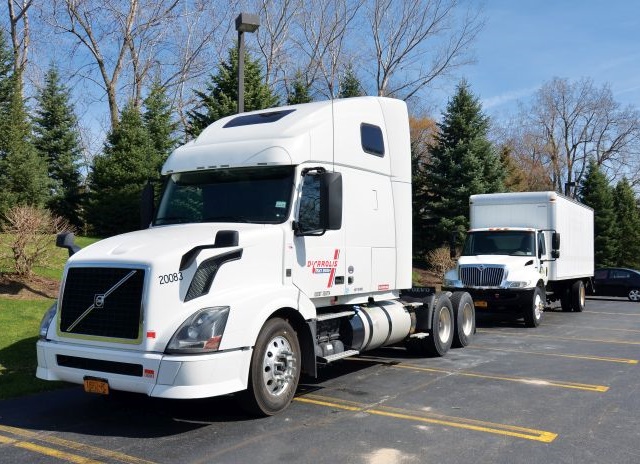
Our test truck was a rented 2013 Volvo VNL. Vnomic's development test truck is in the background. Photo: Jim Park

">

Our test truck was a rented 2013 Volvo VNL. Vnomic's development test truck is in the background. Photo: Jim Park

">

Since you can't physically sit beside your drivers all day coaching their driving habits and performance, some sort of monitoring tool can be useful. However, if drivers see such devices as annoying or impeding their ability to drive, they won't happily accept the intrusion. A technology company in Pittsford, N.Y., has found a happy medium: a monitoring device that encourages drivers to do better without getting on their nerves or taking away drivability, while providing back-office data that helps fleets coach and instruct drivers on better driving habits to save fuel.

I recently paid a visit to Vnomics and saw how its engineers and developers had adopted the True Fuel technology from a military application. I also spent several hours in a test truck proving the system's ability to coax — rather than coerce — me into the green zone.

It's a simple system on the surface, with a huge amount of functionality built in.

The in-truck hardware consists of a reader that plugs into the truck's data port with a Y-cable (to keep the connection free for other applications such as electronic logs), and collects data on vehicle speed, power demand and engine operation. Each device is matched to the components on that particular truck. It reads sensor data from the ECU and sends it to the terminal in bursts via a cellular connection. There's no display to distract the driver; a tone is used to alert him or her to behavior that is problematic. The box is about the size of a paperback novel and it can be installed on or under the dash in less than 15 minutes.

I'll skip over the intricacies of the back-office software. Managers see only a very straightforward interface that shows driver performance and historical trends as well as current and previous trip data. In addition to evaluating driver performance. True Fuel can compare truck performance and fuel consumption information and identify underperforming or improperly spec'd trucks.

Much of what makes this work so well is how Vnomics interprets and displays the data. Embedded in the system architecture are the engine's fuel maps as well as the specs and ratings to aid in interpreting the data. Layered over that are driver and environmental information that the system uses to determine if the engine is being operated as efficiently as possible. For example, the system knows if the truck is 400 or 450 hp, whether it's empty or loaded, on flat ground or on a hill. That's all significant, as the driving technique might be different in each case.

It doesn't use fuel consumed as a driver-rating parameter, but rather potential fuel economy: Given where you are operating on the fuel map, how close did you come to using the least amount of fuel needed to generate the required power for operation? This immediately deflates any arguments about driver fuel economy rankings being unfair because they are subject to external influences. It's really about whether or not the driver is operating the truck correctly.

Ben Stevens, Vnomics' sales engineer, explains it this way. If one driver is getting 7.2 mpg out of an algorithm-determined potential of 7.5, he's within 4% of the target, which isn't bad. However, another driver might be getting 6.1 mpg out of a potential 6.2.

In testing Vnomics True Fuel, I made two runs over the same course, mostly stop-and-go driving with a little freeway time. We were bobtailing in a leased tractor with a manual transmission (the system works equally well on automated and automatic transmissions, too). I don't think the fact that we were bobtail matters, because again, the system was watching performance, not fuel consumed.

For the first run I put my bad driver hat on and deliberately drove as poorly as I could — hard braking, idling too much, taking gear changes to wildly high rpm, running in the wrong gear, etc. It was so against my nature to drive like this that I really had to work at it.

My score was a 46 out of a possible 100. I thought it would be much worse given how badly I was behaving. Stevens told me he has seen drivers with scores in the low 20s. I can't even imagine how badly you have to screw up to earn a score like that.

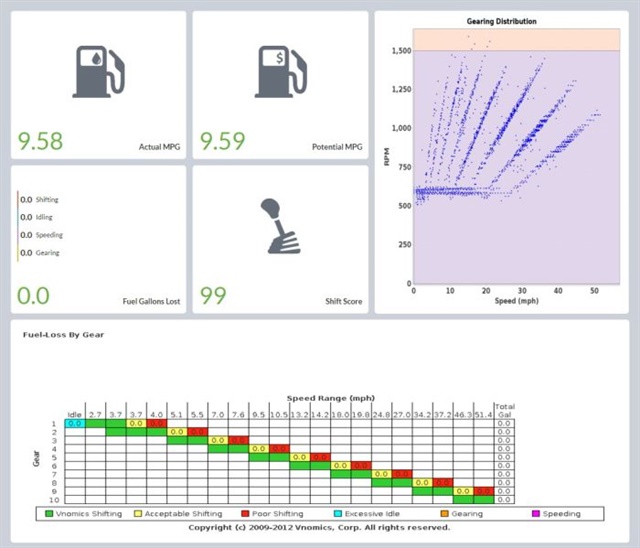
Run 2 was the Good Jim run. I diligently tried to keep the revs down, accelerate gently, minimize idling, skip gears, etc. I did pretty well, causing the alert to sound only three times for a score of 99.

Incidentally, each of the three times I messed up and over-revved a gear, I was talking to Ben. This was a real an eye-opener for me. The conversation distracted me from concentrating on my shifting. I can certainly drive properly when I'm thinking about it, but I could never maintain that level of concentration all day long.

And that may be the real benefit to True Fuel. A good, diligent driver gets a gentle alert from a not-unpleasant-sounding beep to remind him or her that they are slipping. That's a lot easier to take than finding out at the end of the month that you blew your fuel bonus.

VIDEO: Vnomics Test Drive Pt. 1- Bad Driver, Vnomics Test Drive Pt. 2 - Good Driver
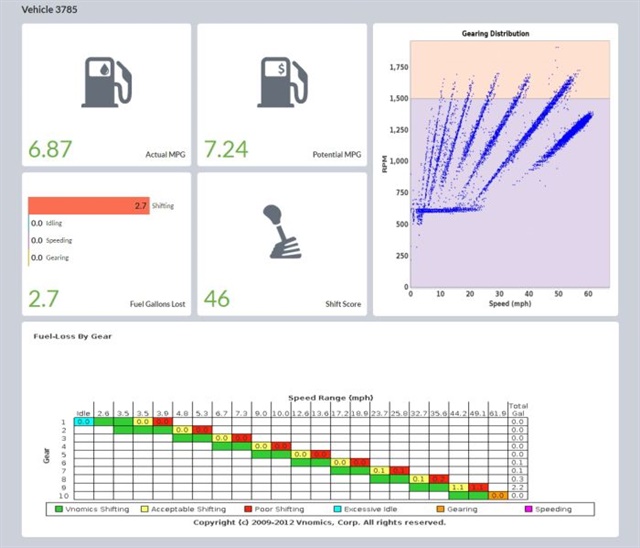
pstrongThe blue lines are a series of dots indicating my shift points. Also shown are actual and potential mpg as well as gallons wasted and my shift score. It's an easy-to-read representation of how well I was driving. The score is based on how close I came to my potential best fuel economy, not the actual mpg./strong Source: Vnomics/p

Follow @HDTrucking on Twitter