Author: Vitaliy Dadalyan

OOIDA Fires Back on ELD Rule Ahead of September Court Hearing

<img width="150" src="http://www.automotive-fleet.com/fc_images/news/m-omnitracs-eld.jpg" border="0" alt="

Photo: Omnitracs

" >

Photo: Omnitracs

" width="300">

The Owner-Operator Independent Drivers Association has filed a reply brief to the government's arguments defending its controversial electronic logging mandate in the association's lawsuit, scheduled to be heard by a federal court next month.

OOIDA is seeking an injunction to halt the implementation of the rule.

Friday, Aug. 12, OOIDA filed a reply brief in the suit, originally filed last December only a day after the final rule was published by the Federal Motor Carrier Safety Administration. The reply brief is a legal precursor to oral arguments on Sept. 13.OOIDA's case hinges on five arguments:

  • The devices as mandated are unable to do the job as prescribed.
  • The rule offers no protection against harassment of drivers.
  • The benefits of the rule do not outweigh the costs
  • They erode drivers' Fourth Amendment protections against unreasonable searches and seizures
  • Driver privacy is not protected
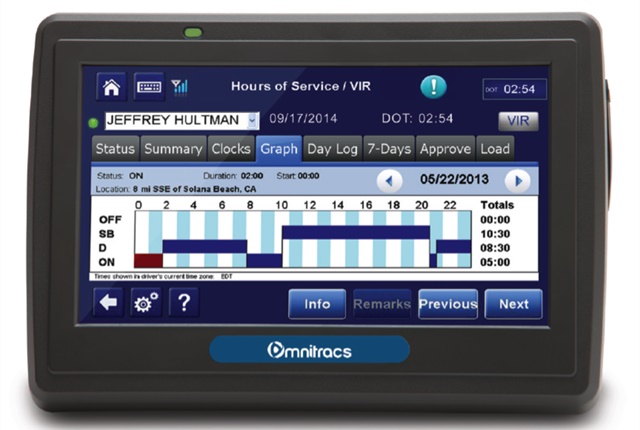
  • The ELD mandate affects an estimated 3 million interstate drivers of vehicles manufactured after model year 2000. By December 2017, drivers will have to replace paper logbooks with electronic devices.

    The association previously challenged a similar mandate in August 2011 and the court ruled in favor of OOIDA's arguments that the previous rule did not protect drivers against harassment. FMCSA went back to the drawing board to rewrite the rule in a way that would address the court's concerns.

    With this track record of derailing mandatory e-logs once before, the association is confident it can do it again.

    In June, FMCSA forcefully defended the ELD rule in a brief that it was required to submit to the U.S. Court of Appeals for the Seventh Circuit. In that brief, FMCSA argued that the ELD rule is constitutional as it does not violate the Fourth Amendment prohibition of unreasonable searches; that the mandate does not impinge on drivers' rights to privacy, and that its cost-benefit analysis “amply supports” the rulemaking.

    The reply brief filed by OOIDA Friday is in response to FMCSA's brief. According to an article on the website of association magazine Land Line, the brief counters the agency's arguments thus:

    1. Do ELDs do what they're supposed to do? In the Moving Ahead for Progress in the 21st Century (MAP-21) highway bill, Congress directed FMCSA to “prescribe regulations … requiring that a commercial motor vehicle … be equipped with an electronic logging device … capable of recording a driver's hours of service and duty status accurately and automatically.”

    However, OOIDA says ELDs as mandated don't do this, because they can't automatically track non-driving on-duty time.

    2. Does the law protect against driver harassment? This is the key issue that OOIDA used to prevail in its 2011 lawsuit, and the association says the agency still has not addressed this issue satisfactorily, despite an express prohibition on driver harassment, with civil penalties for violations and a procedure for drivers to file written complaints of harassment by a carrier.

    “FMCSA takes the position that it is not required to address all instances of harassment, but only those related to HOS violations, and then only harassment perpetrated by motor carriers,” the OOIDA brief states.

    3. Do they save more than they cost? OOIDA's suit claims FMCSA has no proof that ELDs improve hours of service compliance or reduce crashes. In its June brief, FMCSA pointed out that “as an initial matter,” it was “not statutorily required to do a cost-benefit analysis at all, so any objection to that analysis provides no basis to vacate the rule.” Nevertheless, FMCSA said its own analysis, using data from motor carriers already using electronic logs, fully supports the rule. OOIDA's reply brief disagrees, saying “FMCSA has provided no valid evidentiary support for its conclusion that ELDs will reduce HOS violations or crash risk.”

    The association says FMCSA has not studied the effectiveness of the devices, and ignored a 2014 study that found no differences between trucks using electronic logs and trucks not using them in recordable and fatigue-related crash rates.

    4. Does an ELD constitute unreasonable search? FMCSA in its June brief flatly declared that “ELDs do not violate the Fourth Amendment. ELDs are neither a ‘search' nor a ‘seizure' under the Fourth Amendment. ELDs are not surreptitiously attached to a vehicle by the government, but are installed by a motor carrier openly and pursuant to regulation with the advanced knowledge of the carrier and driver, who effectively consent to their installation and use by voluntarily participating the commercial motor carrier industry.”

    OOIDA's reply brief points to a 2012 Supreme Court ruling against law enforcement agencies placing GPS or other tracking devices on private citizens' vehicles without a warrant. OOIDA dismissed FMCSA's argument that trucking is a “pervasively regulated” industry and that drivers are giving their consent to search merely by agreeing to participate in the industry.

    5. Do they violate driver privacy? FMCSA in its brief said the rule “takes appropriate measures to preserve the confidentiality of personal data contained in ELDs, relying in part on existing regulations and federal law protecting the release of private information, as well as committing the agency to redact private information from the administrative record in an enforcement action, and further requiring motor carriers to protect private data consistent with sound business practices and requiring ELDs have secure access to data and use encryption methods while transferring data.”

    FMCSA said the OOIDA brief “contains only vague assertions that the agency should have done more, without specifying exactly what additional procedures they desire or explaining why the provisions adopted are not ‘appropriate measures' as Congress required.”

    In its reply, OOIDA said the agency is misrepresenting what Congress required.“FMCSA's truncation of the statutory language conveniently omits reference to the words ‘shall institute appropriate measures' and gratuitously represents that ‘Congress required the FMCSA to consider ‘appropriate measures.'”

    The OOIDA brief goes on to detail ways data can be used to harass drivers, in unrelated criminal investigations for example.

    Related from the archives: OOIDA Refutes Recent Electronic Logging Device Study (2014)

    Follow @HDTrucking on Twitter

    The OEMs have stepped up

    While the truck makers are keeping their some of their plans quiet about the technologies they plan to deploy to meet the anticipated Greenhouse Gas Phase 2 emissions standards, they are not just sitting idly by.

    In a review of new Class 8 model trucks in the recent issue of Fleet Owner, the OEMs shared some changes they are making NOW to make their trucks more fuel efficient.

    If you have not read the article here is brief recap of some of the changes coming for 2017 models:

    read more

    Vnomics awarded National Science Foundation Grant

    Funds, data to support research at the University of Rochester on using machine learning to improve fuel efficiency

    Vnomics Corp., providers of True Fuel, announced it is providing matching funds, data and expertise to support research at the University of Rochester into the use of machine learning to improve the fuel efficiency of commercial vehicles. The company said its support is part of a grant awarded by the National Science Foundation for its Young Innovators Internship Program.

    read more

    A fire truck takes flght

    Loadmasters with the 439th Airlift Wing, Air Force Reserve Command, load a 1982 Mack 1250 GPM pumper fire truck into the belly of a C-5B Galaxy cargo plane at Joint Base McGuire-Dix-Lakehurst NJ for a 3,700 mile journey to Managua, Nicaragua. Retired from the Mercer Engine No. 3 firefighting company of Princeton, NJ, this fire truck is being donated to a group of volunteer firefighters in Managua. (All photos courtesy of the U.S. Department of Defense)

    Kenworth sees 2017 U.S. truck market continuing at 2016 levels

    Company holds steady with product development plans, reports strong adoption rates for Paccar MX-13/11 engines

    KIRKLAND, WA. Characterizing the 2016 economic climate as “a good year overall though off slightly from last year,” Kenworth Truck general manager Mike Dozier nevertheless sees U.S. retail Class 8 sales falling off from an initial forecast set a range of 260,000 to 280,00. Given softer than expected sales in the first half, that forecast is now down in the range of 235,000 to 240,000, he said during a press conference at company headquarters.

    read more

    Kenworth Prepares to Launch Fuel-Economy Spec’ed Day Cab T680

    <img width="150" src="http://www.automotive-fleet.com/fc_images/news/m-kenworth-t680-advantage-day-cab.jpg" border="0" alt="

    Kenworth now offers the fuel-efficient Kenworth T680 Advantage Day Cab for pickup and delivery and regional haul operators.

    ">

    Kenworth now offers the fuel-efficient Kenworth T680 Advantage Day Cab for pickup and delivery and regional haul operators.

    ">

    BELLEVUE, WASH -- Kenworth will extend its T680 fuel economy Advantage package into vocational applications soon with the launch of two new, T680 Advantage Day Cab models, but will cut production of the T660 by the end of the year.

    The announcement came Friday at Kenworth headquarters in Bellevue, Wash., ahead of a demonstration of Bendix's new Fusion Advanced Vehicle Safety system.

    Kenworth Chief Engineer Kevin Baney said the new trucks will help pickup and delivery and regional haul operators save money with enhanced fuel economy benefits pioneered and refined on the company's Advantage highway tractor.

    The new T680 Advantage Day Cab features an optimized powertrain built around the 2016 Paccar MX-13 or MX-11 engine. A fuel efficiency-optimized Eaton Fuller Advantage series 10-speed automated transmission is standard, combined with Meritor MT40-14X drive axles rated at 40,000 lbs. Other key features include Kenworth Driver Performance Assistant, Kenworth Predictive Cruise Control, Kenworth Neutral Coast, and FlowBelow aero wheel covers.

    Aerodynamics provide the foundation for any fuel-efficient truck design today, and the T680 Advantage Day Cab is no different, with aerodynamic treatments designed to further reduce aerodynamic drag and improve fuel economy. These include a front air dam, roof cap “bulb” seal, lower fairing extensions, and lower fairing closeouts – all carefully engineered to expedite airflow across all surface areas on the truck and negate aerodynamic drag and vacuum areas as much as possible.

    All told, Baney said, the combination of a highly efficient powertrain and super-slippery aerodynamic profile give the T680 Day Cab up to a 6% boost in fuel economy, compared to a non-optimized version of the truck.

    The new model will debut later this month.

    Kenworth upgrades T370 medium-duty vocational truck

    In other news, Kenworth announced that it is enhancing its T370 medium-duty truck with additional new options that further expand its capabilities for vocational customers.

    These upgrades include a new, durable straight steel channel bumper, larger size 385/65R22.5 steer tires, and rugged, molded thermoplastic fender extensions. The heavy front axles can be paired with 46,000-lb. rear axles to create specifications ideally suited for vocational applications, such as dump, fuel delivery, utility, crane, service trucks, or mixers.

    Additionally, Kenworth CEO Mike Dozier noted that after a successful 10-year run, the company will "sunset" production of its T660 Class 8 tractor. The final production run of 500 units is underway now. Dozier noted that more than 60,000 T660s have been sold over the past decade.

    Low- and Zero-Emission T680 Day Cabs to be Tested in California Ports

    pstrongKenworth plans to build two proof-of-concept Kenworth T680 Day Cab drayage tractors, like the CNG-fueled truck pictured here, to transport freight from the Ports of Los Angeles and Long Beach to warehouses and railyards along the I-710 corridor in the Los Angeles basin./strong/p

    Kenworth also announced it has received $8.6 million in grants for low-emission T680 Day Cab drayage truck projects in California. The three government grants will support low-emissions projects involving Kenworth T680 Day Cabs targeted for use as drayage tractors in Southern California ports.

    The first two projects are funded at $1.9 million each by the U.S. Department of Energy Office of Energy Efficiency and Renewable Energy, with Southern California's South Coast Air Quality Management District as the prime applicant. Kenworth will build two proof-of-concept T680 Day Cab drayage tractors to transport freight from the Ports of Los Angeles and Long Beach to warehouses and railyards along the I-710 corridor in the Los Angeles basin.

    The first will be a hybrid electric drayage truck producing near-zero emissions using a currently available compressed natural gas engine to generate electrical power. The second will feature a hydrogen fuel cell offering true zero-emissions operation. These trucks are expected to be identical, except for their power generation systems. Both trucks will have an all-electric range of 30 miles, as well as on-board CNG and hydrogen capacity, respectively, of 100 diesel gallons equivalent.

    The third project is funded at $4.8 million by the California Air Resources Board, again with the SCAQMD as the prime applicant. Kenworth will build four hybrid-electric T680 Day Cabs and support the customer field test of the units in Southern California drayage operations.

    “Hybrid-electric powertrains are expected to be required within seven to 10 years to meet emissions requirements in several major metropolitan areas of the United States," said Mike Dozier, Kenworth general manager and Paccar vice president. "Already California is considering regulations requiring port drayage trucks to run at zero-emission levels when operating in economically disadvantaged communities. These T680 Day Cab projects are a great opportunity for Kenworth to advance the development of key technologies that may play a critical role in the trucks of the future.”

    Related: Q&A – Kenworth General Manager Talks Trucking's Future Challenges

    Follow @HDTrucking on Twitter