Author: Vitaliy Dadalyan

High Cancellations Hurt July Class 8 Truck Orders

<img width="150" src="http://www.automotive-fleet.com/fc_images/news/m-t680-light-1.jpg" border="0" alt="

Photo: Tom Berg

">

Photo: Tom Berg

">

It looks like July was another off month for Class 8 truck orders as industry analysts are predicting some of the lowest numbers since 2010, according to preliminary numbers from ACT Research and FTR.

FTR is predicting Class 8 truck orders will come in at around 10,400 units while ACT Research is projecting 10,500 units for the month. Both forecasts are well below July 2015 orders and mark one of the weakest months since 2010. Compared to June, orders were down 19%, which FTR attributed to higher than normal order cancellations in the month.

“Usually there are a low number of cancellations in July, but not this year," said Don Ake, FTR's vice president of Commercial Vehicles. "The high cancellations are likely the result of fleets placing large orders at the end of 2015, for delivery a year out. OEMs are trying to confirm Q4 production, with some orders shaking out of the backlog as a result.”

Class 5-7 medium duty truck orders remained “on trend” according to ACT Research, which projects July's orders to hit 14,500 units. This is down from June's order numbers, which hit 15,200 units.

“In line with the two-speed U.S. economy of healthy consumers and weak industrial activity, the two-speed commercial vehicle story continued to unfold in July,” said Kenny Vieth, ACT's president and senior analyst. “Medium duty orders remained on trend, while Class 8 orders continued to soften.”

Related: Fleets Answer the Question, 'How's Business?'

Follow @HDTrucking on Twitter

FR8 Revolution Launches Online Freight Management Platform

<img width="150" src="http://www.automotive-fleet.com/fc_images/news/m-fr8-1-3.jpg" border="0" alt="

Screenshot via FR8.guru

">

Screenshot via FR8.guru

">

Provider of cloud-based, data-driven tools for the transportation industry FR8 Revolution has launched FR8.guru, a new platform and marketplace with routing, scheduling and tracking features.

FR8.guru helps carriers schedule, route and load their trucks and offers real-time load tracking for shippers. Since receiving an $8.5 million investment from European truck manufacturer MAN Truck & Bus AG, FR8.guru has been in a closed beta with select carriers, shippers and brokers, undergoing finalizing and testing.

The platform gives small- and medium-sized fleet owners more control and oversight of fleets through an online dashboard. The software tracks a fleet of up to 500 trucks, providing carriers and shippers real-time notification of estimated arrival dates and times.

When fleets have excess capacity or backhauls to fill, FR8.guru can find freight to fill, improving fleet utilization and reducing wasted fuel and emissions from driving empty miles.

For drivers, FR8.guru has a companion driver mobile app that provides routing and schedule information, helps drivers establish a reliability track record, and gives drivers details on when they can expect to pick up additional shipments or when they will be home next. By giving drivers input and visibility into their schedule and an anonymous way to rate their experience with docks and shippers, FR8.guru aims to improve their lives on the road, noted the company.

“FR8 Revolution is building the operating system for the entire trucking industry,” said Matthew Kropp, CEO of FR8 Revolution. “Our beta test has been well-received and widely successful and we are excited to open up our platform to even more carriers.”

For more information, click here.

Related: German Truck Manufacturer Invests In Freight-Matching Startup

Follow @HDTrucking on Twitter

Cargo Thefts Decline, Average Loss Increases

<img width="150" src="http://www.automotive-fleet.com/fc_images/news/m-a5903fe0-82d7-4e29-8adf-80c06a129dbb-cnet-2016-q2-heat-map-clusters-black-1.jpg" border="0" alt="

Highlighted areas show incidents of the most cargo thefts in the second quarter. Graphic: CargoNet

">

Highlighted areas show incidents of the most cargo thefts in the second quarter. Graphic: CargoNet

">

A new report reveals the number of reported cargo thefts in the U.S. fell during the second quarter of the year compared to the same time in 2015, but the average value of the heists increased, according to the cargo theft prevention and recovery service CargoNet.

Its command center logged 297 reports of cargo theft, identity theft, vehicle theft and other criminal intelligence matters relating to the United States and Canadian supply chain. Of these incidents, 192 involved thefts of cargo, down 15% compared to a year earlier.

An estimated $39 million in cargo was stolen in second-quarter 2016, up $1.3 million from the 2015 second quarter. Sixty-one percent of incidents had a loss value recorded, averaging $330,339, up $63,243 from cargo theft incidents reported in second-quarter 2015.

Also in second-quarter of 2016, CargoNet recorded eight cargo theft incidents worth $1 million or more and one valued at an estimated $8 million.

During the most recent quarter, $14.6 million in electronics items were stolen in cargo thefts, the most costly category, but not the most frequently stolen commodity. Food and beverage items were stolen most often, though losses in the category decreased 17% year-over-year, totaling $3.81 million.

Warehouse or distribution center locations were the most common location for cargo theft, with 53 thefts. Unsecured yards were the next most common with 29 cargo thefts, growing 45% year-over-year.

Fifty-nine percent of unsecured yard thefts occurred in Texas and California, though the Lone Star State had a larger share. In contrast, cargo thefts were down 26% at truck stops and 36% lower at parking lots.

Many of the top states showed a decrease or little change in reported cargo theft when comparing the second quarters of 2015 and 2016. However, cargo theft incidents in California climbed 86%, from 37 reported incidents to 68 reported incidents, totaling $17.4 million in losses. Nineteen fictitious pickups were reported also in the state, eight more than in second-quarter 2015.

Across the United States and Canada, 139 trailers and 124 tractors were reported stolen in second-quarter 2016, down from 173 trailers and 143 tractors in second-quarter 2015.

Follow @HDTrucking on Twitter

Spot Market Flatbed Rates Continue Rise; Vans, Reefers Fall Again

The number of available loads on the spot truckload freight market increased 3.5% during the week ending July 30, sending load-to-truck ratios higher at the close of July, but only flatbed rates are continuing to head higher.

New figures provided by the freight matching service provider DAT Solutions, based on its load boards, show the number of flatbed load posts fell 3% and truck posts declined 7% compared to a week earlier, causing the load-to-truck ratio to increase 5% to 14.4 loads per truck.

The national average flatbed rate increased 1 cent to $1.92 per mile. All reported rates include fuel surcharges.

Most major flatbed markets were down but one bucked that trend, Raleigh, North Carolina, where strong construction activity helped propel spot rates up 14 cents last week to an average of $2.54 per mile. The lane from Raleigh to Tampa has gained 35 cents in the past month to $2.55 per mile.

On the dry van side there is one surprise, according to DAT, the monthly average spot rate of $1.64 per mile in July is 2 cents higher than the average in June, when shippers typically have more demand for truckload capacity.

The number of van-load posts increased 6% last week while the van load-to-truck ratio rose slightly to 2.8 loads per truck on a 5% drop in the number of posted trucks. Regionally, markets with the highest average outbound rates showed little or no change compared to the previous week, but ranged from a low of $1.58 per mile in Dallas to a high of $2.12 in Los Angeles.

Meantime, the national average spot reefer rate fell another 3 cents to $1.93 per mile. That's below the June average but only by 4 cents. By comparison, last year's national reefer rate dropped 10 cents from June to July

The number of reefer load posts gained 13% last week while truck posts fell 5%, which led to an 18% jump in the reefer load-to-truck ratio to 5.1 loads per truck.

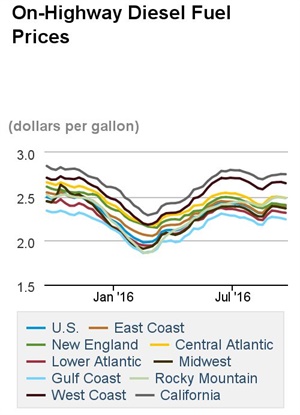
Overall activity in DAT's spot freight market happened as the total number of available loads increased 3.5%, truck posts declined 5% and the national average price of diesel slipped 3 cents to $2.35 per gallon.

“The typical mid-July slump isn't as bad for some truckers as it was in previous years,” said DAT Analyst Peggy Dorf last week in a post of the company's blog. “A downturn in July is a normal seasonal trend on the spot market, but it's sometimes followed by a rebound in August and September. Reefers may get a pay raise then, too, when grocers stock up on fresh food for back-to-school season.”

Follow @HDTrucking on Twitter