Author: Vitaliy Dadalyan

OOIDA Vows to Continue Fight Against Mandatory ELDs
The Owner-Operator Independent Drivers Association says it's not giving up on its battle against mandatory electronic logging devices, despite its failure to get the Supreme Court to review the constitutionality of the ELD mandate that goes into effect this December.

The U.S. Supreme Court announced Monday that OOIDA's appeal to the high court will not be reviewed.

OOIDA contends that a mandate to electronically track commercial truck drivers was never about safety and that the government was never able to demonstrate how such a mandate would improve safety.

“We are extremely disappointed that the Supreme Court does not see the merit in reviewing our case with so many questions about its constitutionality,” said Jim Johnston, president and CEO of OOIDA.

Johnston said OOIDA will continue to pursue the issue on the congressional side as part of its “Knock Out Bad Regs” campaign and will continue to communicate with the Trump administration about this and other regulations.

OOIDA had filed the petition seeking a review of a ruling from the U.S. Court of Appeals for the Seventh Circuit regarding the electronic logging device mandate. The court had ruled against the association last year on its lawsuit against the Federal Motor Carrier Safety Administration.

OOIDA says mandating electronic logging devices is the equivalent of warrantless surveillance of truckers and that the government's weak excuses for doing so fail to justify violating drivers' Fourth Amendment rights.

The association also says there are still many questions about the technical specifications and enforcement aspects of the mandate.

“The mandate has everything to do with large, economically motivated entities using the government to impose their will on small businesses which comprise the majority of the trucking industry. Until the government is able to answer many fundamental and basic questions about the mandate, they should at least delay its implementation,” said Johnston.

OOIDA contends ...Read the rest of this story
Fuel economy: From research to reality

On the surface, SuperTruck projects might seem like a waste of time and money. But they are helping OEMs make their everyday commercial products more fuel efficient.

In mid-2016, the u.s. dept. of energy (DOE) announced that it would fund a second heavy-truck research and development project, dubbed SuperTruck II, to the tune of $80 million. And many fleet managers might've rightly rolled their eyes, wondering whether such government expenditures ever result in real-world benefits for trucking companies.

read more

...Read the rest of this story

Isuzu Produces 40,000th Gasoline N-Series

<img width="150" src="http://www.automotive-fleet.com/fc_images/news/m-40000-truck-photo-1.jpg" border="0" alt="

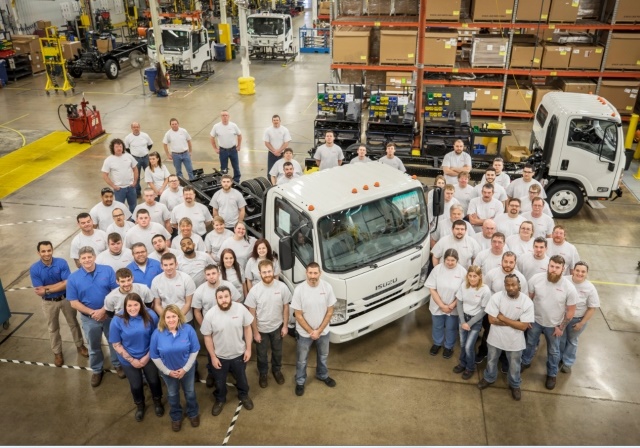
The 40,000th gasoline-powered Isuzu N-Series truck has been produced at the Spartan Motors, Inc. facility in Charlotte, Mich., on June 8, 2017. (Photo: Isuzu Commercial Truck of America)

">

The 40,000th gasoline-powered Isuzu N-Series truck has been produced at the Spartan Motors, Inc. facility in Charlotte, Mich., on June 8, 2017. (Photo: Isuzu Commercial Truck of America)

">

Isuzu Commercial Truck of America, Inc., distributor of low-cab-forward trucks, announced that the 40,000th gasoline-powered Isuzu N-Series truck has been produced at the Spartan Motors, Inc. facility in Charlotte, Mich. The truck rolled off the line June 8, 2017.

“From April 2015 to June 2016 — a span of 15 months — we went from 20,000 to 30,000 gas-powered Isuzu trucks produced in Charlotte,” said Shaun Skinner, president of Isuzu Commercial Truck of America. “Now, only 12 months later, another 10,000 N-Series gas trucks have been built. That's a testament to the increasing popularity and growing reputation of our gasoline engine, low-cab-forward trucks.”

Assembly of Isuzu N-Series gasoline trucks began at Spartan in April 2011.

Isuzu N-Series gasoline trucks are powered by a Vortec 6.0L small-block V8 engine that produces 297 hp at 4,300 rpm and generates 372 ft.-lbs. of torque at 4,000 rpm. The powerplant is mated to a 6-speed automatic transmission with double overdrive and lock-up torque converter for enhanced fuel economy and performance.

An optional version of the engine is capable of being converted to run on compressed natural gas (CNG) or liquefied petroleum gas (LPG, or propane).

A full range of gasoline-powered models is available:

NPR (12,000-pound GVWR)

Single Cab in wheelbases of 109, 132.5, 150 and 176 inchesCrew Cab in wheelbases of 150 and 176 inches

NPR-HD (14,500-pound GVWR)

Single Cab in wheelbases of 109, 132.5, 150 and 176 inchesCrew Cab in wheelbases of 150 and 176 inches

Isuzu also markets diesel-powered N-Series trucks, the Reach Van powered by Isuzu and the all-new Class 6 FTR, launched last month. Reach and FTR are also assembled by Spartan Motors.

“We offer the most complete line of low-cab-forward medium-duty trucks in ...Read the rest of this story

New president for Roadrunner LTL operation

New hire Frank Hurst is a 21-year LTL industry veteran.

Roadrunner Transportation Systems, Inc. is promoting Frank Hurst to be the president of Roadrunner Freight, the company's asset-light LTL business.

Hurst joined the company in January this year as senior vice president of sales & marketing for the Roadrunner Freight unit, after having served for three years as vice president and general manager for North America Corporation, a distributor of facilities, packaging and marketing supplies.

read more

...Read the rest of this story

Isuzu builds 40,000th gasoline N-Series truck

Truck rolled off the line at the Spartan Motors plant in Charlotte, MI, which has been building the N-Series since April 2011.

Isuzu Commercial Truck of America noted that its 40,000th gasoline-powered Isuzu N-Series truck rolled off the production line at the Spartan Motors assembly plant in Charlotte, MI, back on June 8 this year.

Assembly of Isuzu N-Series gas trucks began at the Spartan facility back in April 2011, the OEM noted.

“From April 2015 to June 2016—a span of 15 months—we went from 20,000 to 30,000 gas-powered Isuzu trucks produced in Charlotte,” said Shaun Skinner, Isuzu's president, in a statement.

read more

...Read the rest of this story

Supreme Court Denies Petition to Hear Electronic Logging Device Challenge

<img width="150" src="http://www.automotive-fleet.com/fc_images/news/m-u-s-supreme-court-pub-domain-3-1.jpg" border="0" alt="

The U.S. Supreme Court will not hear a challenge to the ELD mandate. Photo: Public domain

">

The U.S. Supreme Court will not hear a challenge to the ELD mandate. Photo: Public domain

">

The U.S. Supreme Court has denied the Owner-Operator Independent Drivers Association's request to take on the issue of the constitutionality of electronic logging devices.

The June 12 announcement of the court's denial of OOIDA's petition means the court will not hold hearings on whether the regulation violates drivers' rights to privacy under the Fourth Amendment, which means a lower court ruling upholding the Federal Motor Carrier Safety Administration's ELD mandate stands.

Under the electronic logging device rule, motor carriers and drivers must transition to ELDs by Dec. 17 of this year. Those that were using automatic onboard recording devices prior to Dec. 18, 2017, may continue using AOBRDs through Dec. 16, 2019. Suppliers of ELDs must conform to technical specifications, certify their ELDs, and register them with FMCSA.

Along with the issue of protecting driver privacy, in its petition to the Supreme Court, OOIDA also was seeking a ruling on whether the ELD rule violates the Fourth Amendment by failing to establish a regulatory structure at the state and federal levels that serves as a substitute for a warrant.

OOIDA will no doubt continue to push the issue in the other two branches of the federal government, Congress and the White House, as part of its “Knock Out Bad Regs” campaign.

According to OOIDA, requiring electronic monitoring devices on commercial vehicles “does not advance safety since they are no more reliable than paper logbooks for recording compliance with hours-of-service regulations.”

Related: 14 Things You Need to Know Before ELDs Become Mandatory

Follow @HDTrucking on Twitter

...Read the rest of this story