Author: Vitaliy Dadalyan

Super Trucks: Pie in the Sky, or Pathway to Super Fuel Savings?

<img width="150" src="http://www.automotive-fleet.com/fc_images/articles/m-volvo-supertrucks-1.jpg" border="0" alt="

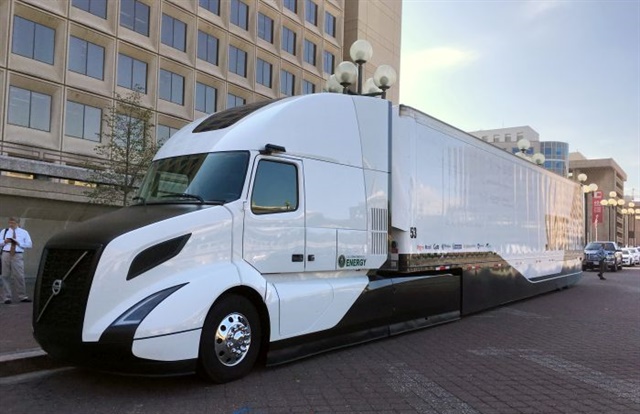
Volvo Truck's SuperTruck was revealed in September 2016. It achieved more than 12 mpg during the test run, and demonstrated an 88% improvement in freight efficiency and a 70% improvement in fuel efficiency over the baseline truck, a 2009 Volvo VNL 670. Photo: Jim Park

">

Volvo Truck's SuperTruck was revealed in September 2016. It achieved more than 12 mpg during the test run, and demonstrated an 88% improvement in freight efficiency and a 70% improvement in fuel efficiency over the baseline truck, a 2009 Volvo VNL 670. Photo: Jim Park

">

The September 2016 unveiling of Navistar's SuperTruck brought to a close the first round of the U.S. Department of Energy funded research and development project aimed at improving freight efficiency and reducing heavy-truck fuel consumption. The results were spectacular. And that begs the question, where do we go from here?

HDT reported on each SuperTruck as it was unveiled, and looking back, one can see the similarities in the various approaches the truck makers took, as well as those unique to each project.

The most obvious development in each case was the aerodynamic work. All the OEs went long on aero, an easy target. That's not to say the task was simple, as there was extensive design work along with modeling and testing. But at the end of the day, the closer each could get to the ideal aerodynamic shape, i.e., something similar to a rain drop, the greater the gains would be. Each OE ran into the brick wall of trailer shape, of course, but added a lot of bolt-on gear to the trailer to change what they could.

All used full-length trailer skirts that reached from close to the ground up to the bottom rail of the trailer. The problem is the potential for body damage resulting from day-to-day use. Fleets would never accept the maintenance problems associated with that sort of side skirt, but it's interesting to note that some of today's newer products are taller than previous versions. Maybe there is a growing acceptance that the aero benefits might outweigh the maintenance headaches.


The ...Read the rest of this story

Meet the Pro-Marijuana, Pro-LGBT Rights Truck Driver Running for Governor of Alabama

<img width="150" src="http://www.automotive-fleet.com/fc_images/blogs/m-jason-childs-1.jpg" border="0" alt='

Childs answered "Roll Tide" when asked the first question that Alabama politicans usually get on the campaign trail. Photo: Jason Childs

' >

Childs answered "Roll Tide" when asked the first question that Alabama politicans usually get on the campaign trail. Photo: Jason Childs

' width="225" height="251">

These are strange political times in America today. So much so that an ex-evangelical preacher and current truck driver is running on a progressive Democratic platform for the governorship of one of the reddest states in the nation.

Gadsden native Jason Childs says that both political parties have failed blue- and middle-class collar families nationwide. And he wants to help return the Democratic party to its labor-oriented and populist roots by running for the Alabama's governorship on a host of progressive issues: Childs says he is for civil rights for all citizens, including Lesbian, Gay, Bisexual, and Transgender rights, favors legalizing marijuana, supports the Second Amendment and wants to repeal Alabama's current tax on groceries – a tax he says unfairly targets poor and working class families in the state.

It's a strange platform considering the 46-year-old Childs' background: He attended conservative Christian schools Liberty University and eventually graduated from the Florida Bible College and began a career as an evangelical, Southern Baptist preacher at the age of 17. But, the domination doesn't allow divorcees to preach, and after a too-early marriage failed, Childs found himself casting around for another profession.

In 2006, Childs decided he wanted to see America. He obtained his CDL and hit the road as a long-haul trucker. And it was during his trips across the country that his world view was challenged and eventually changed. “I talked to other drivers at truckstops, and ate with workers on warehouse docks, and I realized the reality of life for working- and middle-class Americans was much different then I'd been taught,” he said. “Their struggles are no being addressed by either party, nationally. And the Republican take-over of Alabama ...Read the rest of this story

Economic Watch: Fed Hikes Interest Rates Again as Retail Sales, Inflation Ease a Bit

Despite retail sales falling by the biggest amount in 16 months and a dip in consumer prices, the Federal Reserve raised interest rates on Wednesday for the third consecutive quarter as the central bank signaled its confidence in the U.S. economy.

The Federal Open Market Committee pushed its benchmark interest rate higher to a range of 1% to 1.25%, meaning both consumers and trucking companies will face higher costs when it comes to borrowing money from banks.

This latest hike, coupled with earlier ones starting in 2015, has moved the federal funds rate higher by a full percentage point. Even with this latest increase the rate is still extremely low by historical standards ever since it was dropped to near zero by the end of 2008 due to the Great Recession.

The FOMC said it is leaving the door open to more interest rate hikes in the near term, most likely one more time this year and three times each in 2018 and 2019.

TD Economics noted the FOMC “was somewhat sanguine on the economy, indicating that activity has been ‘rising moderately' while the labor market ‘continued to strengthen' as job gains 'moderated but have been solid' and unemployment declined."

“The statement highlighted consumer spending has accelerated recently, while business investment continued to expand. Inflation was viewed as having 'declined recently' while the core measure is running 'somewhat below 2%,' but expected to stabilize near the target over the medium-term," said Michael Dolega, senior economist at TD Economics, part of TD Bank Group. "At the same time, inflation expectations were viewed as little- changed and still low."

He said a Fed statement about this latest hike was largely as expected, with the Fed emphasizing the continued labor market improvement and accelerating economic growth as reasons to be optimistic for the economic and inflationary outlook. As such, ...Read the rest of this story

Spot Truckload Freight Rates Soar Along With Load-to-Truck Ratios

<img width="150" src="http://www.automotive-fleet.com/fc_images/news/m-dat-rtow-wide-56-3.jpg" border="0" alt="

Graphic: DAT

">

Graphic: DAT

">

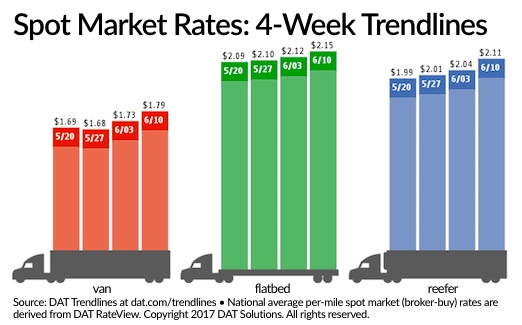
Average spot truckload freight rates jumped sharply for the second straight week in all three major equipment types while load-to-truck ratios also headed much higher for the week ending June 10, according to new figures from DAT Solutions and based on its network of load boards.

The number of available loads was up 30% compared to the previous week, which was shortened by the Memorial Day holiday and included the annual Roadcheck truck inspection blitz. A 20% increase is more in line with expectations.

According to DAT, brokers and shippers paid a premium for capacity in most major markets and lanes. Load-to-truck ratios reflected the increased freight activity:

Van ratio: 5.7 loads per truck, up 12% from previous weekReefer ratio: 10.1 loads per truck, up 33%Flatbed ratio: 49.2 loads per truck, up 27%

Nationally, the number of posted van loads increased 12% while truck posts were 8% higher. The national average van rate gained 6 cents to $1.79 per mile. Outbound rates were up in almost every major van freight market:

Los Angeles: $2.28 per mile, up 10 centsChicago: $2.06 per mile, up 6 centsDallas: $1.76 per mile, up 3 centsCharlotte: $2.16 per mile, up 11 centsPhiladelphia: $1.73 per mile, up 5 cents

Of the top 100 van lanes, only 26 had lower rates.

Reefer load posts increased 30% while truck posts fell 2%, which helped move the national average rate 7 cents higher to $2.11 per mile. California shipments are expected to stay strong at least through the Fourth of July, and a few lanes crossed the $3 mark:

Fresno-Denver surged 61 cents to $3.14 per mileLos Angeles-Portland, Oregon, was up 45 cents to $3.33 per mileSacramento-Portland added 50 cents to $3.21 per mileSacramento-Salt Lake City rose 27 cents to an average of $3.00 mile

Florida outbound rates tumbled, including Lakeland-Charlotte, which plunged 84 cents to an ...Read the rest of this story

Michelin Reveals ‘Wheel with No Air’ Tire Concept

<img width="150" src="http://www.automotive-fleet.com/fc_images/news/m-michelinvisionaryconceptjune2017-1.jpg" border="0" alt="

Michelin's long-term Visionary concept can perhaps be best summed up as a "wheel with no air." Photo: Michelin

">

Michelin's long-term Visionary concept can perhaps be best summed up as a "wheel with no air." Photo: Michelin

">

MONTREAL. Looking not unlike a lushly blue life form on James Cameron's cinematic world of Pandora, the prototype of Michelin's Visionary concept tire glowingly held center stage here on June 14 at the tire maker's Movin' On global conference on sustainable transportation.

Michelin Group Executive Vice President of Research and Development Terry K. Gettys called the airless tire-and-wheel combination a long-term concept that represents nothing less than “a concrete demonstration of a system of solutions for the future of sustainable mobility.”

More specifically, it can be viewed as the sum of three key elements:

First off, the Visionary concept is more than a tire— it is “a wheel with no air,” as Michelin put it. It's designed to last as long as the vehicle with its “ultra-durability” coming from its honeycomb structure, which Gettys said was inspired by the natural forms of the growth process at work in the plant, mineral or sometimes even in the animal world (coral being one example). It is also made of all-organic recycled materials and is engineered to be fully recyclable.Secondly, its tread can be "replenished" by a 3D printer. Per Michelin, the material used, which draws on cold-cure technology, delivers the same performances as a conventional tread. But with one notable difference— the tread is completely biodegradable. That means if the tread is worn or even of road conditions have changed, such as due to going off road or in winter weather, you can print the tread you need in “a matter of minutes.” In addition, because 3D printing is an “additive technology,” it adds just the quantity of material that is necessary, where it is necessary, with no waste or loss.Finally, the Visionary concept is a connected ...Read the rest of this story

No Tariffs, No Certainty for Truck Tires

<img width="150" src="http://www.automotive-fleet.com/fc_images/articles/m-mtd-feature-1.jpg" border="0" alt="

“Due to consistently lower diesel prices, many fleets are asking for tires that offer long tread wear and enhanced traction,” says Brian Buckham at Goodyear.

">

“Due to consistently lower diesel prices, many fleets are asking for tires that offer long tread wear and enhanced traction,” says Brian Buckham at Goodyear.

">

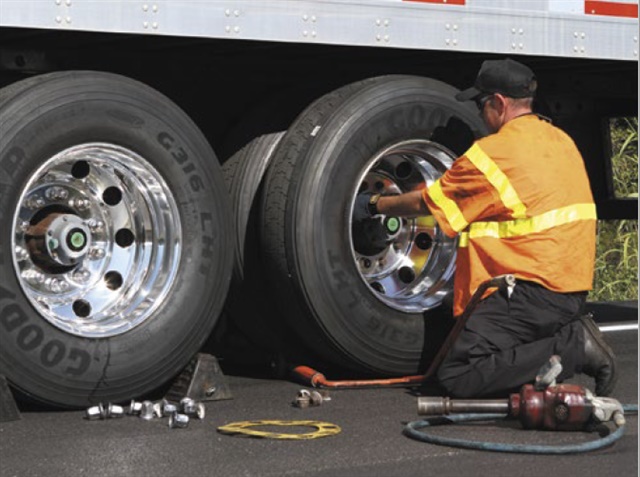
When it comes to medium truck tires, fuel efficiency and cost-per-mile considerations remain priorities, but there are other trends driving the segment as well.

Heavier front axles on trucks are requiring higher load ratings on steer tires. Fleets are adapting to wide-base tires.

Smart tires, outfitted with sensors, are monitoring everything from changes in a tire's pressure to the truck's load and speed. The data can help fleet managers calculate and understand the factors contributing to tire wear.

And those are just a few of the highlights. Fourteen tire manufacturers outlined the top trends in truck tires.

But there's another force at play in the current truck tire market, one some might have thought was settled. Tariffs — and even a lack of tariffs — are creating uncertainty.

The decision in February 2017 by the International Trade Commission (ITC) not to impose tariffs on truck and bus tires from China was a stunner. There had been no indication leading up to the ITC's vote that the case would go that way, and the early stage of the investigation indicated nearly all truck and bus tires from China would be subject to tariffs of around 50%. Dealers and tire distributors tried to beat what seemed like an inevitable price hike. Now they're sitting on excess inventory as these imports are returning to the U.S. market.

Rick Phillips, vice president of sales for Triangle Tire USA, says that's the biggest impact of the tariff decision. “But going forward the impact of the decision will ultimately be determined by the end users buying the tires, and by the dealers delivering the tires.

“The market certainly has an appetite for products in this space and that ...Read the rest of this story