Author: Vitaliy Dadalyan

Automated Transmissions Yesterday, Today, and Tomorrow

<img width="150" src="http://www.automotive-fleet.com/fc_images/articles/m-amtfuel-1.jpg" border="0" alt="

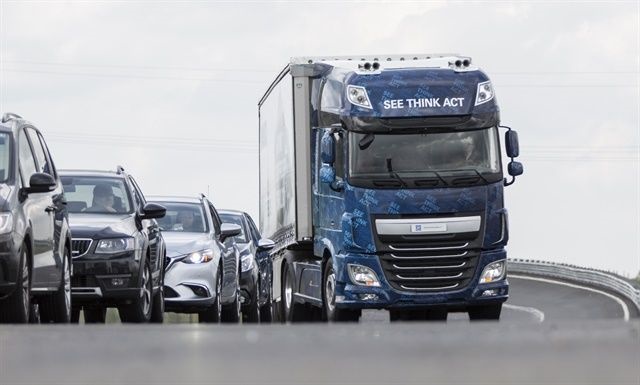
More power and increased safety and comfort seem to be the marching orders for OEMs and suppliers developing the next generation of heavy-duty AMTs. The Innovation Truck, unveiled last year, is a concept vehicle proving out these features for ZF. Photo: ZF

">

More power and increased safety and comfort seem to be the marching orders for OEMs and suppliers developing the next generation of heavy-duty AMTs. The Innovation Truck, unveiled last year, is a concept vehicle proving out these features for ZF. Photo: ZF

">

When the first semi-automated manual transmissions began appearing on the market more than 20 years ago from Eaton and Rockwell (which later became Meritor), few would have imagined the popularity automated manuals enjoy today.

At the time, automatic transmissions were popular in vocational and medium-duty applications but were almost unheard of in linehaul, mostly because of the premium price and the limited range of gears.

It's been a bit over a decade since true AMTs really came into the market, when in 2006 Eaton introduced the UltraShift and Volvo Trucks announced it was bringing its I-Shift to North America. Since then, Eaton and Volvo have both improved their offerings, Mack adapted a version of the I-Shift tuned to its trucks, and Daimler entered the market with the Detroit DT12 AMT.

Fast-forward to today, and the success rate of these transmissions has been unprecedented, thanks in part to their fuel-saving abilities.

A decade ago, reports that AMTs enjoyed take-rates of around 75% on new truck builds in Europe raised a lot of eyebrows in North America. Drivers here were different, everyone said; North American drivers were devoted to manual gearboxes as a point of pride, while North American fleets would be unwilling to shell out the higher price for AMTs. Even the most optimistic analysts predicted a very slow climb to 50% of the market in a decade or so. Maybe.

Those experts were wrong.

Today, commercial vehicle OEMs consistently report take-rates for new long-haul/over-the-road builds solidly around the 75% mark, with Daimler Trucks North America and Volvo Trucks North America eyeballing sales north of the ...Read the rest of this story

Commentary: Product Standards Coming to Heavy-Duty Market

<img width="150" src="http://www.automotive-fleet.com/fc_images/articles/m-denise-rondini-2013-3-32-1.jpg" border="0" alt="

Denise Rondini

" >

Denise Rondini

" width="185" height="278">

Wouldn't it be great if there were a consistent way for everyone across the supply chain to have the same information about heavy-duty truck parts? According to Sheila Andrews, director, government affairs, for the Auto Care Association, this would create a more efficient movement of parts through the supply chain and is something that has been done by other industries with great success.

While the light-duty industry has been using the PIES (Product Information Exchange Service) standard since 2002, work on standards for heavy-duty parts is just beginning. Andrews says setting standards in light-duty was easier because they could be based on make/model/year information. That won't always work for heavy-duty parts. The team working on setting heavy-duty parts standards is using vehicle vocation as the starting point.

Columns would be set for the agreed-upon traits, and manufacturers would then provide as much of the data as they desired. This will be a voluntary standard, so manufacturers can withhold any information they think is proprietary.

Information could include things such as product dimensions, dimensions of the packaging, materials used in manufacturing, width of threading, etc. The standard also likely will include some best practices, Andrews explains. “If a photo is going to be included, there will be details about the background the product should be on, what type of views to include (top, side, bottom), and the resolution of the photo. The goal again is consistency.”

If it sounds like a daunting task to standardize information on all heavy-duty truck parts, Andrews says, “We understand that this is going to be like eating an elephant, so we will have to do it one bite at a time.” So the team working on this project is starting with setting standards for the top 20 categories of parts used on heavy-duty trucks.

The assembled group ...Read the rest of this story

Everyday Heroes Truck Auctioned to J&L Transportation

<img width="150" src="http://www.automotive-fleet.com/fc_images/news/m-everyday-heroes1-2.jpg" border="0" alt='

The "Everyday Heroes" Kenworth T680. Photo: Kenworth

'>

The "Everyday Heroes" Kenworth T680. Photo: Kenworth

'>

The “Everyday Heroes” Kenworth T680 was auctioned off for charity to Phoenix-based J&L Transportation, netting 89,000 for the Truckers Against Trafficking non-profit group.

Truckers Against Trafficking's mission is to stop human trafficking by educating, mobilizing and empowering truck drivers and rest stop employees. The $89,000 donation is the largest in the non-profit's history. The Everyday Heroes truck auction was spearheaded by the Inland Kenworth dealership.

“This culminated an 8-month project that had a tremendous finish,” said Don Blake, Inland Kenworth's new truck sales manager in the Phoenix area. “Our sponsors came together to donate and discount their pricing in order for us to build the Everyday Heroes Kenworth T680. I was on pins and needles as the auction and bidding took place, and was so happy that the truck was going to a local company that demonstrated its commitment to such a worthy cause.”

The Kenworth T680, fully loaded with a 76-inch sleeper, 485-hp Paccar MX-13 engine, and Eaton Fuller Advantage 10-speed automated transmission, joins 35 other trucks in the J&L Transportation fleet. The truck will be placed in J&L's dedicated fleet and used in Arizona, California, and Nevada.

“Though I have not encountered human trafficking, it does exist in our world,” said Mike Jimenez, owner of J&L Transportation. “It's been my experience that when our industry gets behind a cause, it is a worthwhile cause. When Don expressed his interest, along with Inland Kenworth and all the other supporters and sponsors intent on doing this project, I knew J&L should be a part of the answer to end such heartbreaking events.”

According to Kendis Paris, TAT's executive director, human trafficking is an industry estimated to be worth $32 billion in the United States alone, and $150 billion globally. To further its education, TAT has the Freedom Driver's Project ...Read the rest of this story

PeopleNet Adds Continental TPMS Integration

<img width="150" src="http://www.automotive-fleet.com/fc_images/news/m-contipressurecheck-1.jpg" border="0" alt="

Photo: Continental

">

Photo: Continental

">

PeopleNet has announced the integration of the ContiPressureCheck tire pressure monitoring system from Continental.

After the completion of a beta test, the ContiPressureCheck system is now available to fleets that have deployed PeopleNet technology in their trucks. The TPMS also drivers and back-office personnel to continuously monitor real-time pressure and temperature of their tires.

The ContiPressureCheck sensor is mounted on the inner liner of a tire, unlike comparable systems that have wheel or valve-mounted sensors. The sensor placement can protect it from theft or damage while providing an accurate measurement of the tire's pressure and temperature. The system can accommodate multiple configurations for a range of commercial tire types, including tractors, trailers, buses, and coaches.

“With PeopleNet's expertise in the world of telematics and our long history of providing truck tire solutions, this relationship gives fleets the best of both worlds,” said Paul Williams, executive vice president, Continental Commercial Vehicle Tires. “In addition to the positive impact that correct air pressure has on driver safety, CPC will also help increase tire life and minimize downtime related to tire failures.”

Related: PeopleNet Adds Weather, File Sharing to ConnectedFleet

Follow @HDTrucking on Twitter

...Read the rest of this story

DAT Offers AscendTMS for Free to Carrier Customers

<img width="150" src="http://www.automotive-fleet.com/fc_images/news/m-ascendtms-1.jpg" border="0" alt="

Screenshot via DAT Solutions

">

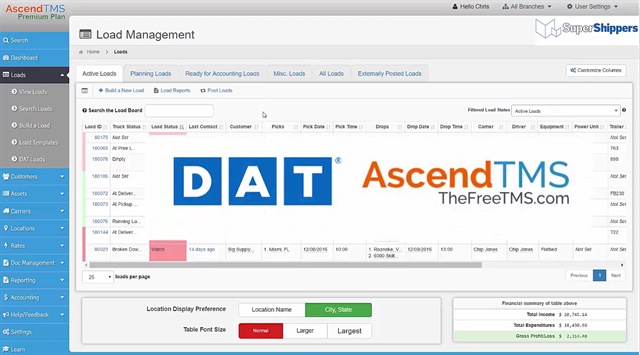
Screenshot via DAT Solutions

">

DAT Solutions has announced that it has integrated its most popular carrier features into the AscendTMS for carriers and it will be offered to current and future DAT carrier customers for free.

DAT TruckersEdge, Express, and Power carrier customers can log into the AscendTMS and search the database of loads and post their trucks as they would inside of the DAT load board app or desktop product.

“Freight matching is increasingly about efficiency. The integration of AscendTMS and DAT's load board features lets our carrier customers, especially smaller ones with fewer technical or financial resources, match their empty trucks with available DAT loads with the press of a single button,” said Don Thornton, DAT senior vice president. “We are pleased to make AscendTMS carrier functionality available to our carrier network, the largest source of spot market capacity with 1.3 million trucks.”

The free AscendTMS for DAT Solutions' carriers is available immediately. It offers a complete business management solution, including:

Complete dispatch controlLoad tracking, ELD integration IFTA tax reporting, and fuel card importsAsset and driver management, driver pay and settlement, driver textingA 26,000 strong shipper directoryQuickBooks integration, easy EDIReal-time load funding with Triumph Business CapitalBranch and agent management, cargo claims handling, full document management A free truckload rate index, and deeply integrated load searching and matching

DAT load boards are also integrated with all major carrier and broker TMS solutions, including its own DAT Keypoint.

Related: Trucker Path Features Integrated Into AscendTMS

Follow @HDTrucking on Twitter

...Read the rest of this story