Author: Vitaliy Dadalyan

The Rolling Resistance Paradox

<img width="150" src="http://www.automotive-fleet.com/fc_images/articles/m-rolling-resistance-4.jpg" border="0" alt="

Photo: Jim Park

">

Photo: Jim Park

">

Be careful what you ask for because you just might get it. If the lowest possible rolling resistance is your only consideration when spec'ing tires, chances are you'll be mighty disappointed in the tire you get. In fact, no tire maker in the world would even offer such a tire, but it's theoretically possible.

If you want really low rolling resistance, try steel wheels, as in train wheels. Steel-on-steel has almost no rolling resistance, but almost no traction either. They'll last a good long time, but drivers wouldn't be happy with the ride. I'm using an absurd example to illustrate the point, but an extremely low rolling resistance tire would have similar properties: traction and ride would be poor, the tires might last 50,000 miles, and it would cost you much more over a two-year time frame than the value of the fuel they saved.

Tire makers often express the design goals in the form of a triangle, each axis being one of three important considerations: traction, tread life, and rolling resistance. Historically an improvement in one forced compromises in the other two, but that's not universally true anymore. Through tire design, it is possible to use technologically advanced compounds and tire-construction techniques to minimize a tire's rolling resistance with little or no impact on traction or tread life.

“A number of factors influence a tire's rolling resistance, including the compounds used, casing design and tread pattern,” says Bill Walmsley, product category manager, Michelin Americas Truck Tires. “In most cases, the depth of a tire's tread blocks is inverse to rolling resistance. The deeper the tread blocks, the better the grip but the worse for fuel economy.”

Sidewall construction can also reduce rolling resistance. However, there are some tire design options available that can lower the rolling resistance, such ...Read the rest of this story
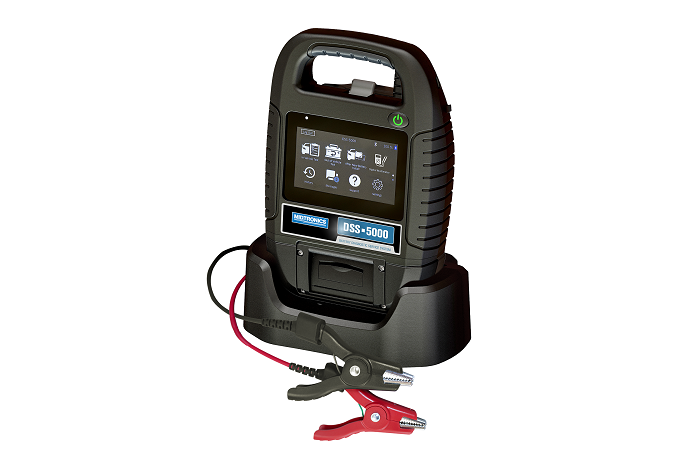
Midtronics Diagnostic System Monitors Batteries

Midtronics introduced the DSS-5000 Battery Diagnostic Service System, featuring Conductance Profiling that is designed to provide information about the battery state of charge and state of health.

The new Midtronics technology delivers fewer charge and retest decisions, in addition to battery reserve capacity warnings. The DSS-5000 can detect and flag reserve capacity issues helping to avoid the loss of vehicle function or no-start conditions.

The DSS-5000 supports diagnostics for conventional lead-acid, AGM, and EFB batteries and advanced vehicle systems, including start-stop. Featuring a three-piece design that is easy to carry and hold, the DSS-5000 includes a controller with 5-inch full-color touchscreen display, tester pod, and charging/storage dock (integrated printer is optional). An integrated camera supports VIN capture. The detachable controller can make it easier to perform system test and scanning functions and provides a convenient option for sharing battery diagnostic results with customers.

The touchscreen provides easy system navigation and displays a series of pre-programmed service apps that promote quick, error-free testing – and is useful for busy shops or inexperienced technicians. The tool automatically identifies the vehicle and battery system from the VIN and guides the user through how to properly test the vehicle, including a battery registration function (if required) and on-screen reset checklist.

The DSS-5000 supports future vehicle/battery technologies via automatic software updates delivered wirelessly with Midtronics Battery Management Information System (BMIS) program maintenance. VIN capture through an integrated camera establishes vehicle service records within BMIS and offers shop management an administrative tool to establish and monitor team battery service goals. On-tool WiFi and Bluetooth capabilities support flexible networking capabilities.

Follow @HDTrucking on Twitter

...Read the rest of this story
Saving Fuel by the Dollar and by the Minute

<img width="150" src="http://www.automotive-fleet.com/fc_images/articles/m-fuel-purchasing2-1.jpg" border="0" alt="

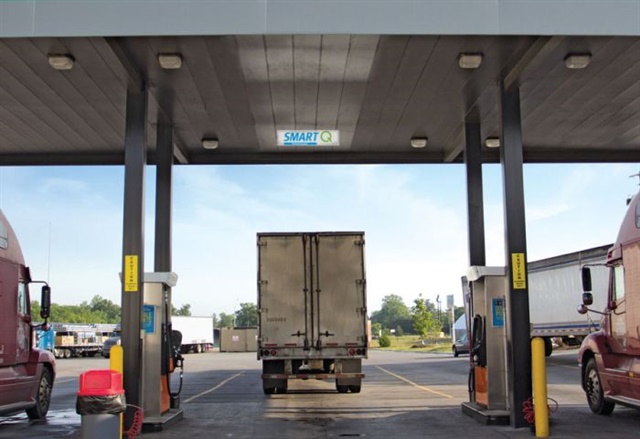
The latest development with fuel-card programs is the option to access them with cardless technology. Likewise, pre-existing cardlock systems that enable drivers to quickly purchase fuel at unattended fuel islands may now be accessed without an actual card. The enabling technology is radio frequency identification (RFID). Photo: Comdata

">

The latest development with fuel-card programs is the option to access them with cardless technology. Likewise, pre-existing cardlock systems that enable drivers to quickly purchase fuel at unattended fuel islands may now be accessed without an actual card. The enabling technology is radio frequency identification (RFID). Photo: Comdata

">

There's more to saving fuel than just not burning it. It's called buying it for less. One of the surest ways to do that is to leverage high-tech solutions that take the guesswork and the data-crunching out of where to buy fuel at the best price on the road.

From various fuel-card options to analytical software tools and fueling apps for drivers, there's a basketful of ways to save money on the fuel spend for any size fleet, often coming with the bonus of making fueling easier and faster for drivers.

An example of how fuel-payment technology has expanded well beyond using cards instead of cash is the relationship that Cherry Hill, New Jersey-based fleet NFI has established with EFS, a Wex company. NFI's fleet operations recently moved its fuel-payments business to EFS because it was impressed by its technology and approach to partnering with fleets, according to Ike Brown, NFI vice chairman and president.

“With a dedicated fleet of more than 2,200 tractors across North America, ultimately we wanted a strategic partner with the highest level of customer service,” Brown says — a partnership that would go well beyond just how best to buy fuel on the road. “EFS' unique integration approach and real-time reporting helped us identify efficiencies in our network.” NFI is using the EFS fuel card, which Brown says allows for integration into its existing transportation-management system. The fleet has also signed on for EFS' fuel tax solution, fuel management, purchasing control and terminal fuel solutions.

On the card

For many fleets, fuel cards represent ...Read the rest of this story

Economic Watch: Manufacturing Hits Nine-Month Low, Home Sales Rebound

A first look at the nation's manufacturing sector this month shows conditions have hit a nine-month low, while home sales have roared back amid near-term expectations the overall economy will continue with a moderate expansion.

The seasonally adjusted Flash U.S. Manufacturing Purchasing Mangers' Index (PMI) from financial information services provider IHS Markit fell from a final May level of 52.7 to a preliminary reading of 52.1 in June.

While a level above 50 indicates manufacturing activity is expanding, this is the slowest pace since last September.

The weaker PMI reading largely reflected softer rates of output and new business growth in June, which more than offset stronger contributions from job creation and inventory building, according to the report.

According to Chris Williamson, chief business economist at IHS Markit, the U.S. economy is ending the second quarter on a softer note.

“The average expansion seen in the second quarter is down on that seen in the first three months of the year, indicating a slowing in the underlying pace of economic growth,” he said. “While official GDP [gross domestic product] data are expected to turn higher in the second quarter after an especially weak start to the year, the relatively subdued PMI readings suggest there are some downside risks to the extent to which GDP will rebound.”

A final reading on June will be out in early July, along with the more closely watched monthly survey of purchasing managers from the Institute for Supply Management.

New, Existing Home Sales Come Back to Life

This report came as separate ones showed the market for both new and existing homes has turned around.

New home sales in May increased 2.9% from the month before to a seasonally adjusted annual rate of 610,000 while the April level was revised upward, according to the Commerce Department.

When May is compared to the same time a ...Read the rest of this story

Film Promotes Pennsylvania RR’s TrucTrain Service in the 1950s

<img width="150" src="http://www.automotive-fleet.com/fc_images/blogs/m-pennsy-piggyback-1.jpg" border="0" alt="

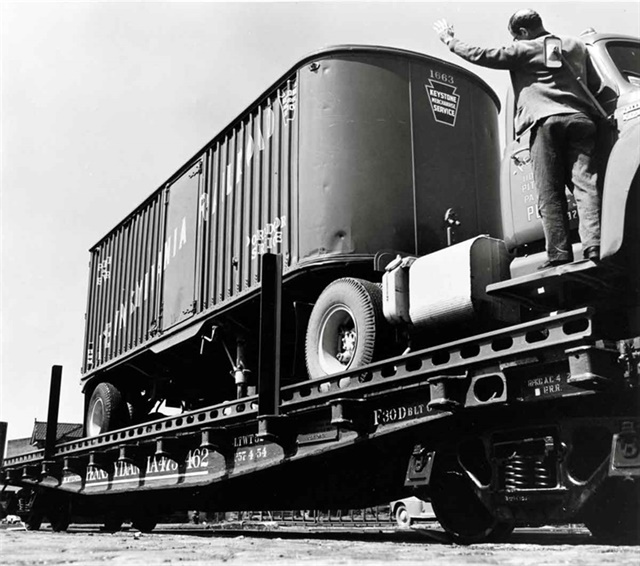
The guy on the running board is there strictly for the camera, because drivers in piggyback terminals were very good at backing trailers onto flatcars. Photo: Pennsylvania Railroad/Classic Trains

">

The guy on the running board is there strictly for the camera, because drivers in piggyback terminals were very good at backing trailers onto flatcars. Photo: Pennsylvania Railroad/Classic Trains

">

Before I was a truck buff, I was a train fan. So, when I got into the truck-writing business, first in 1973 and then for good in '78, it pained me to hear drivers and executives talk about railroads as “the enemy.” Sometimes they gloated over how they were taking business from the rails, and they could do it because they offered better service.

Meanwhile, railroad people had also come to view the trucking industry as a great threat and an unfair competitor, because taxes were used to build highways while the railroads built and maintained their own tracks and rights-of-way, and paid taxes on all of it. They didn't acknowledge that truck operators paid plenty of extra taxes to use the highways, and continue to. Books have been written on that subject, so I shan't go further with it here.

But there was an area where railroads and trucking companies cooperated in the 1950s. That was trailer-on-flatcar (TOFC) service, also known as “piggyback.” I just came across the above photo, shot about 1950, of a short trailer being backed onto a piggyback flatcar in Chicago. That got me searching for more “pig” pictures, and I immediately found a short promotional film produced for the long-defunct but once powerful Pennsylvania Railroad.

The 1955 film is almost pro-trucking, with the narrator calling it “a great industry.” It talks about crowded highways populated by cars and an increasing number of large trucks, and includes one scene of “blocked” traffic (today, we call that gridlock). But, the narrator proclaims, the solution lies with America's railroads and their “excess capacity” – caused by truckers stealing their freight, ...Read the rest of this story

Trucking’s Share of Cross-Border Freight Falls

The value of freight moved between the U.S and its North American Free Trade Agreement partners Canada and Mexico moved higher in April for the sixth straight month, but trucking's share fell, according to new U.S. Transportation Department figures.

U.S.-NAFTA freight totaled $91.1 billion in current dollars in April, 0.8% higher than compared to the same time in 2016.

Despite the overall gain the value of freight moved by truck fell 5.5% while air freight fell 2.1%. The value of commodities moving by pipeline increased 63.5%, vessel by 27.8%, and rail by 5.8%.

The large percentage increase in the value of goods moving by pipeline and vessel was due in part to a 25% increase in the year-over-year price of crude oil between April 2016 and April 2017, according to the report.

The top commodity category transported between the U.S. and Canada during April was vehicles and parts, of which $4.8 billion, or 53.7%, moved by truck and $3.9 billion, or 43.8%, moved by rail.

Trucks carried 62.6% of U.S.-NAFTA freight and continued to be the most heavily utilized mode for moving goods to and from both U.S.-NAFTA partners. Trucks accounted for $29.4 billion of the $49.5 billion of imports or 59.5%, and $27.6 billion of the $41.6 billion of exports, or 66.3%.

Rail remained the second largest mode by value, moving 16.4% of all U.S.-NAFTA freight.

U.S.-Canada Truck Freight Falls 2.8 Percent

The value of U.S.-Canada freight flows increased by 2.5% in April from a year earlier to $47 billion as the value of freight on three major modes increased from a year earlier.

The value of freight carried on pipeline increased by 67.1%, vessel by 13.8%, and rail by 6.4%. Truck decreased by 2.8%, and air decreased by 7.2%.

Trucks carried 57.6% of the value of the freight to and from Canada while rail carried 17.7% followed by ...Read the rest of this story