Toward Zero Accidents: Volvo Active Driver Assist now standard
read more
...Read the rest of this storyread more
...Read the rest of this storyMercedes-Benz Actros tractor used to demonstrate Daimler's Highway Pilot Connect autonomous technology on German roads. Photo: David Cullen
" >According to Infoholic Research, the global autonomous vehicle market revenue is expected to grow at a compound average growth rate (CAGR) of 39.6% over the next 10 years-- resulting in a $126.8 billion market by 2027.
“The increasing investments from the automakers, the rising consumer demands, and technology advancements in the automotive industry have led to the increased demand for driverless vehicles,” stated the research firm in a press release on its newly released market report.
“In the current market scenario, self-driving is not just limited to cars but is also gaining popularity among public transport and trucks," said Infoholic Research. Thus, most of the enterprise sectors including retail, manufacturing, transportation and logistics will prefer autonomous vehicles for delivery purposes in the future.”
Mercedes-Benz Actros tractor used to demonstrate Daimler's Highway Pilot Connect autonomous technology on German roads. Photo: David Cullen
" width="259" height="271">The report segments the market and analyzes it by product type, autonomous vehicles type, and operating regions.In terms of product type, software is expected to hold the major market share, followed by the hardware and services segments.
“The software segment is mainly driven by the fully autonomous vehicles when compared to semi-autonomous vehicles,” Infoholic stated. And while hardware providers have “new business opportunities due to different types of components that will be used in autonomous vehicles,” hardware market share is expected to drop in the coming years as "the adoption rate of autonomous vehicles increases."
Segmentation by region shows that North America is the leading arena in the autonomous vehicle market. Infoholic called it “an attractive destination for key stakeholders due to the availability of high-end infrastructure, rising investments from automakers, and government initiatives."
Also key will be the Asia Pacific region. China, India, and Japan are expected to lead that market for the next 6 to 8 years. The researchers ...Read the rest of this story
The North American Council for Freight Efficiency (NACFE) said 6x2 axle configurations continue to offer “undeniable fuel consumption improvement,” but adoption rates remain fairly low due to higher tire wear, poor residual values, and a negative perception.
read more
...Read the rest of this storyTrucking reporters took the new Volvo VNL for a spin on the test track at Volvo's New River Valley facility. Photo: Jack Roberts
">Trucking reporters took the new Volvo VNL for a spin on the test track at Volvo's New River Valley facility. Photo: Jack Roberts
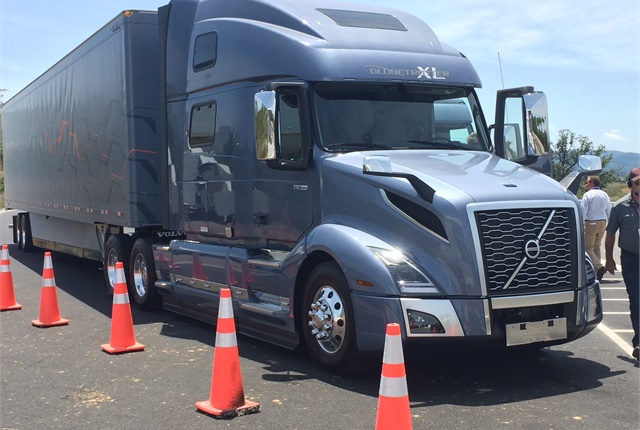
">A lot has happened in the 20 years since Volvo Trucks North America last introduced a Class 8 highway tractor. The excitement among Volvo engineers, designers and executives at the company's New River Valley, Virginia, manufacturing facility and sparking-new Customer Center was palpable for the official unveiling of the 2018 VNL tractor on July 11.
Volvo's VN model, which debuted in 1996, was a tremendous step forward in terms of aerodynamic design. So in terms of styling, the new VNL is more of a refinement instead of a departure. The design DNA the new VNL inherited from its predecessor is clearly evident, although the new truck features a pointedly more wide-bodied stance, with tapering lines flowing down and toward the rear of the tractor. It is an aesthetically pleasing look — this is a sharp-looking truck — but it is also a design with function: The new truck boosts a 1% boost in aerodynamic efficiency compared to the older design. That doesn't sound like a lot. But, as Volvo on-highway product manager Jason Spence, notes, when you're in an industry that celebrates a tenth of a percent boost in fuel economy, 1% is not bad at all.
More savings come from pairing the new aerodynamic design with Volvo's latest fuel-focused powertrain technologies. This includes downspeed cruising at just a shade over 1,100 rpm and a new, compound-turbocharger option for the high-horsepower D13 that will be available next year. All told, Volvo engineers say the new VNL delivers a full 7.5% boost in fuel economy compared to the latest models of the previous-generation VN tractor.
In the CabWhile the truck's exterior builds upon proven Volvo design cues, inside the cab ...Read the rest of this story

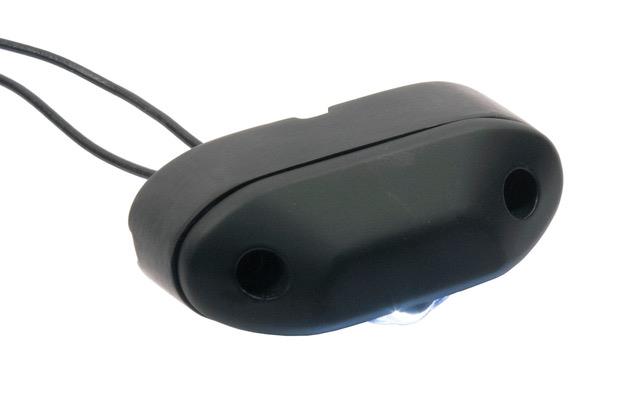
Peterson's 290 series LED License/Utility light, has a compact, rugged design and a single-diode Great White LED designed for good performance and durability.
The light features precision optics and improved light dispersal combined with a compact design and single-diode economy.
The 290 series lights are available as low-profile utility/auxiliary lights measuring just 3-inch wide by 0.6-inch high, or as legal license lights when installed with either a top- or side-mount spacer bracket. Hard-wired with a choice of either stripped leads or .180 bullet connectors, the new lights surface-mount on 2-inch centers.
“We think our new 290 series lights are the most exciting LED license light design on the market,” said Mark Assenmacher, Peterson's marketing director. “Their precision optics with optimal light output and superior dispersal make these USA-made products the best value in LED license lights.”
Follow @HDTrucking on Twitter
...Read the rest of this storyImage: Office of the Architect of the Capitol
">Image: Office of the Architect of the Capitol
">The subcommittee draft for the next House Transportation, Housing and Urban Development (THUD) appropriations bill features several riders favored by trucking interests, including a long-sought measure that would preempt states from enacting laws dictating meal and rest break requirements for truckers. A similar rider is attached to the reauthorization bill covering DOT that was advanced last month by the Senate Committee on Commerce, Science and Transportation.
For several years now, trucking lobbyists have been seeking a legislative provision that would prevent individual states from enacting their own meal and rest break rules for CDL drivers, as well as to prohibit states from requiring that those drivers be paid certain types of added compensation, such as detention pay. That effort failed on Capitol Hill no less than three times last year.
Proponents of this reform have been pushing hard for Congress to more directly address state preemption of federal driver rules ever since a Supreme Court ruling in May 2015 upheld a California statute requiring a paid 10-minute rest break every four hours and a paid 30-minute meal period every five hours for truck drivers.
The House bill would also prevent the Federal Motor Carrier Safety Administration from advancing a safety-fitness determination rulemaking until the DOT Inspector General has issued certain certifications required by law.
The back story on this rider is a bit more complex. Earlier this year, the Federal Motor Carrier Administration announced it was scrapping its proposed rule on a revised methodology for issuing safety-fitness determinations for motor carriers. The agency had issued its SFD notice of proposed rulemaking back in January of last year.
FMCSA explained in a March 23 notice in the Federal Register that despite having recently announced it would next issue a supplemental notice of proposed rulemaking, it had decided ...Read the rest of this story

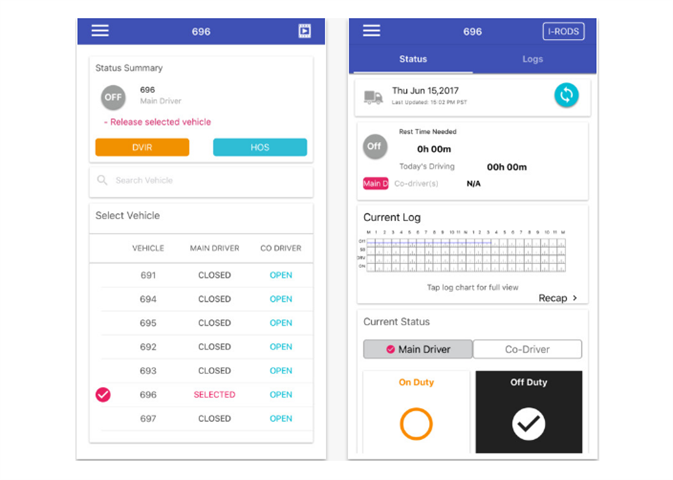
FleetUp's Voice Over HOS app is designed to assist both drivers and fleet managers in complying with the Electronic Logging Device mandate, requiring commercial carriers and drivers to use ELDs to track hours of service.
FleetUp VoHOS offers automatic voice assistance, alerting drivers to possible HOS infractions and providing step-by-step instructions on how to stay in compliance. Leveraging step-by-step voice instructions to comply with ELD regulations, the Voice Assistance feature reminds drivers to log out and end trips, complete pre- and post-DVIRs and take necessary breaks to avoid shift violations.
“FleetUp HOS was designed with safety, simplicity and ease of use in mind, not just for those managing the data, but also for the drivers who are on the forefront of being responsible for complying with ELD regulations,” said Ezra Kwak, chief technology officer at FleetUp. “As a FMSCA-certified platform, HOS violations can be eliminated when complying with Voice Assistance commands within the app.”
FleetUp VoHOS is triggered by HOS events such as trip status, remaining driving hours, potential violations, DVIR completion reminders, app training and usage.
The FleetUp HOS Companion App is available for download immediately from Google Play for Android devices and is coming soon to the App Store for iOS devices, included with any FleetUp ELD or Fleet Management subscription purchase.
Follow @HDTrucking on Twitter
...Read the rest of this story