Author: Vitaliy Dadalyan

Earnings Watch: Schneider Profit Rises 5.2%

Trucking, intermodal and logistics services provider Schneider National Inc. on Aug. 1 reported that its second quarter profit increased 5.2% from a year earlier while revenue improved 8.1%.

Net income totaled $46.5 million as earnings per share fell to 27 cents from 28 cents. Adjusted earnings totaled 23 cents per share, meeting Wall Street expectations.

The increase in revenue to $1.075 billion was largely attributed to the June 2016 acquisitions of carriers Watkins & Shepard and Lodeso, higher fuel surcharge revenue, brokerage growth, and revenue generated from the company's equipment leasing business

“We are pleased with our performance in the second quarter and reported overall results that were in line with what we had expected across all three of our businesses, including a number of key customer wins that we anticipate will help set the stage for our results in the second half of 2017,” said Chris Lofgren, CEO.

Schneider's truckload segment reported revenue excluding fuel surcharge of $543 million, a 4.5% improvement from a year earlier while income from operations fell 13.7% to $53.2 million.

Inflationary driver costs and lower gain on sale of equipment due to the continued weakness in the used equipment market were partially offset by earnings improvements from effective fleet sizing, freight selection, and improving market conditions throughout the quarter, according to the company.

Intermodal segment revenue minus fuel surcharges increased 3.8% to $194.3 million while income from operations decreased 17.7% to $11.2 million.

The hike in Intermodal revenue minus fuel surcharges was due to a 10.6% increase in intermodal volume partially offset by a 6.2% decrease in revenue per order, according to Schneider. Intermodal revenue per order was $1,858, a decrease of $123 compared to second quarter 2016 due to growth in the East and Intra-West, which have shorter lengths of haul, and the continued competitive pricing environment.

Schneider's logistics ...Read the rest of this story
Fleet exoneration: Using video to determine truck accident liability

Inattention, excessive speed, failure to yield, and unsafe lane changes are among the top causes of truck collisions, according to the National Highway Traffic Safety Administration (NHTSA). For fleet managers, preventing collisions caused by their own drivers can be quite challenging because risk factors must be measured before an accident occurs.

read more

...Read the rest of this story

Doing the math on the ELD mandate

Talking about the electronic logging device (ELD) mandate these days is like opening up Pandora's Box – a lot of negatives come screaming out, with the lid slammed shut before “hope” gets a chance to escape.

In the eyes of many within trucking, the ELD mandate is nothing but a burden – a significant extra cost that can't be recouped via “savings” such as by jettisoning pencil and paper recordkeeping.

read more

...Read the rest of this story

Nationwide Rail Services Gains Safety Advantage With Each Drop-And-Hook

<img width="150" src="http://www.automotive-fleet.com/fc_images/articles/m-nationwide-rail-services-1.jpg" border="0" alt="

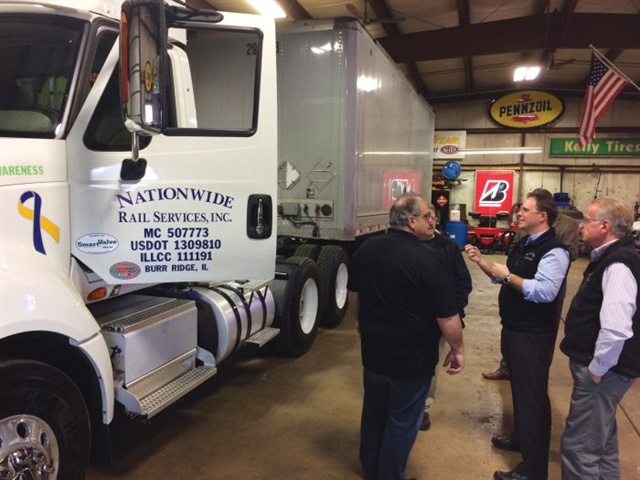
NRS shared with their insurance company how the SmartValve reduces driver injuries by conducting a live demonstration with the assistance of Rush Truck Centers. 

">

NRS shared with their insurance company how the SmartValve reduces driver injuries by conducting a live demonstration with the assistance of Rush Truck Centers. 

">

If Nationwide Rail Services were to include “safety” as a line item in its assets, it wouldn't seem far-fetched to its insurance carrier. The 30 drivers employed by NRS perform 300 to 400 drop-and-hook operations every day, with a chance for injury each time ­— more so as the average age of the driver increases. But NRS is proactively mitigating workers' compensation costs, and its insurance carrier is participating in the process.

“Our company's success is built on a foundation of safety,” says NRS President and CEO Joseph Barton. “We take great pride in our strong relationship with safety coordinators and trainers at our insurance carrier in our ongoing quest for top-notch safety.

“Many of the trailer lots that NRS supports have trailers wedged in too tight to access landing gear, the lots are uneven from years of trailer storage, and, due to new [federal] rules, drivers have limited time to wait for yard trucks,” he explains. “All this results in drivers having to get in and out of the cab far more often with each drop-and-hook.”

NRS discovered that drivers getting in and out of the cab account for the highest number of trucking injuries, with the second highest resulting from the strain involved in adjusting landing gear. With an average of $55,000 per workers' comp claim for significant, non-fatal drop-and-hook related injuries, NRS looked for a solution to keep drivers safer and healthier.

Rush Truck Centers in Huntley, Illinois, recommended the fleet install the Hadley SmartValve, an electronic height control system with advanced features to make drop-and-hook operations faster, easier, and safer. NRS installed the SmartValve system on five of its International ProStar day cabs in September ...Read the rest of this story