Author: Vitaliy Dadalyan

Economic Watch: Core Capital Goods Orders Soar, Existing Home Sales Slip

New orders for big-ticket durable goods fell in July by the most in nearly three years, as orders and shipments for core-capital goods surged, according to a new report, while a separate one showed the market for existing home sales declined following a drop in new home sales.

The 6.8% drop in orders for new durable goods was largely due to drop in the volatile aircraft sector and follows a revised 6.4% improvement in June, according to the Commerce Department. Many analysts were anticipating a slightly larger decline.

Excluding transportation orders, new orders for durable goods increased 0.5% in July, marking three consecutive monthly improvements.

Shipments of durable goods increased 0.4% in July from the month before, the third straight monthly gain.

The closely watched orders for nondefense capital goods minus aircraft, an indicator of business investment, increased 0.4% in July, slightly better than Wall Street expectations, and is up from being nearly unchanged in June. Compared to July 2016, orders for these goods are up 3.3%.

Shipments of core capital goods jumped 1% in July following an upwardly revised to a 0.6% increase in June following an originally reported 0.1% gain. Core capital goods shipments are used to calculate equipment spending in the government's gross domestic product measurement.

The gain in durable goods shipments translates into a “special plus and one that will lift gross domestic product,” once the third quarter is over and numbers are released, according to analysts at Econoday.

“Positives are definitely the theme of today's report, one that helps offset last week's unexpected decline in manufacturing production and supports the enormous strength being signaled by advance regional reports,” they said. “The economy may very well get a solid second-half boost from what has been an improving factory sector.”

Existing Home Sales Drop Following New Home Decline

On the other hand, sales of existing ...Read the rest of this story

The Fleet Owner 500 Awards Finalists

Winners in nine categories will be announced at the first-ever North American Commercial Vehicle show in Atlanta at the end of September.

To honor advances and innovation in private fleet operations across the country, Fleet Owner is holding its inaugural “Fleet Owner 500 Awards” ceremony this fall in conjunction with the North American Commercial Vehicle (NACV) exposition in Atlanta, GA.

Eighteen fleets drawn from nine distinct industry segments are in the running for the awards, with these motor carriers selected from the annual “Fleet Owner 500” list of the largest private fleet operations in North America.

read more

...Read the rest of this story

Spot Truckload Rates Fall for Second Straight Week

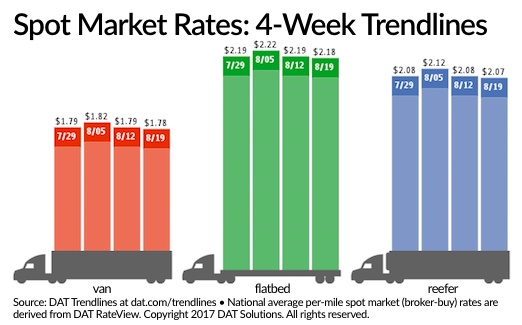
Spot truckload freight rates moved slightly lower for the second consecutive week for the seven-day period ending August 19 as freight volume remained strong, according to the freight matching service provider DAT Solutions.

The number of loads posted on its load boards declined 2.1% compared to the previous week while available truck capacity was unchanged. The is due a seasonal transition, driven largely by produce harvests, according to DAT Analyst Peggy Dorf on the DAT blog.

“Reefers are needed, but anything that affects reefers will affect dry van traffic, as well, so there's a geographic shift in the van segment,” she wrote. “More loads are available in the Upper Midwest and Northeast, while the Southeast is winding down, and trends in the Western region are mixed.”

Nationally, van load posts fell 1% and truck posts increased 1% to push the van load-to-truck ratio from 4.9 to 1 to 4.8 to 1. The national average van rate fell 1 cent to $1.78 per mile, a small change in an otherwise firm freight market, but down from a four-week high of $1.82 per mile. All reported rates include fuel surcharges.

Refrigerated load posts increased 5% and truck posts declined 2%, which resulted in a 7% increase in the load-to-truck ratio, hitting 9.3 to 1. At $2.07 per mile, the national average reefer rate was 1 cent lower compared to the previous week but is down 5 cents from two weeks earlier.

The Midwest is heating up for reefers, which is a normal trend for this time of year. More loads are moving out of the Grand Rapids market, and outbound rates rose in Green Bay and Chicago, according to DAT. More loads left Sacramento last week but it's still not a high-volume market at this point in the summer.

Flatbed load posts declined 7% while truck posts ...Read the rest of this story

Magellan says ELD solution now FMCSA certified

Magellan announced that its commercial-grade truck navigation and electronic logging device (ELD)-compliant Hours of Service (HOS) tracking solution is now Federal Motor Carrier Safety Association (FMCSA) certified and listed on the FMCSA online registry.

Magellan explained its HOS/ELD solution offers automated logging tools, reports and alerts to keep drivers on time and in compliance. An HOS management web portal allows for HOS, DVIR and IFTA reports.

read more

...Read the rest of this story

Leasing rules are changing, but fiscal advantages will remain

Broad changes will go into effect a year from now altering how equipment leases are accounted for on corporate balance sheets. Yet those changes shouldn't impact trucking too much.

New lease accounting rules will hitting the books in a little over a year, changing how trucking companies that lease trucks, trailers and other equipment “recognize” the value of such assets on their balance sheets.

read more

...Read the rest of this story