Author: Vitaliy Dadalyan

As Texas begins to recover, Florida braces for Hurricane Irma

Damage from Harvey not as bad as feared, consultant says

The damage to infrastructure and oil refineries from Hurricane Harvey does not appear to have been as severe as initially feared.

But as freight shipments resume and recovery efforts continue in and around the Houston area, preparations are well underway throughout Florida for Hurricane Irma, expected to make landfall over the weekend.

“It is my understand the infrastructure recovery is happening fairly quickly,” Josh Brogan, vice president with global management consulting firm A.T. Kearney, told Fleet Owner.

read more

...Read the rest of this story

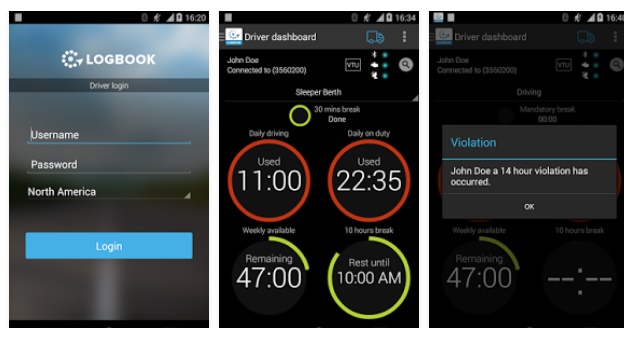
Q. I know that drivers must have an ELD information packet available, but can this information packet be in electronic format?

A. Yes. The user's manual, instruction sheet, and malfunction instruction sheet can be in electronic form, which conforms to the federal register titled “Regulatory Guidance Concerning Electronic Signatures and Documents” (76 FR 411).

No matter the format, beginning Dec. 18, 2017, a driver using an ELD is required to have an ELD information packet onboard his or her vehicle. The information packet must consist of:

A user's manual for the driver describing how to operate the ELDAn instruction sheet describing the data transfer mechanisms supported by the ELD and step-by-step instructions to produce and transfer the driver's hours-of-service records to an authorized safety officialAn instruction sheet for the driver describing ELD malfunction reporting requirements and recordkeeping procedures during ELD malfunctions

In addition, the driver should have a supply of blank driver's record of duty status (RODS) paper graph-grids sufficient to record his or her duty status and other related information for a minimum of 8 days in the event the ELD malfunctions or is deemed non-compliant.

The Federal Motor Carrier Safety Administration (FMCSA) recommends that drivers have this packet and graph-grids in their vehicle prior to the Dec. 18, 2017, ELD Mandate deadline.

Follow @HDTrucking on Twitter

...Read the rest of this story

Spot Truckload Freight Rates Jump as Harvey Disrupts Supply Chains

The availability of spot truckload freight increased 2.9% while available trucking capacity fell 4.3% for the week ending Sept. 2, the first full week after Hurricane Harvey made landfall, according to DAT Solutions and its network of load boards.

This resulted in national average rates rising compared to the previous week with the biggest happening in the van sector, up 12 cents to $1.90 per mile, and its best showing out the past four weeks.

Flatbeds and reefers moved up more modestly, 2 cents and 3 cents, respectively, with flatbeds at an average of $2.20 per mile and reefers not far behind at $2.10 per mile. Both were also at four-week highs.

These rates include a fuel surcharge but not accessorial fees that compensate the carrier for loading, unloading, layovers, and detention, all of which have likely risen significantly for trucks carrying relief supplies, according to DAT. The rearrangement of supply chains, the difficulty of shipping in the flooded region, and a tightening spot market pushed rates higher on 78 of the top 100 van lanes in the country.

Nationally, van load posts increased 4% and truck posts declined 5% compared to the previous week, to yield a 9% increase in the load-to-truck ratio, from 5.2 to 5.6 loads per truck.

Reefer load posts increased 11% and truck posts declined 4%, which resulted in a 16% increase in the load-to-truck ratio, to 11.6 loads per truck.

Flatbed load posts fell 4% while truck posts dipped 4%. That caused the load-to-truck ratio to increase 0.5%, to 26.7 loads per truck.

Not surprisingly, the spot truckload freight market felt the effects of Hurricane Harvey and its aftermath in several ways. The number of available outbound loads from Houston plunged 72% compared to the previous week, when the storm came ashore late on Aug. 25. Despite the loss of volume, ...Read the rest of this story

Piedmont Natural Gas opens Hickory CNG refueling station

Piedmont Natural Gas announced it has added a Hickory, NC, location to its network of public compressed natural gas (CNG) refueling stations.

The Hickory station, located near the junction of Interstate 40 and U.S. 321, is the 11th public refueling station Piedmont has opened throughout its service territory of North Carolina, South Carolina and Tennessee. Here's a map that shows all of Piedmont's public CNG refueling facilities.

read more

...Read the rest of this story