Author: Vitaliy Dadalyan

FMCSA Issues Two Commonsensical ELD Exemptions

Having decided to grant part of a United Parcel Service request for a limited 5-year exemption from some provisions of the electronic logging device mandate, the Federal Motor Carrier Safety Administration will now allow all motor carriers— not just UPS-- and drivers to make use of two new temporary exemptions from the ELD rule.

The first exemption will temporarily permit the use of portable “driver-based” ELDs to record engine data “only when the driver is in a CMV and the engine is powered." What that means in plainer English is that drivers who use smartphone- or tablet-based ELDs (as do UPS drivers) will be able to indicate a change of duty status when they are outside of and away from their truck.

The second exemption will temporarily allow carriers to configure an ELD with a “yard-move mode” that does not require a driver to re-input the truck's yard-move status every time the tractor is powered off.

The two exemptions are being granted for the 5-year period beginning on Oct. 20, 2017 and ending on Oct. 20, 2022— unless they are rescinded at any time by FMCSA.

The agency stated that the exemptions will be rescinded if:

Motor carriers and/or drivers fail to comply with the terms and conditions of the exemptionsThe exemptions have resulted in a lower level of safety than was maintained before they were grantedContinuation of the exemptions would not be consistent with the goals and objectives of 49 U.S.C. 31136(e) and 31315(b)

FMSCA further stated that: “Interested parties possessing information that would demonstrate that motor carriers or drivers participating in either of the exemptions are not achieving the requisite statutory level of safety should immediately notify FMCSA.”

The agency noted that it will evaluate any such information and “if safety is being compromised or if the continuation of the exemption is not consistent ...Read the rest of this story

The Human Element, First and Foremost

<img width="150" src="http://www.automotive-fleet.com/fc_images/blogs/m-mb-trucker.jpg" border="0" alt="

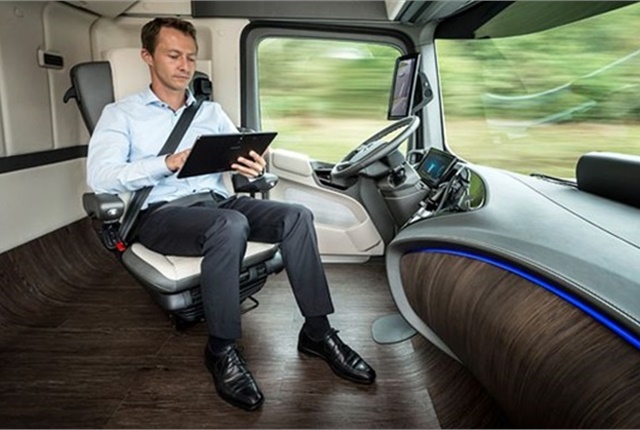
Properly deployed, technolgy should make our lives easier and more productive. Photo: Mercedes-Benz

">

Properly deployed, technolgy should make our lives easier and more productive. Photo: Mercedes-Benz

">

With 2017 about to go into the books, it seems likely it will be remembered as a turning point in the history of trucking and transportation– the year when “the future” stopped becoming something we all read about, talked about, and wondered about and instead became a reality to be carefully considered and prepared for.

In the course of the past year, give or a take a few months, every single Class 8 truck manufacturer serving the North American market has unveiled a new, or significantly upgraded truck. And all of these new models not only feature the latest technological breakthroughs, but are designed with the next 10 to 15 years' worth of technology in mind.

For the first time ever, fleets have the option of buying “upgradable” trucks – vehicles that will only increase in productivity and efficiency as new technologies come on line and can be uploaded into the truck's onboard computer system.

And yet, for all the futuristic tech designed into these new trucks, it is striking to note that the majority of it has been engineered with the needs of drivers and fleet managers foremost in mind. We're seeing this again and again now as OEMs and suppliers alike bring new systems online. Everything from advanced cruise control systems to active and passive collision avoidance systems to telematics “war rooms” manned by knowledgeable, friendly event managers who are there to make sure a “human touch” is present during the entire repair process.

And that's what technology is supposed to do. From the time oneof our early ancestors first picked up a sharp stone to help skin an animal he or she had just killed, tools and technologies have developed over the ages to make our lives ...Read the rest of this story

Intelligent Brake Interlock

WABCO, a global supplier of technologies and services that improve the safety, efficiency, and connectivity of commercial vehicles, introduced Intelligent Brake Interlock, an advanced electronic brake interlock system that improves the safety of tank trailers that haul hazardous materials or are equipped with cryogenic equipment.

WABCO's Intelligent Brake Interlock uses proprietary technologies to improve the safe operation of tank trailers by ensuring that the vehicle does not move during loading and unloading. The breakthrough system monitors vehicle speed as well as the position switch and locks the foundation brakes electronically. An electronic failsafe provides an additional layer of safety by helping to prevent inadvertent brake activation while the vehicle is in motion.

Now available for specification and retrofit, Intelligent Brake Interlock improves safety and reliability of transportation for pneumatic-braking trailers hauling gasoline, diesel and crude oil, cryogenic and compressed gases such as hydrogen, oxygen, carbon dioxide, argon and natural gas, food grade materials, as well as heated tanks and chemicals.

Follow @HDTrucking on Twitter

...Read the rest of this story

Ryder Adds DriveCam to 4,400 Trucks

<img width="150" src="http://www.automotive-fleet.com/fc_images/news/m-lytx-dc3p-drivecam-interior-center-f-2-1.jpg" border="0" alt="

Image courtesy of Ryder and Lytx

">

Image courtesy of Ryder and Lytx

">

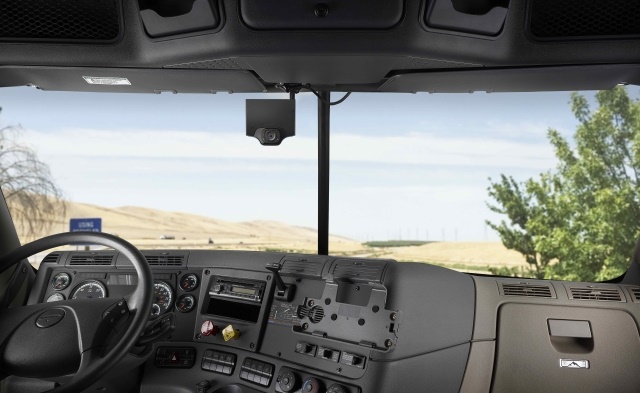
Ryder System, Inc., a provider of commercial fleet management, dedicated transportation, and supply chain solutions, announced its partnership with Lytx and the implementation of DriveCam into 4,400 Ryder vehicles supporting its Supply Chain Solutions (SCS) and Dedicated Transportation Solutions (DTS) business divisions.

The DriveCam program addresses safety by combining data and video analytics with real-time driver feedback and coaching, resulting in reductions in injuries and collisions. The Company made the decision to incorporate DriveCam's solution as part of its operational initiatives after a six-month DriveCam pilot at various Ryder locations.

“As an industry leader in safety and security, we recognize the importance of investing in technologies like DriveCam that enable us and our professional drivers to make continuous improvements around safe practices and driving behaviors,” said Sandy Hodes, Ryder's SVP and Deputy General Counsel. “Our partnership with Lytx reinforces our commitment to our drivers and our core value of safety in the communities we serve.”

In the past 12 months, the DriveCam program has allowed Ryder to identify and target the top behaviors contributing to fleet risk. This has enabled Ryder's professional drivers to significantly improve their results, reducing well over half the number of near collisions while increasing both following distance and response time. The program has also enhanced the quality of communications between Ryder and its professional drivers, and in turn, has encouraged the Company's drivers to embrace continuous improvement and best practices adoption.

“While the DriveCam program does the heavy lifting to pinpoint risk in fleets, it's up to the Ryder team to take action on the insights DriveCam delivers,” said Lytx Executive Vice President and Chief Client Officer David Riordan. “The extent to which Ryder has improved driver behavior is a testament to the quality of its drivers, engagement of its frontline managers, ...Read the rest of this story

Endurant automated transmission: A league of its own

Some 42 months before the new Endurant automated transmission's launch, the program engineers locked themselves in an abandoned warehouse to start completely from scratch. Well, not quite, but close — and it was about that consummate a ground-up effort. Here are some scenes and impressions from testing out the transmission at Eaton Proving Grounds in Marshall, MI.

read more

...Read the rest of this story