You can’t avoid new technology


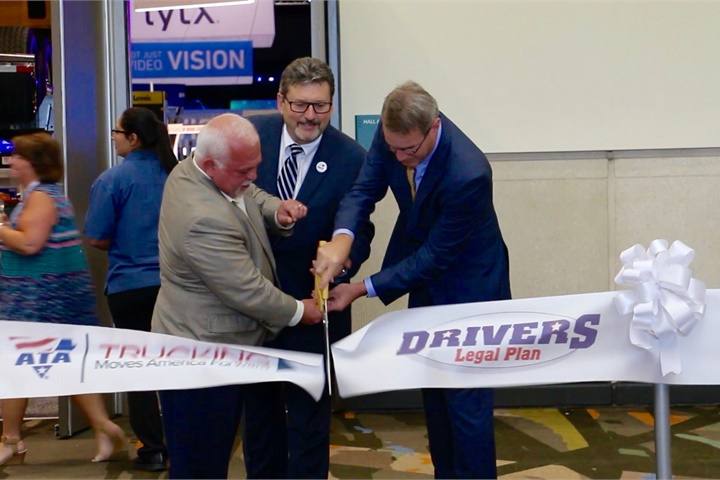
The American Trucking Associations' 2017 Management Conference & Exhibition kicked off over the weekend in Orlando, Florida, with the first exhibit hall session, educational sessions on topics such as CSA and big data, awards galore, and a special economic and business session.
Follow @HDTrucking on Twitter
...Read the rest of this storyORLANDO – The trucking industry could be short 50,000 drivers by the end of 2017, warned American Trucking Associations Chief Economist Bob Costello Sunday at the American Trucking Associations Management Conference & Exhibition.
The driver shortage was a key part of a wide-ranging presentation called “How Do Your Numbers Stack up?”
According to the report, ATA's first in-depth examination of the driver shortage since 2015, the driver shortage eased in 2016 to roughly 36,500 – down from 2015's shortfall of 45,000.
“We experienced a ‘freight recession,' last year, which eased the pressure on the driver market,” Costello said. “Now that freight volumes accelerating again, we should expect to see a significant tightening of the driver market.”
In the report, ATA projects the shortage to reach 50,000 by the end of 2017 and if current trends hold the shortage could grow to more than 174,000 by 2026.
Driver turnover at large truckload fleets, which hit an all time high of 130% in 2005, averaged 81% last year with the freight slowdown. But by the second half of this year, it was back up to 90%, Costello noted.
While 50,000 is an all time high for the industry, he said, it feels even worse. “There's quality vs. quantity. This is where the shortage feels much worse.
Derek Leathers, president and CEO of Werner Enterprises, explained, “The real issue I think we're all faced with is the quality driver shortage. The ability to find drivers who meet the quality expectations we all have. This summer we crested 100,000 applications for the year. The problem was the hire rate in terms of meeting quality criteria was 2.7%.”
Costello detailed the causes of the shortage in the report, including the demographics of the aging driver population, lifestyle issues, regulatory challenges and others; as well as possible solutions.
Over the next 10 years, he said, ...Read the rest of this story
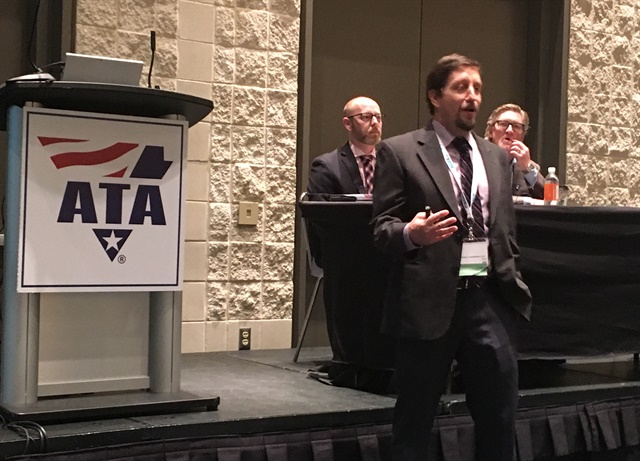
FMCSA's Joe DeLorenzo speaking in Orlando. Photo: David Cullen
">FMCSA's Joe DeLorenzo speaking in Orlando. Photo: David Cullen
">ORLANDO-- Boiled down to its essence, the congressionally mandated review of the Compliance, Safety, Accountability program by the National Academies of Sciences found that the Federal Motor Carrier Safety Administration should move to a more scientific method to drive the Safety Measurement System that signals which motor carriers are at highest risk for future crashes, according to an FMSCA official.
“The National Academies said to FMCSA, ‘The model you have is pretty good, but it's not based on a principled scientific approach. We would like to see a better statistical model behind SMS,'” FMCSA Director of Compliance and Enforcement Joe DeLorenzo, said on Oct. 22 during an educational session here at the American Trucking Associations' annual Management Conference & Exhibition.
He said NAS recommended that FMSCA take about two years to study a more scientific modeling approach known as “Item Response Theory” and then consider implementing it to make the SMS function more accurately. “Our focus,” he told the audience, “remains focused on the prevention of crashes, not the prediction of crashes.”
DeLorenzo said the hope is that an IRT-based method would help develop “an estimate of the measure of ‘safety culture' for each carrier and be used to monitor and identify carriers in need of intervention,” rather than just zero in on violations.
To accomplish all that may take digging into a variety of data points, such as driver pay, driver turnover, and miles travelled. He likened such an approach to the IRT-type scoring used in such standardized tests as the SAT (Scholastic Aptitude Test), familiar to generations of students applying for college admission, that weights answers not just on whether they are “right” or “wrong” but also on how they reflect a student's depth of understanding.
“This is a long-term development,” DeLorenzo ...Read the rest of this story