ATA adopts policy to shape development, regulation of automated vehicles
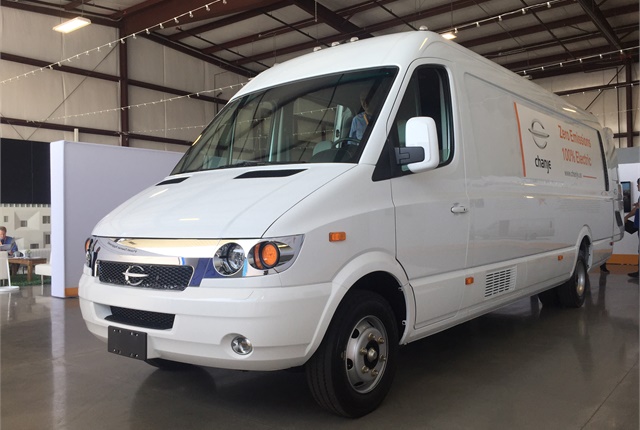
The Chanje V8070 provides 100 miles of electric range with 3,000 pounds of payload, and can reach a top speed of 80 mph.
">The Chanje V8070 provides 100 miles of electric range with 3,000 pounds of payload, and can reach a top speed of 80 mph.
">Chanje, makers of a Class 5 electric delivery van, is partnering with eMotorWerks, a charging solutions provider, to deliver an energy-as-a-service (EaaS) program to its commercial fleet customers with a smart charging platform, the company has announced.
The new fleet operating system, based on eMotorWerks' JuiceNet control platform, uses automated algorithms and load balancing to allow multiple charging stations to operate simultaneously under peak load settings, the companies announced in a release.
"Our collaboration with eMotorWerks allows us to deliver dynamic charging capabilities that support drivers, utilities, operators, and CFOs alike," said Bryan Hansel, CEO of Chanje. "Along with our new partner, we look forward to introducing fleets to the world of smart-grid charging."
These stations will give commercial fleet operators access to a customized cloud-based JuiceNet control platform to manage EV charging, avoid peak pricing, maximize charging with renewable energy, and track electricity usage.
“By combining our JuiceNet-enabled stations with the automotive and EV expertise of Chanje, our collaboration will deliver market-leading smart grid charging products to both drivers and automakers in one seamless approach,” said Valery Miftakhov, founder and CEO of eMotorWerks.
Chanje Energy unveiled its Class 5 battery-electric commercial van at an Oct. 18 media and customer event in Fullerton, Calif. The vehicle provides 100 miles of electric range with 3,000 pounds of payload, and it can reach a top speed of 80 mph.
Chanje has partnered with Ryder for sales and service.
Ryder Named Exclusive Provider for Chanje Electric Van
Follow @HDTrucking on Twitter
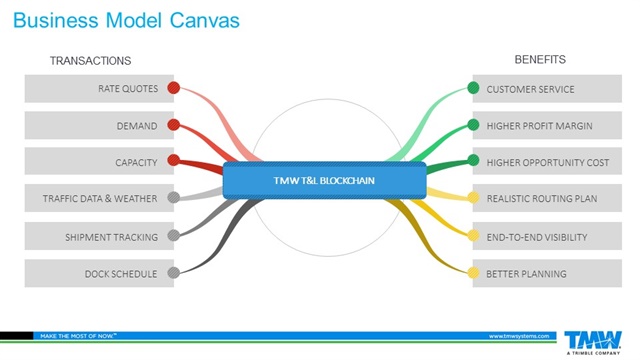
...Read the rest of this storyBlockchain can be used to manage and monitor every aspecft of a logistics chain in real time. Photo: TMW Systems
">Blockchain can be used to manage and monitor every aspecft of a logistics chain in real time. Photo: TMW Systems
">A while back, my boss, HDT editor in chief Deborah Lockridge, asked me to get up to speed on emerging blockchain technology with an eye toward doing a web article.
I duly went out and read a few articles on the subject – but I didn't get it. So I found a couple of promising YouTube videos and watched them. And it still didn't click for me. It just seemed to be an incredibly complex concept that I was never going to grasp.
Last week, TMW Systems hosted a web seminar to explain blockchain and its forthcoming move into this technology and market. This seminar was better – but I still didn't have a handle on what, exactly, was going on with blockchain. So I called TMW's executive vice president, Tim Leonard, the following Monday, and he was graciously able to talk me through this new technology.
Turns out I was overthinking it.
So if you're like I was, having trouble wrapping your head around what blockchain is and how it works, let me see if I can help you out. (I mean, that's my job, after all.)
The first thing you need to understand is that blockchain is an internet-based system that enables efficient, fully-transparent agreements for companies that need to ship, or actual ship goods. It's a logistics-enabler.
In a way, it's sort of a mini-internet. Think of Amazon: It's a slick, powerful commerce network in its own right. But it is powerless without the internet. But when it is plugged into the internet, it becomes an incredibly powerful and efficient tool for buying, selling, shipping and receiving goods.
Same basic concept, here.
Now, imagine there's a brand-new widget rolling off an assembly line right now ...Read the rest of this story
Photo of Tom Camp courtesy of UPS.
">Photo of Tom Camp courtesy of UPS.
">Tom Camp has driven more than 1 million miles for UPS without an accident and achieved a feat no other company driver has achieved — a spotless 55-year safety record.
Camp, 77, began his UPS career in 1962 delivering packages in suburban Detroit. Only one other UPS driver has reached 50 years without an accident. Ron Sowder of Dayton, Ohio, had 50 accident-free years when he retired in 2012. The Livonia, Mich.-based Camp has been wearing the number 50 on his uniform patch.
"You need to assume other drivers are not as aware as you are," said Camp. "If you assume the other guy is daydreaming, that's a good first step."
UPS is donating a $25,000 grant in Camp's honor to the University of Michigan's Transportation Research Institute, and Gov. Rich Snyder has declared Oct. 18, 2017 Safe Driving Awareness Day in the state.
Of the 102,000 UPS drivers, 9,349 have driven for 25 years or more without an avoidable accident. Of those, 91 have gone 40 years and 10 have reached the 45-year mark with an accident. Ronnie McKnight, who drives in Manhattan, New York, is now number two with 48 years of safe driving.
During his tenure, Camp has seen an increase in congestion and distraction by other drivers on the roads.
"Traffic has doubled since I started with Big Brown," said Camp. "I can't count how many times I've seen folks do crazy things behind the wheel – reading the paper or doing their make-up. Cell phones are a part of it, too, but it's more than just that."
Follow @HDTrucking on Twitter
...Read the rest of this storyORLANDO – Three of North America's largest trucking associations – American Trucking Associations, the Canadian Trucking Alliance, and Mexico's CANACAR – have come to the defense of the North American Free Trade Agreement, which they see as a business driver.
In a joint statement released during ATA's annual Management Conference & Exhibition this week, the groups urged negotiators to “update the trade agreement in a manner that continues to benefit trade.”
Motor carriers haul the vast majority of trade by value across international borders, supporting the supply chain for everything from cars to agriculture and pharmaceuticals, the statement notes.
“Trucking and trade are synonymous,” said Bob Costello, the ATA's chief economist, during a session at the meeting. Every year, 46,000 U.S. trucking jobs can be linked to trade with the Canada and Mexico, he said.
NAFTA negotiations have been extended into 2018 after hitting an impasse on several issues such as the process used to resolve disputes, and a U.S. proposal to include a sunset clause that would require the agreement to be renewed every five years.
The trade agreement has had an undeniable impact on the trucking industry, with trucks moving 71% of the value of surface trade across the Canada-U.S. border and 82% of the value across the U.S.-Mexico border.
“NAFTA truck-transported trade supports tens of thousands of trucking industry jobs across the continent and generates billions in revenue annually,” notes the joint statement. “Trucking jobs created from North American trade are good-paying jobs, from our professional commercial drivers, to dispatchers, sales personnel, managers, and many others,” it reads. “In fact, our industry demonstrates how trade creates good, solid long-term jobs across the continent. The ripple effects are significant, too. In order to haul all the trade across our borders, our industries have to buy a significant amount of goods and services, ...Read the rest of this story
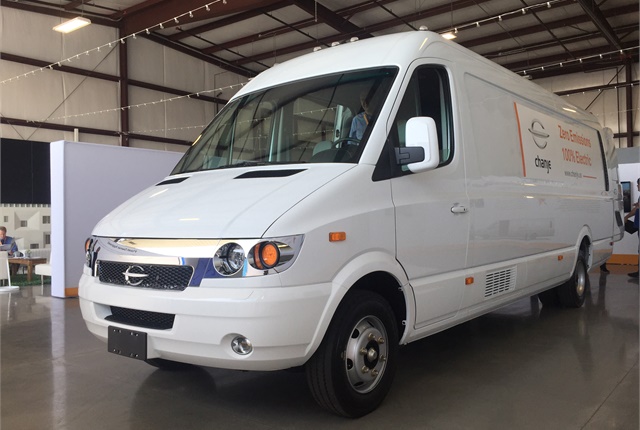
The Chanje V8070 provides 100 miles of electric range with 3,000 pounds of payload, and can reach a top speed of 80 mph.
">The Chanje V8070 provides 100 miles of electric range with 3,000 pounds of payload, and can reach a top speed of 80 mph.
">Chanje, makers of an electric delivery truck, announced today it is partnering with eMotorWerks, a charging solutions provider, to deliver an energy-as-a-service (EaaS) program to its commercial fleet customers with a smart charging platform.
“We are offering fleet customers a ‘one-stop-shop' of purpose-built electric trucks as well as the energy services, without them having to worry about the installation or energy load management,” said Bryan Hansel, CEO of Chanje. “Our collaboration with eMotorWerks allows us to deliver dynamic charging capabilities that support drivers, utilities, operators, and CFOs alike. Along with our new partner, we look forward to introducing fleets to the world of smart-grid charging.”
The new fleet operating system, based on eMotorWerks' JuiceNet control platform, uses automated algorithms and load balancing to allow multiple charging stations to operate simultaneously under peak load settings, the companies announced in a press statement.
“By combining our JuiceNet-enabled stations with the automotive and EV expertise of Chanje, our collaboration will deliver market-leading smart grid charging products to both drivers and automakers in one seamless approach,” said Valery Miftakhov, founder and CEO of eMotorWerks.
These stations will give commercial fleet operators access to a customized cloud-based JuiceNet control platform to manage EV charging, avoid peak pricing, maximize charging with renewable energy, and track electricity usage.
Chanje Energy unveiled its Class 5 battery-electric commercial van at an Oct. 18 media and customer event in Fullerton, Calif. The vehicle provides 100 miles of electric range with 3,000 pounds of payload, and it can reach a top speed of 80 mph.
Chanje has partnered with Ryder for sales and service.
Ryder Named Exclusive Provider for Chanje Electric Van
Follow @HDTrucking ...Read the rest of this story
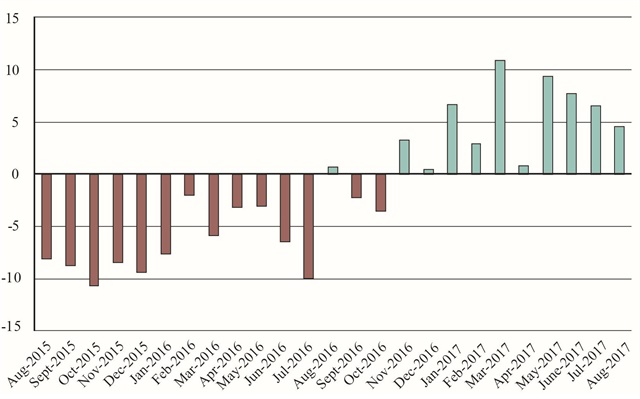
U.S.-NAFTA freight value percent change from previous year. Graphic: U.S DOT
">U.S.-NAFTA freight value percent change from previous year. Graphic: U.S DOT
">The value of freight moved between the U.S. and its North American Free Trade Agreement Partners totaled $97.4 billion during August as all five major transportation modes carried more freight, according to the U.S. Transportation Department.
The 4.6% rise is the 10th consecutive month in which the year-over-year value in current dollars of U.S.-NAFTA freight increased from the same month of the previous year.
The value of commodities moving by pipeline increased 13.2%, air by 8.4%, vessel by 4.5%, truck by 3.6%, and rail by 3.2%. The large percentage increase in the value of goods moving by pipeline is due in part to an increase in the volume of mineral fuel imports, according to the department.
Trucks carried 64.7% of U.S.-NAFTA freight and continued to be the most utilized mode for moving goods to and from both U.S.-NAFTA partners. Trucks accounted for $31.9 billion of the $52 billion of imports, or 61.4%, and $31.1 billion of the $45.4 billion of exports, or 68.5%.
Rail remained the second largest mode by value, moving 15.1% of all U.S.-NAFTA freight, followed by vessel, 5.8%; pipeline, 5.5%; and air, 3.9%.
The surface transportation modes of truck, rail and pipeline carried 85.3% of the total value of U.S.-NAFTA freight flows
Comparing August 2016 to August 2017, the value of U.S.-Canada freight flows increased by 4.7% to $49.5 billion as the value of freight on four major modes increased from a year earlier.
The value of freight carried on pipeline increased by 20%, air by 7.1%, truck by 3.4%, and rail by 1.1%. Vessel decreased by 5.3% due in part to a decrease in the volume of mineral fuel shipments.
Trucks carried 58.9% of the value of the freight to and from Canada. Rail carried 15.9% followed by pipeline, 10.3%; air, 4.8%; and vessel, ...Read the rest of this story