Survey: Higher-than-average pay for foodservice drivers

The 13th annual Heavy Duty Aftermarket Week will be held Jan. 22-25 at the Mirage in Las Vegas. The event is a four-day conference for the North American independent heavy-duty aftermarket industry.
This year's keynote speaker will be Josh Linkner who is giving a presentation titled, “Everyday Innovation: Fueling People, Partners and Profits".
Linkner is the author of four books, two New York Times Bestsellers: Disciplined Dreaming: A Proven System to Drive Breakthrough Creativity, and The Road to Reinvention: How to Drive Disruption and Accelerate Transformation, as well as his latest book, Hacking Innovation. He is also the Founding Partner of Detroit Venture Partners, investing in and mentoring over 100 startups.
Linkner has twice been named the Ernst & Young Entrepreneur of the Year and is a President Barack Obama Champion of Change award recipient. He is a regular columnist for Forbes, The Detroit Free Press, and Inc. Magazine. His work on innovation has been featured in The Wall Street Journal, Harvard Business Review, CNN, and The New York Times
HDAW is a business-to-business, executive conference presented by a joint operating committee of industry leaders from 14 distinguished industry associations: American Council of Frame and Alignment Specialists, Association of Diesel Specialists, Auto Care Association/ HDDA, Automotive Electric Association, Commercial Vehicle Solutions Network, HDA-Truck Pride, Heavy Duty Manufacturers Association, Heavy Duty Aftermarket Canada, APRA's Heavy Duty Remanufacturing Group, International Truck Parts Association, Overseas Automotive Council, Power Heavy Duty, Service Specialists Association, and Vipar Heavy Duty.
Heavy Duty Aftermarket DialogueDuring HDAW, The Heavy Duty Manufacturers Association, the Heavy Duty division of the Motor & Equipment Manufacturers Association, will host the 6th annual Heavy Duty Aftermarket Dialogue. The HDAD conference will be held on Jan. 22, 2018 at The Mirage, immediately preceding HDAW.
HDAD is co-presented by HDMA and MacKay & Company. The day-long conference is scheduled ...Read the rest of this story
Image: SmartDrive
">Image: SmartDrive
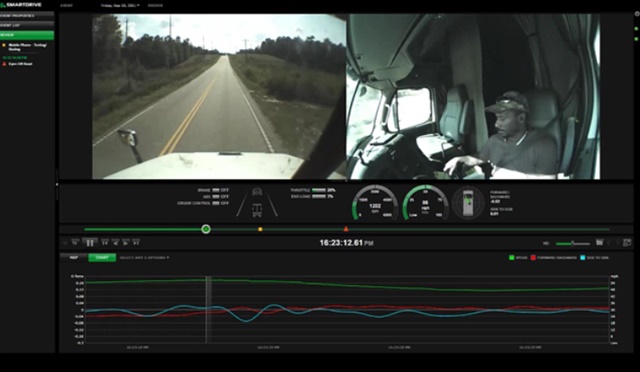
">SmartDrive Systems has introduced the SmartDrive SmartSense line of intelligent driver-assist sensors designed to identify dangerous driving risks.
By combining purpose-built sensors with engine computer data, telematics, accelerometer, and SmartDrive analytic data, the company has developed a solution to more accurately identify risk. With the SmartDrive's video review and a training database of over 200 million analyzed risky driving events, the sensor algorithms can be tuned to optimize triggering efficacy and system performance.
The first sensor in the suite, SmartSense for Distracted Driving, uses these advanced computer vision-based algorithms, paired with the SmartDrive video analytics platform, to address distracted and inattentive driving.
When combined with the SmartDrive program and its Extended Recording capability, SmartSense offers fleets a more complete picture of what led to driver distraction, how it manifested and what the outcome was, enabling fleets to provide detailed feedback and actionable coaching to improve driver safety.
Instead of relying exclusively on vehicle maneuvers, such as hard braking, aggressive swerving or lane departure to capture driver cell-phone use or other causes of distraction, the SmartSensor interprets driver cues proven to accurately indicate distraction, such as head and eye movements. When the sensor detects distraction, inattention or drowsiness, it triggers a video, which is prioritized and offloaded for immediate verification and intervention, allowing fleets to act quickly.
SmartSense for Distracted Driving operates with the SmartDrive video analytics platform and includes:
Distraction and inattention triggers that detect when eyes are off the road for a defined time period or a driver has exceeded a specific number of distracted incidentsPurpose-built hardware with infrared sensors to capture distraction even when sunglasses are wornIn-cab alerts when distraction or inattention occursPrioritized review and risk scoring for video of distraction eventsIntegration with the proven SmartDrive video safety programSmartSense for Distracted Driving will be available in the first quarter of 2018.
"With the SmartSense ...Read the rest of this story
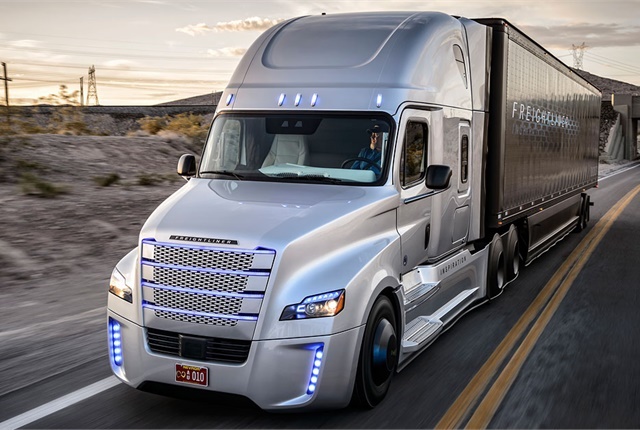
ATA has issued 21 policy points aimed at smoothing the eventual deployment and operation of autonomous trucks. Photo: Freightliner
">ATA has issued 21 policy points aimed at smoothing the eventual deployment and operation of autonomous trucks. Photo: Freightliner
">In a sign that events are accelerating rapidly on the autonomous trucks front, American Trucking Associations has unanimously approved its first-ever policy for the development of automated trucks at its annual meeting in Orlando, Fla. ATA's new policy covers a variety of topics including safety, the roles of the federal and state governments, uniformity across state lines, infrastructure, and education.
The new policy is comprehensive in nature and divided into eight key policy points that the agency has identified as crucial for the successful deployment and operation of autonomous trucks. Those eight policy points are Safety, Flow of Interstate Commerce, Federal Preemption and State's Rights, Uniform State Laws, Infrastructure and Connectivity, Public Education and Maintainability.
Working within those policy points, ATA developed more detailed action plans to work with various government and law enforcement agencies as well as OEMs, suppliers and members as autonomous technology use in trucking draws near.
Key points outlined in the new policy include:
The trucking industry, led by ATA, should invest in coalition building with government, academia, research institutions, and private sector to demonstrate the rising level of safety related to automated and connected vehicle technology.Demonstrations of automated trucks are needed to provide data to establish safety and other benefits of this technology. Initial data generated by technology developers, based on their safety and validation testing, will be valuable.Government regulators and lawmakers should revise or remove outdated safety-related laws, regulations, and guidance as data demonstrates a technology's ability to provide an equivalent or higher level of safety than current regulations support or incorporate.As automated truck technology is developed, tested, and commercialized, it is critical that federal, state and local laws do not create disparities that limit commerce and obstruct the successful adoption ...Read the rest of this story