Author: Vitaliy Dadalyan

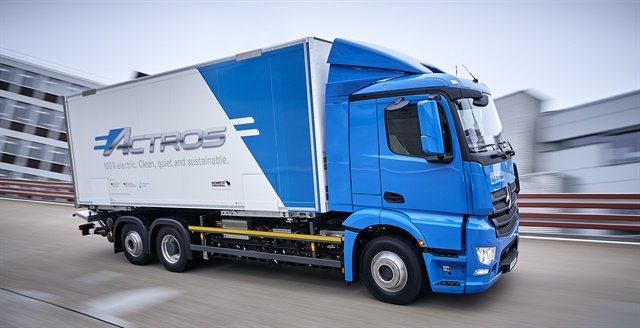
Daimler Fleet-Testing Heavy-Duty Electric Actros Truck

Daimler has begun fleet-testing its Mercedes-Benz eActros fully electric heavy-duty truck as it nears full production, planned to begin in 2021. Photo: Daimler AG

">

An all-electric heavy-duty hauler fitted with the Mercedes-Benz tri star may be on the market in just three years.

Taking the next step toward rolling out a fully electric heavy-duty hauler, Germany's Daimler Ag will soon be placing its Mercedes-Benz eActros emissions-free trucks with some customers so that they can test “their everyday feasibility and economic efficiency under real-life conditions.”

According to Daimler, the electric truck “could go into” full production starting in 2021.

Operating solely on battery power, the eActros offers a range of up to 200 km (124 miles) yet offers the “customary level of performance and payload,” the OEM stated in a Feb. 21 news release.

The customer test fleet consists of 10 trucks in 2-axle and 3-axle variants, with GVWs of 18 or 25 metric tons. The field-testing will start in the next few weeks and will run until at least mid-2020. Its aim is to establish energy requirements for some specific applications as well as the economic efficiency of the electric trucks and to compare their environmental performance vs. diesel trucks.

“Initially the [fleet testing] focus will be on inner-city goods transport and delivery services – the ranges required here are well within the scope of our Mercedes-Benz eActros,” said Stefan Buchner, Head of Mercedes-Benz Trucks.

"We have developed a vehicle that has been configured from the outset for electric mobility,” he added. “Compared with our prototype, quite a few technical changes have been made: the power supply is now ensured by eleven [lithium-ion] battery packs in all – and wherever possible we have used already proven components that are ready, or very close to ready, for use in [full] series production.”

The road testing will help drive “ongoing optimization ...Read the rest of this story

Economic Watch: Manufacturing at 40-Month High, Existing Home Sales Slip Again

A preliminary report about the U.S. manufacturing sector for this month showed business conditions continue improving, hitting a 40-month high, while a separate one on existing home sales revealed a decline for the second straight month amid higher prices and a supply shortage.

The Flash U.S. Manufacturing Purchasing Manager's Index from the financial information services provider IHS Markit rose to 55.9 in February, up from 55.5 the month before as it pointed to the fastest improvement in overall business conditions since October 2014. A reading above 50 indicates manufacturing is expanding.

A sharp and accelerated rise in incoming new business helped to boost the headline PMI in February, while manufacturing production growth was little-changed since January. The latest rise in new order volumes was the steepest for around three-and-a-half years, which survey respondents attributed to greater sales to domestic clients alongside further export gains.

Improving manufacturing business conditions also reflected a robust rise in payroll numbers and sustained pre-production stock building in February. Meanwhile, there were signs of stretched supply chains, with delivery times from vendors lengthening for the 14th month running.

Greater demand for inputs and rising commodity prices contributed to a sharp rise in average cost burdens across the sector. The latest increase in manufacturing input prices was the fastest since December 2012. Efforts to alleviate pressure on operating margins led to the steepest rate of factory-gate price inflation for just over four years in February.

“Business activity growth accelerated markedly in February, suggesting the economy is growing at its fastest pace for over two years,” said Chris Williamson, Chief Business Economist at IHS Markit.

He said this report, along with surveys, are indicative of the U.S. gross domestic product rising at an annualized rate of 3%. This GDP expanded at a rate of 2.6% in the final quarter of 2017, down slightly from ...Read the rest of this story