Why Altria Group Wasted No Time Raising Its Dividend
Investors often have to wait longer, but not this year. Find out why.
Investors often have to wait longer, but not this year. Find out why.
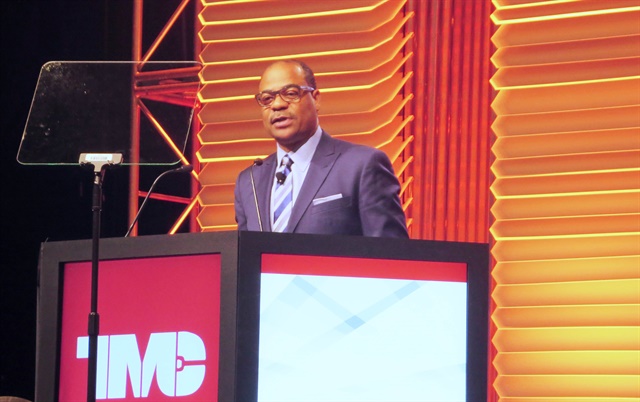
Fear of the unknown discourages investment in new trucking technologies, such as electric trucks, said UPS' Carlton Rose. Photo: Deborah Lockridge
">Electric vehicles, driverless trucks, platooning, drones… Sitting still and worrying about all the new technology coming at us is not an option, said Carlton Rose, UPS president, global fleet maintenance and engineering, at the kickoff breakfast for the ATA's Technology & Maintenance Council Annual Meeting in Atlanta early Tuesday.
“You cannot be a linear thinker in an exponential world,” said Rose, who worked his way up through the UPS ranks after serving as a driver and technician.
“Today's excellence is tomorrow's mediocrity,” he said, building on this year's TMC meeting theme, “Driving Excellence Through Expertise.”
Excellence, he noted, evolves, pointing to some of the earliest mobile phones as an example. But it's evolving ever faster.
The first step in understanding what the excellence of tomorrow looks like, he said, is understanding what mediocrity looks like today.
“Mediocrity is polluted air,” he said. “Mediocrity is over 97,000 crashes across our industry, more than half of which involve injury or death. Today mediocrity is standing still, watching and worrying, as technology moves ahead faster than ever before.”
With that in mind, Rose outlined three areas where he believes the industry and UPS need to pursue excellence: Cleaner cities, safer vehicles, and knowledgeable people.
He pointed to UPS' extensive fleet of alternative powered vehicles, including natural gas (especially renewable natural gas), hybrid and electric. UPS first bought electric vehicles in the 1930s. “You'd think by now we would have a fleet of battery powered trucks… but decades of cheap oil got in the way.” Now we're catching up.
When it comes to safer vehicles, he noted, while we're hearing a lot about autonomous trucks, the stepping-stone technologies, ADAS (advanced driver assistance system) could prevent up to 63,000 truck-related crashes each year. ...Read the rest of this story
Range Rover unveils the SV Coupe, a two-door, hand-built version of the carmaker's flagship with bags of luxury and a $295,000 price tag.
Texas kicks off primary season ahead of the 2018 midterm election, with implications for Democrats and Republicans alike in an election year that could alter the direction of Congress and statehouses around ...
Ryanair expects to exercise "pretty much all" of the options it has to buy Boeing's 737 MAX 200 jets, chief executive Michael O'Leary said on Tuesday. Ryanair has options to buy 100 of the planes, which it expects will lower its fuel consumption and offers a greater number of seats.
Mar.06 -- Space Exploration Technologies Corp. launched a Falcon 9 carrying a customer satellite early Tuesday, its fifth mission of the year. SpaceX is targeting roughly 30 total missions in 2018, including flying its new Falcon Heavy rocket again in June. That's up from 18 missions in 2017.