Talking shop: How to overcome the truck tech shortage

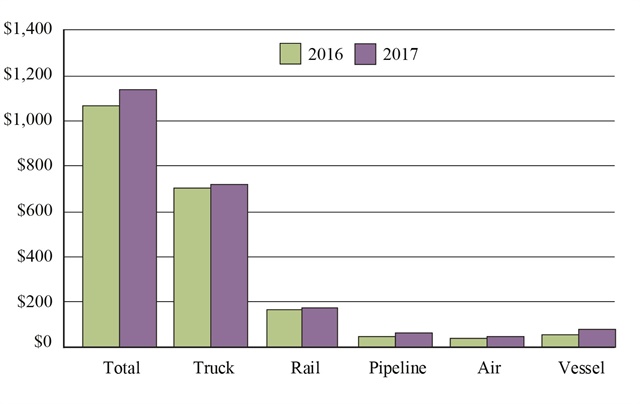
The value U.S.-North American freight by mode in billions: 2016-2017. Graphic: U.S. DOT
">Trucking posted the biggest loss of the five major transportation modes when it came to the value of U.S. freight moved between Canada and Mexico last year, according to new Transportation Department figures.
Its 2.2% drop in 2017 from 2016 came as rail declined 0.2% and air fell by 0.1%.
In contrast, the share of the value of freight moved by vessel rose by 1.2% and the pipeline share increased by 1.1%. A 17.3% increase in the year-over-year price of crude oil in 2017 played a key role in the annual increases in the dollar value of goods shipped by pipeline and vessel, according to the report.
Despite the decline, trucks continued to be the most heavily utilized mode for moving goods to and from both Canada and Mexico, carrying 63.3% of the freight transported. Trucks accounted for $720.8 billion of the $1.1 trillion in freight flows with Canada and Mexico in 2017.
Rail remained the second largest mode, moving $174.1 billion or 15.3%, followed by vessel, 6.6%; pipeline, 5.7%; and air, 3.8%. The surface transportation modes of truck, rail, and pipeline combined carried 84.3% of the total value.
Trucks carried 60.2% of the $614 billion of goods imported from Canada and Mexico in 2017, followed by rail, 18.5%; pipeline, 8.4%; vessel, 6.4%; and air, 3.1%. Trucks carried 66.8% of the $525.5 billion of goods exported to Canada and Mexico, followed by rail, 11.5%; vessel, 6.9%; air, 4.8%; and pipeline, 2.6%.
The total value of cross-border freight carried on all modes rose 6.6% from 2016 to $1.2 trillion in current dollars,
Trucking's Decline Seen At Both Land Borders
From 2016 to 2017, the value of U.S.-Canada freight flows increased 7.1% to $582.4 billion.
Trucks carried 57.7% of the value of the freight, followed by rail, 16.2%; pipeline, ...Read the rest of this story

MANCHESTER, N.H. (AP) — Jeff Flake has a direct message for the Republicans of New Hampshire: Someone needs to stop Donald Trump. And Flake, a Republican senator from Arizona, may stand up against the Republican president in 2020 — either as a Republican or an independent — if no one else does.

President Donald Trump consumed Thursday morning's TV headlines with amusement. Reports of tumult in the administration were at a feverish pitch — even on his beloved Fox News — as the president reflected ...