Self-Driving Trucks Need to Gain Traction on Capitol Hill
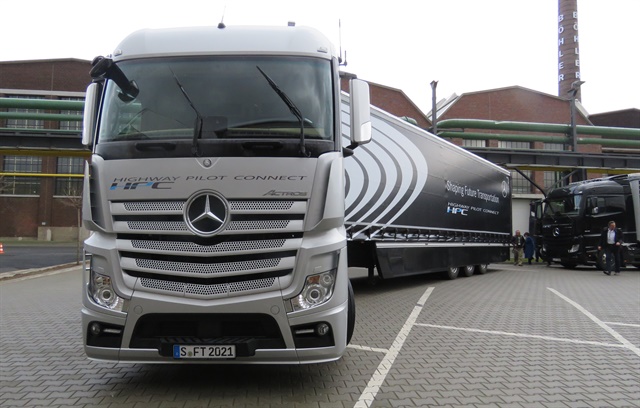
Mercedes-Benz Actros tractor used to demonstrate Daimler’s Highway Pilot Connect autonomous technology on German roads. Photo: David Cullen
“>
Mercedes-Benz Actros tractor used to demonstrate Daimler’s Highway Pilot Connect autonomous technology on German roads. Photo: David Cullen
“>
Despite the argument that some sort of self-driving truck will become an everyday reality before any self-driving car does, legislation that would ease the application of autonomous driving technology to commercial trucks has so far failed to gain traction on Capitol Hill.
While the House on Sept. 6 passed via a bipartisan voice vote a bill that could help speed the development of self-driving cars, the legislation makes no mention of commercial vehicles.
The Safely Ensuring Lives Future Deployment and Research in Vehicle Evolution (SELF DRIVE) Act aims to assist the rollout of fully self-driving cars by allowing federal pre-emption of state authority so that automakers can be exempted from any safety standards deemed not applicable to self-driving technology. In addition, the bill would permit the deployment of up to 100,000 self-driving cars annually over the next several years.
It has been reported that commercial vehicles were cut out of the measure as a sop to labor unions that see self-driving trucks as a threat to jobs. Indeed, the Teamsters lobbied hard this summer to keep trucks out of the House self-driving bill.
“It is vital that Congress ensure that any new technology is used to make transportation safer and more effective, not used to put workers at risk on the job or destroy livelihoods,” Teamsters President James P. Hoffa said in a statement at the time.
Meanwhile, the Senate has yet to take up a bill on any kind of self-driving vehicle. However, Sen. John Thune (R-SD), Chairman of the Senate Committee on Commerce, Science, and Transportation, will hold a hearing next week on “Transportation Innovation: Automated Trucks and our Nation’s Highways” that will look into the benefits of the technology as well as why …Read the rest of this story
