Getting Smart in the Warehouse
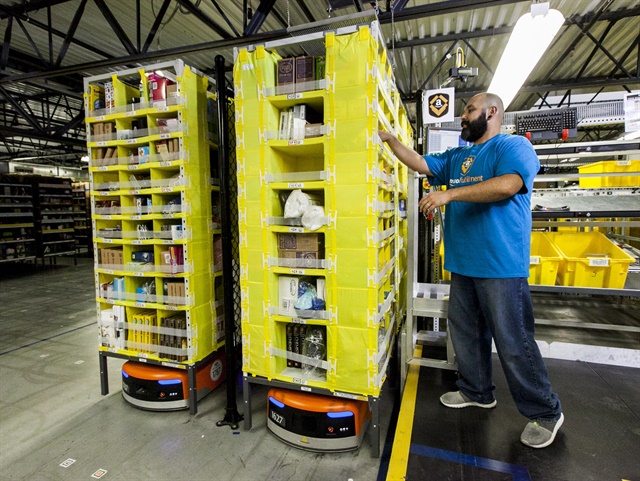
Amazon has been using these small orange warehouse robots for several years to make picking much faster, increasing their number every year. Photo: Amazon
“>
Amazon has been using these small orange warehouse robots for several years to make picking much faster, increasing their number every year. Photo: Amazon
“>
Peek inside the nearest warehouse and you may witness its metamorphosis from a largely static way station along the traditional supply chain into a “smart” staging area that is just one part of a digitally connected supply chain. It’s part of a chain that fulfills shipments from all sorts of places holding goods, including regional warehouses, urban distribution centers, brick-and-mortar stores, and even right off assembly lines.
That’s the vision of 21st century warehousing that is starting to emerge. Today to some degree, such as at Amazon, and increasingly tomorrow for all goods providers, a smart warehouse can be defined as one that deploys automation (and even robotics) alongside advanced warehousing management systems driven by big data to speed the movement and ultimate delivery of goods.
The latest State of Logistics Report, issued last month by the Council of Supply Chain Management Professionals and Penske Logistics, predicts that we’re “moving toward a fully digital, connected, and flexible supply chain optimized for e-commerce and last-mile, last-minute delivery. The next-generation supply chain will enhance fulfillment capabilities and drive efficiencies through technologies ranging from big data and predictive analytics to artificial intelligence and robotics.”
The report, authored by consultancy A.T. Kearney, also holds that steadily rising package volumes are driving the trend toward more regional distribution centers, which will serve as “linchpins of advanced networks as retailers offering same-day delivery move goods closer to densely populated areas. Parcel carriers will follow suit with their own region-focused delivery networks.” Of course, those new distribution patterns will spawn – and already are spawning – new trucking routes, with volumes rebalanced between local and regional DCs. What’s more, carriers will strive and in some cases …Read the rest of this story
