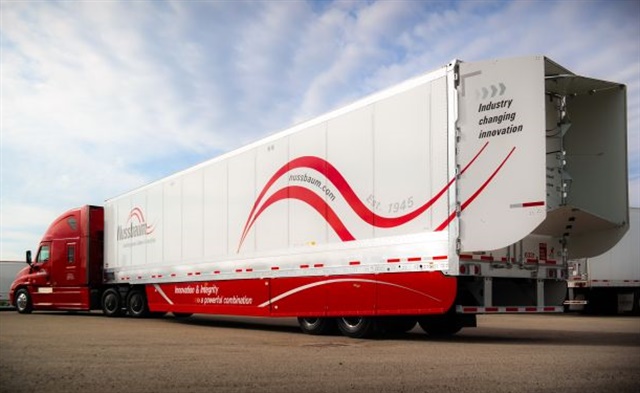
Aerodynamic Devices Can Translate Into Fast Fuel Savings
This trailer owned by Illinois-based Nussbaum Transportation has both an aerodynamic “boat tail” from Stemco TrailerTails and extra-long trailer side fairings it developed with Wabash. Photo: Nussbaum Transportation
“>
This trailer owned by Illinois-based Nussbaum Transportation has both an aerodynamic “boat tail” from Stemco TrailerTails and extra-long trailer side fairings it developed with Wabash. Photo: Nussbaum Transportation
“>
Adding aerodynamic devices to smooth airflow over the vehicle at highway speeds is a (relatively) cheap and easy way for fleets to improve fuel economy in long-haul tractor-trailer applications. But calculating fuel savings and return on investment for aerodynamics can be notoriously tricky. Moreover, not every aerodynamic device on the market today is appropriate for all applications. Luckily, several recent, high-profile studies have made it easier for fleet managers to identify the best devices for their applications and to determine both fuel savings and a realistic ROI timeline.
A particularly valuable information packet was recently released by SmartWay Canada, and it takes an extremely deep dive into the science of tractor-trailer aerodynamics. But on an elemental level, the principles of clean vehicle design can be readily understood by anyone who’s ever stuck their hand outside the window of a car moving at highway speeds: Air is a mass that creates resistance to the objects moving through it. Surfaces with sleek, rounded edges move through this air mass more efficiently. Engines moving vehicles through the air mass don’t have to work as hard — and therefore burn less fuel.
There is also a secondary component to vehicle aerodynamics beyond the ability to simply slip through the air mass efficiently. And that is the science of dealing with low-pressure pockets in the vehicle profile as air passes over it. Again, the science dealing with this problem can be complex. But the overall concept is easy to grasp: Nature abhors a vacuum. If an area on a vehicle is generating a lower-pressure pocket, air moving past it will naturally try to fill that void to equalize overall pressure. This …Read the rest of this story
