FTR: The Economics of 33′ Trailers Only Benefit a Few Markets
Photo: Tom Berg
“>
Photo: Tom Berg
“>
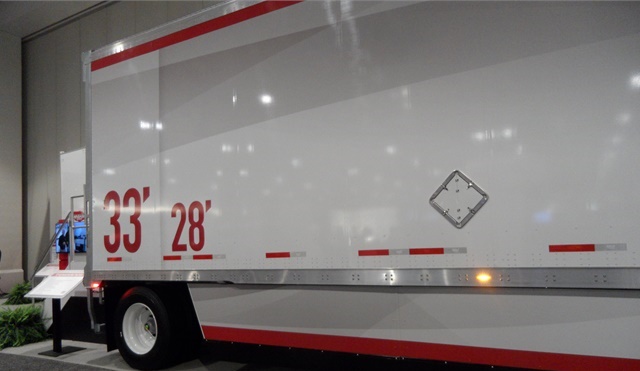
FTR released a new report detailing the economics of using twin 33-foot trailers compared to twin 28-foot trailers and standard 53-foot trailers, showing that in only specific cases would the extra capacity lead to a benefit.
The change from 28-foot to 33-foot double trailers has primarily been based on safety concerns, but newer technologies have allowed for the safe operation of larger trucks since the last expansion of length limits in the early 1990s, according to FTR. Regulators have been debating a proposal to increase the federal maximum length, which would lead to an overall increase of 10 feet for the entire rig.
The thinking behind such an increase is that it would increase capacity per truck. But in reviewing the economics of the change, FTR found that adoption of double 33-foot trailers would likely be limited. It would benefit primarily less-than-truckload and parcel carriers and more niche operations such as the movement of caskets or insulation. Based on its own research, FTR expects load conversion in just the 1-2% range.
While double trailers present increased capacity in space and weight over a single trailer, for shippers of low-density freight the gain in loading capacity is only 4%. The main reason that carriers choose twin trailers over a single trailer is what the industry calls “unit” loading, a common practice in LTL and parcel operations. Since the cube advantage over 53-foot trailers is relatively small, the main reason for a carriers’ preference for doubles is to avoid the re-sorting required to consolidate many customer shipments as the freight moves across the hub-and-spoke terminal networks.
FTR found that for the segments most directly affected by increasing the allowable trailer length, they would see as much as a 10% increase in cost savings. It also expects the longer trailers to decrease the number of …Read the rest of this story
