NACFE Report: Truck Platooning Could Save 4% in Fuel
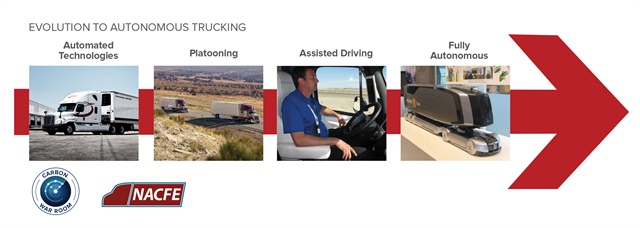
Platooning is one of the steps toward autonomous trucking, but still requires drivers in all trucks, NACFE says.
“>
Platooning is one of the steps toward autonomous trucking, but still requires drivers in all trucks, NACFE says.
“>
Platooning – the electronic linking of trucks where a lead vehicle largely controls the one following — would save about 4% in fuel compared to a pair of rigs running separately, says the latest “confidence” report from the North American Council on Freight Efficiency.
The money thus saved will pay back an investment for necessary equipment in one to two years, say estimates in “Two-Truck Platooning,” released Wednesday by NACFE.
“Two-truck platooning is showing real promise as a fuel-saving technology, even when considering the actual performance in real-world use,” said Mike Roeth, the organization’s executive director, in a statement.
Fuel savings come from reduced air turbulence between the two tractor-trailers when they operate 40 to 50 feet apart, Roeth said. Reducing that distance should save more fuel, but would introduce operating complications, like reduced air flow to the second truck’s radiator.
Testing shows that reduction in fuel use is 7% as the vehicles move at highway speeds, he explained. But probably one-quarter of the time they would not be operating as a platoon as they split up to pick up and deliver freight, stop for driver rest breaks, etc., during a trip. Taking out those times yields the 4% figure.
Payback estimates outlined in three scenarios set equipment costs at $1,050 and $2,800, with the higher figure including more equipment than the lower dollar amount. Installation cost of $200 was also factored in.
Equipment includes collision avoidance systems, adaptive cruise control, and in-cab cameras – all now available on the market, Roeth said. Vehicle-to-vehicle radios, the key element, are not yet available but should be soon as testing and perfecting progress.
Two scenarios assume a tractor would platoon three-quarters of its running time, and a third scenario …Read the rest of this story
