$33 BILLION HEDGE FUND: There could be a recession if the Trump administration doesn’t get its act together
Billionaire Paul Singer's Elliott Management says we might be in for a recession if the Trump...
Billionaire Paul Singer's Elliott Management says we might be in for a recession if the Trump...
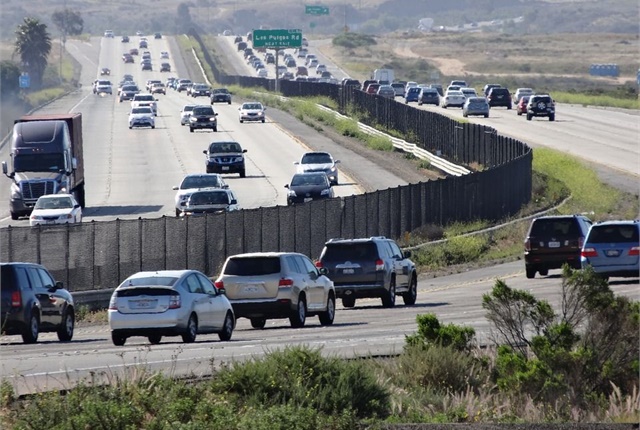
Photo via Max Pixel
">Photo via Max Pixel
">President Donald Trump's 2018 proposed budget slashes the Department of Energy's Vehicle Technology program funding, reducing it from $310 million in FY-2016 to just $82 million. The cuts include terminating funding for the Clean Cities program.
The cuts are part of President Trump's $4.1 trillion budget proposal released on Tuesday. The Vehicle Technologies program funds early-stage, high-risk research to generate knowledge that industry can use to develop and deploy technologies for transportation.
Ken Brown, consultant for Transportation Energy Partners, a non-profit that works with Clean Cities coalitions, said Clean Cities is the only deployment initiative funded by the program, and that the majority of the Vehicle Technology group is focused on research and development of technologies such as batteries, advanced natural gas engines, and biofuels.
“Government-supported research has been key to advancing these technologies, so to see these proposed cuts really shows a lack of vision of what the future is,” he said.
The Congressional Budget Justification stated that the budget will support efforts to contribute to the DOE's goals, including: research and development of advanced vehicle batteries; development of advanced engines to improve vehicle fuel economy; research of advanced materials to reduce vehicle weight; and creation of data analytics to improve energy efficiency of vehicles and overall mobility, including connected and autonomous vehicle technology.
The budget restructures some subgroups of Vehicle Technologies program and reduces funding for every subgroup. Subgroups losing large amounts of funding compared to FY-2016 are: Battery and Electrification Technologies by 74%, to $36.3 million; Materials Technology by 72% to $7.5 million; and Outreach, which includes Clean Cities.
The subprogram formerly named Outreach, Deployment, and Analysis has been separated into two subgroups: Outreach and Analysis. Funding for the previous subgroup was $48.4 million; funding for the new subgroups is $2 million each. For Outreach, funding will be used ...Read the rest of this story
The Latest on President Donald Trump's first trip abroad (all times local): 11:50 p.m. White House economic adviser Gary Cohn says President Donald Trump is "looking at" the future of U.S. sanctions ...
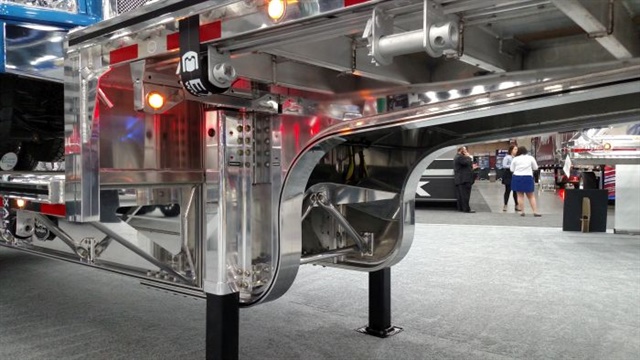
A Mac Trailer aluminum drop deck's transition area includes the 90-degree step (upper left) and a large curved “radius” beneath the upper and lower decks (center). The radius evenly distributes weight and stress between the two areas. Here, I-beam-like flanges add strength to the curved members. Photo: Tom Berg
">A Mac Trailer aluminum drop deck's transition area includes the 90-degree step (upper left) and a large curved “radius” beneath the upper and lower decks (center). The radius evenly distributes weight and stress between the two areas. Here, I-beam-like flanges add strength to the curved members. Photo: Tom Berg
">When freight is tall, trailers that carry it must be short. That's the reason for the drop deck, a variant of the flatbed or platform trailer. A “single drop” or “step deck” has a forward down-step and a main deck that provides another 20 or more inches of vertical space to accommodate large coils of steel and aluminum, outsized mechanical or electrical gear, farm implements, and aircraft engines, among other things. A “double drop” has an even lower deck and an up-step ahead of the rear tandem.
The low main deck lowers the center of gravity, which helps with top-heavy loads, noted Bill Wallace at East Manufacturing, one of the trailer makers HDT visited during the recent Mid-America Trucking Show in Louisville, Kentucky. The depth of a flatbed's understructure tapers upward under its nose, partly to match the height of the tractor's fifth wheel and because less strength is needed at the trailer's front. Likewise, a drop deck's underframe also tapers upward at the rear, which allows the deck to be closer to the ground. This also is because less strength is needed, and it adds space for tall cargo.
Because of a single drop's low main deck, the wheels and tires are typically smaller than the usual 22.5-inch size, 19.5s or even 17.5s. But with a double drop's high rear deck, the 22.5s, with their longer-lasting tires and brakes, can be used.
Drop decks are not needed for most freight. And drop decks cannot carry items like long pipes, except when fitted with ...Read the rest of this story
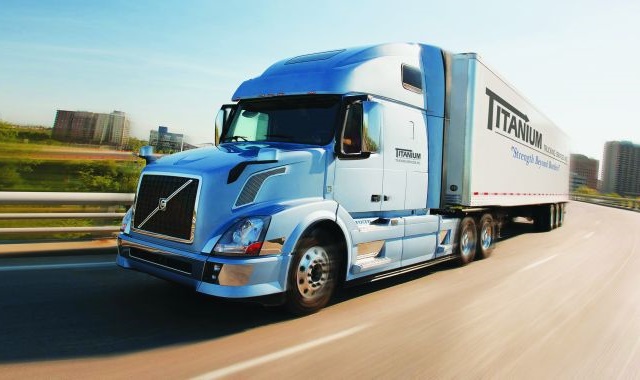
Titanium Transportation has adopted the Blackberry Radar, an end-to-end asset management system that provides more benefits than simply tracking trailers on the move.
">Titanium Transportation has adopted the Blackberry Radar, an end-to-end asset management system that provides more benefits than simply tracking trailers on the move.
">In an effort to boost efficiencies and increase equipment utilization in its growing fleet, Ontario-based Titanium Transportation decided to modernize the way it tracks its more than 1,200 trailers. Add to that a desire to increase customer and driver satisfaction and improve the company's overall return on investment, and you have a very strong argument for trying a new asset-tracking technology from an unexpected supplier.
Once known as an innovative smartphone provider, about two years ago BlackBerry began studying how it could leverage its technology assets to improve the operational efficiency of the cargo transportation and logistics industry. The result was the Radar, an end-to-end asset management system.
“We found BlackBerry Radar very compelling, because it has capabilities beyond traditional trailer tracking that we look forward to using in the future as we expand our use of the solution,” says Marilyn Daniel, Titanium's chief operating officer. “We have already been able to save driver time by locating empty trailers on customer property.
“With BlackBerry Radar, we know exactly where our trailers are on our yards and on our customer's yards,” Daniel says. “When you are dealing with thousands of trailers in a yard, being able to pinpoint the trailer location immediately saves us a lot of time getting drivers and loads on and off the road quickly.”
And while the system was not purchased as a theft deterrent, Daniel appreciates the ability to secure the status and location of each trailer. The transmitted data is encrypted and the system then authenticates the fleet's devices and cloud endpoints before sending anything up to the cloud. This protects both company and customer data.
The device might also allow the fleet to cut costs through equipment ...Read the rest of this story
President Trump's 2018 Budget Photo: White House Office of Management and Budget
">President Trump's 2018 Budget Photo: White House Office of Management and Budget
">Anyone hoping they'll learn lots more about that trillion-dollar infrastructure investment plan President Trump first dangled before the nation back on the day after the election has to be sorely disappointed if they read the foundational document on his federal budget proposal just put out by the White House.
Grandly titled “A New Foundation for American Greatness,” the Fiscal Year 2018 budget document runs over 50 pages.
But less than a single printed page is devoted to “an Infrastructure Plan to support $1 trillion in private/public infrastructure investment.”
What's more, or less as the case is here, the discussion about infrastructure is presented in the most general of terms.
The only mention tying in highways comes in a laundry list of what the plan aims to fix: “surface transportation, airports, waterways, ports, drinking and waste water, broadband and key Federal facilities.”
Rather than seeking substantial increases in federal spending on infrastructure from Congress, the message is loud and clear that Trump sees the private sector riding to the rescue of America's failing infrastructure.
The administration's goal is “to seek long-term reforms on how infrastructure projects are regulated, funded, delivered, and maintained. Simply providing more Federal funding for infrastructure is not the solution. Rather, we will work to fix underlying incentives, procedures, and policies to spur better, and more efficient, infrastructure decisions and outcomes.”
The document claims that the president's target of $1 trillion in investments will be “met with a combination of new Federal funding, incentivized non-Federal funding, and expedited projects that would not have happened but for the administration's involvement (for example, the Keystone XL Pipeline).”
The budget calls for $200 billion in federal outlays “related to the infrastructure initiative,” which appears intended to work as seed money for public-private partnerships (P3) projects, ...Read the rest of this story